
Can the Universe Come Into Existence on Its Own?
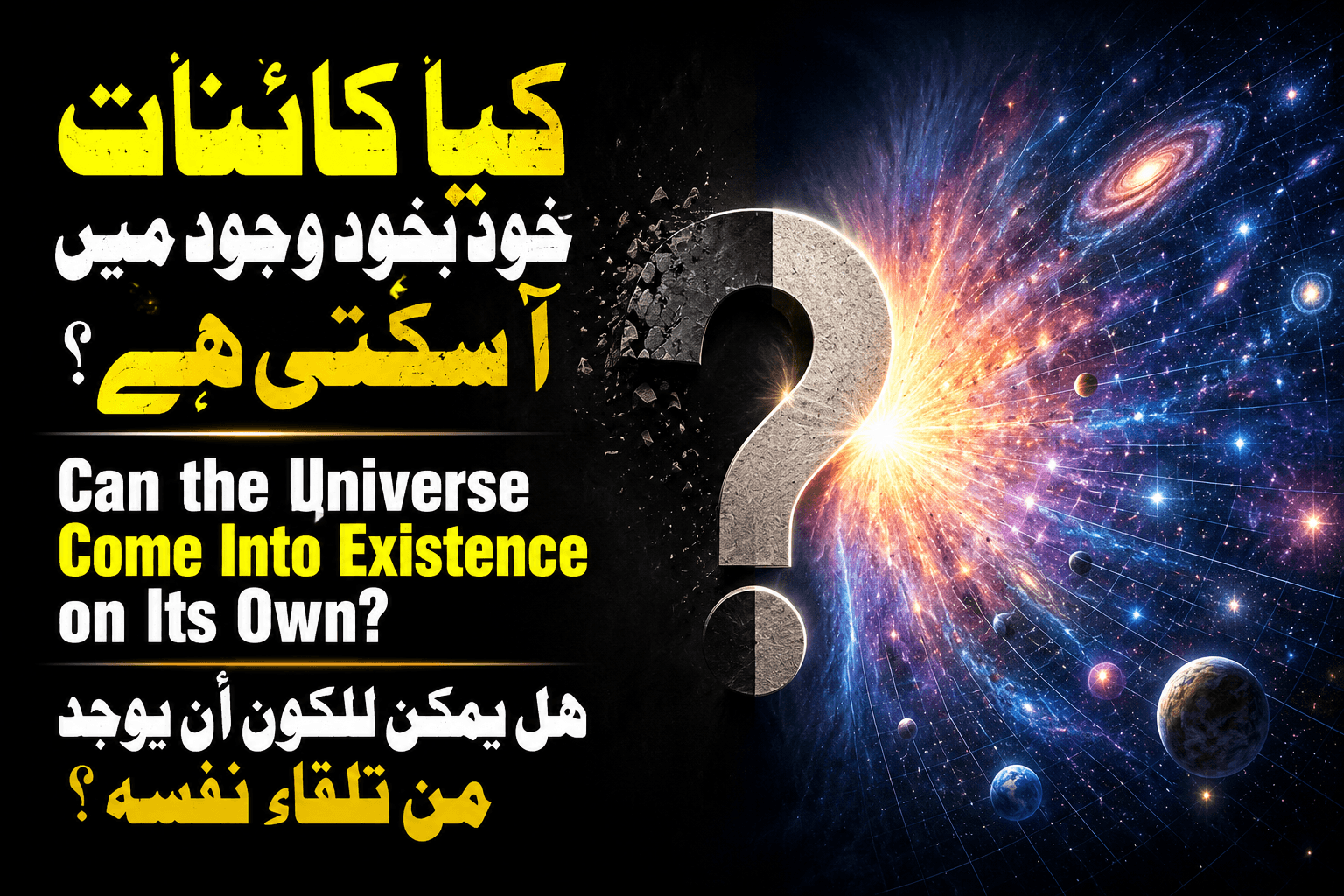
Whenever the existence of God is discussed, some people say with great confidence: "The universe came into existence on its own; it does not need a creator." At first glance, this sounds modern and scientific, but when examined more deeply, it becomes clear that this is not a scientific conclusion but a philosophical claim that itself requires proof.
First, it is necessary to understand what is meant by "on its own." If it means that the universe came into existence without a cause, then the question arises: what is the evidence that something can happen without a cause? Science explains any phenomenon through its causes and laws. If someone claims that the greatest reality of all—the entire universe—came into existence without a cause, then in effect they are asking for an exception to the very principle on which scientific inquiry itself is based. Such a claim requires extraordinary evidence; a mere assertion is not enough.
If by "on its own" one means that the universe created itself, then this is logically impossible. How can something that does not yet exist perform any action? For the universe to create itself, it would have to exist before it existed and not exist at the same time. For a thing to be both existent and nonexistent at once violates the basic principles of reason. Therefore, "self-creation" is not an explanation but a logical contradiction.
Some people immediately refer to the Big Bang. But the Big Bang theory only tells us how the universe began expanding from its initial state. It does not tell us where that initial state came from, why the laws of physics existed, or why the Big Bang happened in the first place. Science is silent on these questions because they lie outside its scope. Therefore, using the Big Bang as evidence against a creator is not scientific but a philosophical interpretation.
Another argument is that the "laws of nature" brought the universe into existence. But laws themselves are not agents. The law of gravity does not create an apple; it only describes how an existing apple will move. Likewise, physical laws explain the behavior of the universe, not its existence. A law has meaning only when there is already a reality to which it can apply.
Now a fundamental question arises: if the universe came into existence on its own, where does the explanation end? Is matter eternal? If so, what is the evidence for that? Are the laws eternal? If so, why do they exist? If every answer is simply, "It just is," then the same can be said about an eternal Creator. The difference is that the concept of a Creator explains the universe, whereas "the universe just is" offers no explanation at all.
The truth is that reason always seeks explanation. When we see a book, we ask about the author. When we see a building, we ask about the architect. When we see software, the idea of a programmer comes to mind. This is not because we are religious, but because our intellect looks for a reasonable cause behind an organized and purposeful system. Then how can we look at the entire universe—with its billions of galaxies, extraordinarily precise physical laws, and astonishing mathematical order—and say, "It came into existence on its own"? That does not satisfy reason; it raises even more questions.
The Holy Qur'an expresses this same reality in a brief yet profoundly logical argument:
﴿أَمْ خُلِقُوا مِنْ غَيْرِ شَيْءٍ أَمْ هُمُ الْخَالِقُونَ﴾
That is, "Were they created from nothing, or are they themselves the creators?"
Reflect carefully: the Qur'an does not make an emotional appeal here; rather, it presents two possibilities: did existence arise without a cause, or did it create itself? When both possibilities are found unacceptable to reason, a third remains: that this universe has a Creator who is not part of the universe itself, but its originator and sustainer.
Therefore, the real question is not, "Does God exist?" Rather, the real question is: "What is the most reasonable, comprehensive, and logical explanation for the existence of the universe?" If the theory of "on its own" is neither logically clear, nor scientifically proven, nor capable of explaining existence philosophically, then the concept of an eternal, immaterial, and necessary Creator is not merely a religious belief; it becomes a profound rational and philosophical explanation for the existence of the universe.
Have a question about this post?
Ask a Question
About the Author
Muhammad Awais
By the boundless grace and guidance of Allah Almighty, Muhammad Awais is associated with the noble journey of teaching, research, and writing. In his quest to quench his thirst for knowledge, he has completed the Dars-e-Nizami (Traditional Islamic Education), an MA in English, an M.Phil in Islamic Studies, and a B.Ed. Currently, he is pursuing his Ph.D. in Islamic Studies at Hazara University. The core of his academic interests primarily revolves around Islamic Sciences, Western Philosophy, contemporary intellectual discourses, Ilm al-Kalam (Islamic Scholastic Theology), and both classical and modern logic—subjects he continuously strives to comprehend more deeply and reflect upon. His association as a 'Master Trainer' with the British Council and other local institutions, coupled with his experience in competitive examinations, has acquainted him with a diverse array of academic disciplines, for which he is profoundly grateful to the Lord of Majesty. With his very limited abilities, he is making a humble effort to contribute a small share towards serving knowledge, offering intellectual guidance, and fostering an environment of positive academic dialogue. It is his heartfelt prayer that the Lord of the Worlds graciously accepts these modest and fragmented efforts in His Divine Presence, and makes this knowledge beneficial for His creation. Ameen.