
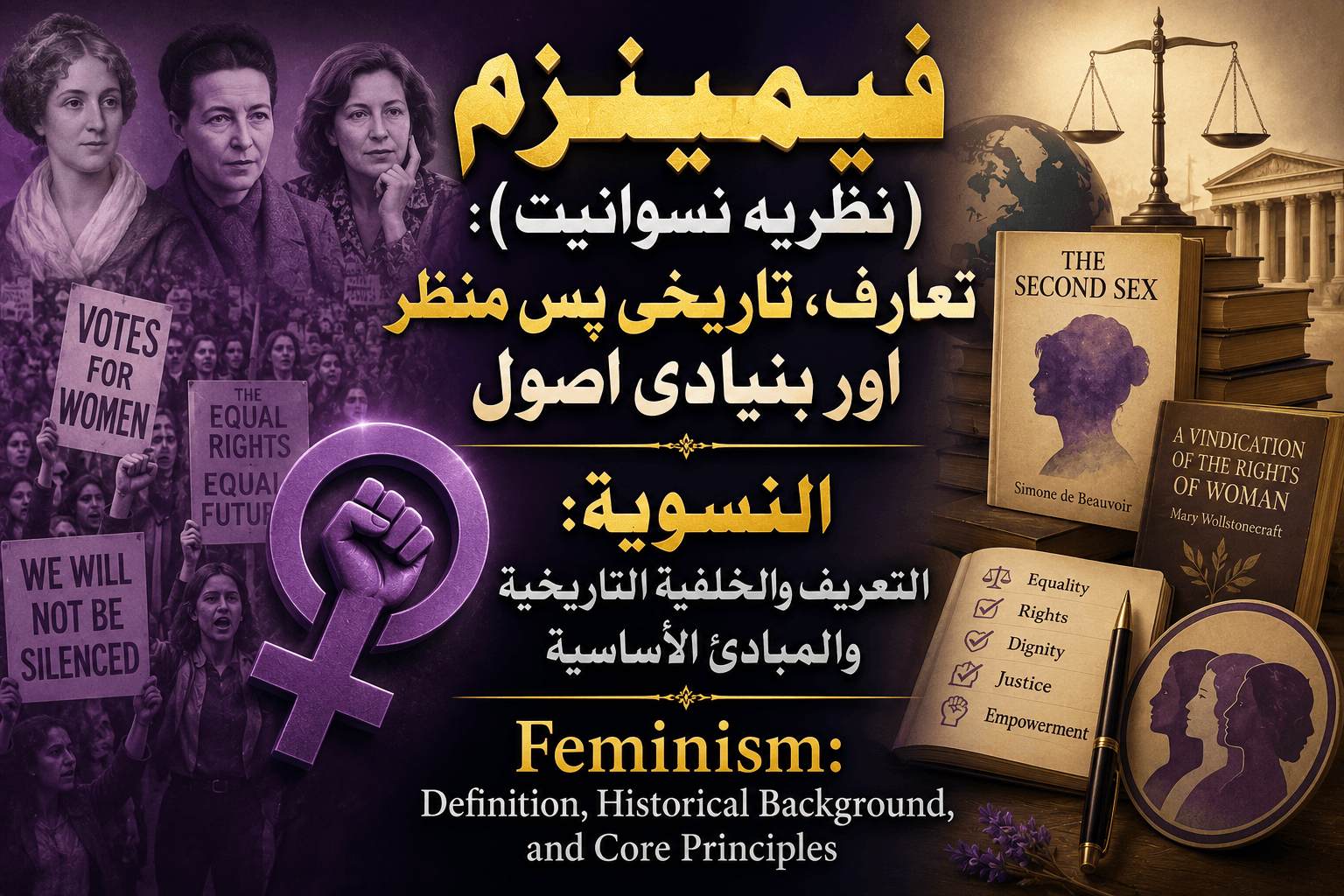
Feminism: Definition, Historical Background, and Core Principles
1. Introduction:
Feminism is an intellectual, political, economic, and social movement that seeks to eliminate inequalities based on gender and to promote women's rights, autonomy, and equal opportunities. At its core, feminism advocates the achievement of full equality between men and women in all spheres of life, including politics, education, employment, law, and social participation.
From a philosophical perspective, feminism is founded on the assumption that human societies have historically been organized around patriarchy—a system of male dominance that has consciously or unconsciously marginalized women, restricted their opportunities, and subjected them to various forms of discrimination and exploitation. Feminist scholars argue that many legal, political, religious, economic, and cultural institutions have traditionally reflected male interests and reinforced unequal power relations.
A central concept in feminist theory is the distinction between biological sex and social gender. While biological sex refers to the natural physical differences between males and females, gender is understood as the collection of social roles, expectations, and behaviors that societies assign to individuals based on their sex. Feminists generally maintain that these gender roles are not biologically determined but are socially constructed, and therefore can be challenged, redefined, and transformed.
2. Historical Background
The history of feminism is not a single, continuous movement but rather a series of intellectual and political developments commonly described as the waves of feminism. Each wave emerged within a distinct historical context and focused on different priorities and objectives.
First Wave Feminism
Late Nineteenth Century to Early Twentieth Century
The First Wave developed primarily in Britain and the United States and concentrated on securing women's legal and political rights. Its principal objectives included women's suffrage, property rights, access to education, and equal opportunities in employment. One of the earliest and most influential works of this period was Mary Wollstonecraft's A Vindication of the Rights of Woman, which laid the philosophical foundation for modern feminist thought by advocating women's education and equal moral status.
Second Wave Feminism
1960s–1980s
The Second Wave expanded the feminist agenda beyond legal equality to address broader social, cultural, and institutional inequalities. Its well-known slogan, "The Personal is Political," emphasized that many issues traditionally considered private—such as family life, domestic responsibilities, reproductive rights, and sexuality—were deeply influenced by social and political structures.
Among the most influential thinkers of this period was Simone de Beauvoir, whose landmark book The Second Sex introduced the famous observation: "One is not born, but rather becomes, a woman." Another major contribution came from Betty Friedan, whose book The Feminine Mystique challenged traditional domestic roles and inspired widespread debate regarding women's social and professional aspirations.
Third Wave Feminism
1990s
The Third Wave questioned the assumption that all women share identical experiences or face the same forms of discrimination. It introduced the concept of intersectionality, arguing that gender interacts with other social factors such as race, ethnicity, class, culture, nationality, and religion, creating diverse forms of privilege and disadvantage.
During this period, many feminist movements also broadened their scope to include discussions surrounding sexual orientation, gender identity, and the rights of LGBTQ+ communities.
Fourth Wave Feminism
2010–Present
The Fourth Wave has been characterized by its extensive use of digital technology and social media platforms to promote women's rights and combat gender-based violence. International campaigns such as #MeToo have drawn global attention to sexual harassment, workplace discrimination, and violence against women.
This contemporary phase of feminism continues to emphasize gender equality, bodily autonomy, equal opportunities, and the elimination of discrimination through both legal reform and digital activism.
3. Core Principles
The philosophical framework of feminism is built upon several fundamental principles that shape its understanding of gender, society, and equality.
Critique of Patriarchy
Feminist theory argues that many social, political, economic, legal, and religious institutions have historically been structured within a patriarchal system that privileges men while limiting women's opportunities and influence. According to this perspective, patriarchal power relations continue to shape social norms, public policies, and institutional practices.
Distinction Between Sex and Gender
One of the central ideas in feminist philosophy is the distinction between biological sex and social gender. Biological sex refers to natural physical characteristics, whereas gender encompasses the socially assigned roles, expectations, and identities associated with being male or female. Feminists generally contend that these gender roles are socially and culturally constructed rather than biologically predetermined.
Bodily Autonomy
Feminism maintains that every woman possesses full authority over her own body. Consequently, decisions relating to reproductive rights, abortion, personal relationships, sexual choices, healthcare, and dress should remain matters of individual choice rather than being determined by the state, society, or religious institutions.
Absolute Equality (Egalitarianism)
A fundamental objective of feminism is the establishment of complete equality between men and women in every sphere of life. Feminist scholars argue that distinctions in rights, responsibilities, opportunities, or social roles based solely on gender constitute unjust discrimination. Accordingly, feminism advocates equal participation and equal opportunities in politics, education, employment, economic life, family relations, and public leadership.
Have a question about this post?
Ask a Question
About the Author
Muhammad Awais
By the boundless grace and guidance of Allah Almighty, Muhammad Awais is associated with the noble journey of teaching, research, and writing. In his quest to quench his thirst for knowledge, he has completed the Dars-e-Nizami (Traditional Islamic Education), an MA in English, an M.Phil in Islamic Studies, and a B.Ed. Currently, he is pursuing his Ph.D. in Islamic Studies at Hazara University. The core of his academic interests primarily revolves around Islamic Sciences, Western Philosophy, contemporary intellectual discourses, Ilm al-Kalam (Islamic Scholastic Theology), and both classical and modern logic—subjects he continuously strives to comprehend more deeply and reflect upon. His association as a 'Master Trainer' with the British Council and other local institutions, coupled with his experience in competitive examinations, has acquainted him with a diverse array of academic disciplines, for which he is profoundly grateful to the Lord of Majesty. With his very limited abilities, he is making a humble effort to contribute a small share towards serving knowledge, offering intellectual guidance, and fostering an environment of positive academic dialogue. It is his heartfelt prayer that the Lord of the Worlds graciously accepts these modest and fragmented efforts in His Divine Presence, and makes this knowledge beneficial for His creation. Ameen.