
Introduction to Liberalism and Its Historical Development
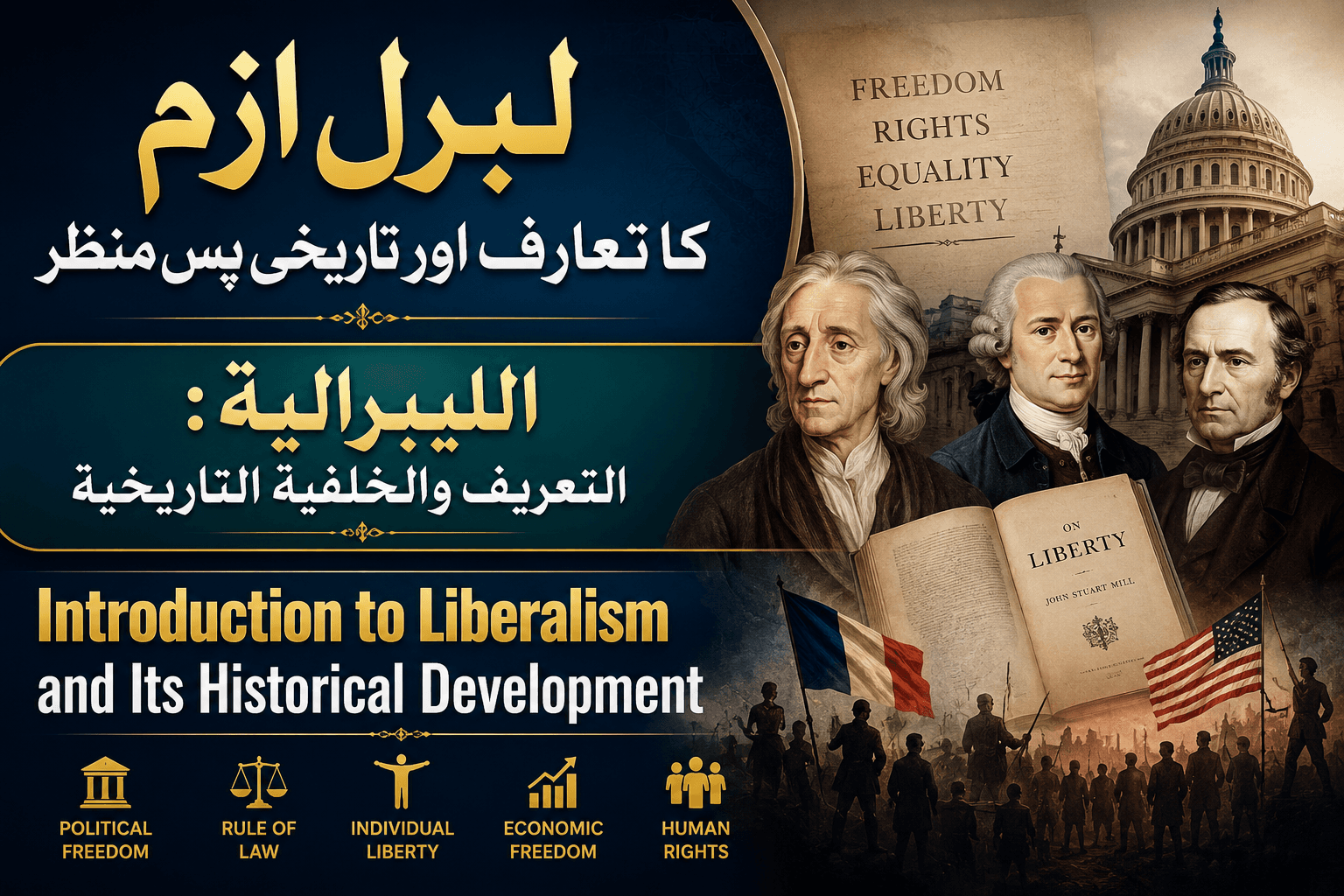
1. Liberalism: Definition and Concept
Liberalism is one of the most influential intellectual traditions of the modern Western world. Over the past few centuries, it has profoundly shaped political institutions, economic systems, legal thought, educational philosophies, social structures, and contemporary understandings of human rights. At its core, liberalism is founded on the belief that the individual is a free and autonomous moral agent who should enjoy the liberty to make personal decisions, express opinions, own property, and determine his or her own way of life, provided that such freedom does not infringe upon the rights and liberties of others.
The term liberal is derived from the Latin word liber, meaning "free." Over time, the word came to represent a philosophical, political, and social outlook that regards individual liberty as one of the highest values of human society. Liberal thinkers generally maintain that the primary purpose of the state is not to dominate individuals but to protect their fundamental rights, safeguard civil liberties, and uphold the rule of law. This commitment to individual freedom explains why constitutional government, legal equality, freedom of expression, religious tolerance, private property, and representative democracy have become defining features of the liberal tradition.
Although freedom has always remained the central ideal of liberalism, its meaning has evolved considerably over time. In its earliest phase, liberalism sought to free individuals from absolute monarchy and arbitrary political authority. Later, economic freedom became one of its principal concerns. In the contemporary era, however, liberalism increasingly emphasizes personal autonomy, individual choice, gender equality, human rights, and the freedom of individuals to define their own identities and lifestyles.
2. Historical Background and Development
Liberalism did not emerge from the ideas of a single philosopher or from one historical event. Rather, it developed gradually through centuries of intellectual, political, and social transformation in Europe. Its origins can be traced to a period when growing numbers of scholars and political thinkers began questioning the absolute authority of the medieval Church, the rigid feudal order, and the unrestricted powers claimed by European monarchs.
During the Middle Ages, European society was largely shaped by the close alliance between the Church and the monarchy. Religious dissent was frequently treated as a crime, intellectual inquiry was tightly controlled, and kings often justified their authority through the doctrine of the Divine Right of Kings. Against this backdrop, a number of influential thinkers began asking whether governments possessed unlimited authority over human beings or whether individuals were born with rights that no ruler could legitimately take away. These questions laid the intellectual foundations of liberal thought.
In the seventeenth century, John Locke gave this emerging movement its most systematic philosophical expression. He argued that every human being is born with certain natural rights, most notably the rights to life, liberty, and property. Governments, according to Locke, exist primarily to protect these rights rather than to violate them. His political philosophy became the cornerstone of what later came to be known as classical liberalism.
The Enlightenment of the eighteenth century further strengthened liberal ideas by promoting reason, scientific inquiry, critical thinking, and confidence in human rationality. These intellectual developments were soon followed by the American Revolution and the French Revolution, both of which translated liberal principles such as liberty, equality, constitutional government, and popular sovereignty into political reality. As a result, liberalism evolved from a philosophical discourse into a powerful political movement that reshaped the modern world.
In the economic sphere, Adam Smith laid the foundations of economic liberalism by advocating free markets, private property, and limited government intervention. During the nineteenth century, John Stuart Mill expanded liberal thought by presenting influential arguments in favor of freedom of expression, civil liberties, and individual autonomy. His writings helped transform liberalism into one of the most influential intellectual traditions of modern political philosophy.
Like every major ideology, liberalism continued to evolve over time. While its earliest advocates focused primarily on limiting governmental power and securing individual liberty, later generations broadened its scope to include social justice, the welfare state, human rights, gender equality, and democratic governance. Consequently, contemporary liberalism is no longer a single, uniform doctrine but a diverse intellectual tradition encompassing multiple schools of thought and varying interpretations of freedom, equality, and the role of the state.
Have a question about this post?
Ask a Question
About the Author
Muhammad Awais
By the boundless grace and guidance of Allah Almighty, Muhammad Awais is associated with the noble journey of teaching, research, and writing. In his quest to quench his thirst for knowledge, he has completed the Dars-e-Nizami (Traditional Islamic Education), an MA in English, an M.Phil in Islamic Studies, and a B.Ed. Currently, he is pursuing his Ph.D. in Islamic Studies at Hazara University. The core of his academic interests primarily revolves around Islamic Sciences, Western Philosophy, contemporary intellectual discourses, Ilm al-Kalam (Islamic Scholastic Theology), and both classical and modern logic—subjects he continuously strives to comprehend more deeply and reflect upon. His association as a 'Master Trainer' with the British Council and other local institutions, coupled with his experience in competitive examinations, has acquainted him with a diverse array of academic disciplines, for which he is profoundly grateful to the Lord of Majesty. With his very limited abilities, he is making a humble effort to contribute a small share towards serving knowledge, offering intellectual guidance, and fostering an environment of positive academic dialogue. It is his heartfelt prayer that the Lord of the Worlds graciously accepts these modest and fragmented efforts in His Divine Presence, and makes this knowledge beneficial for His creation. Ameen.