
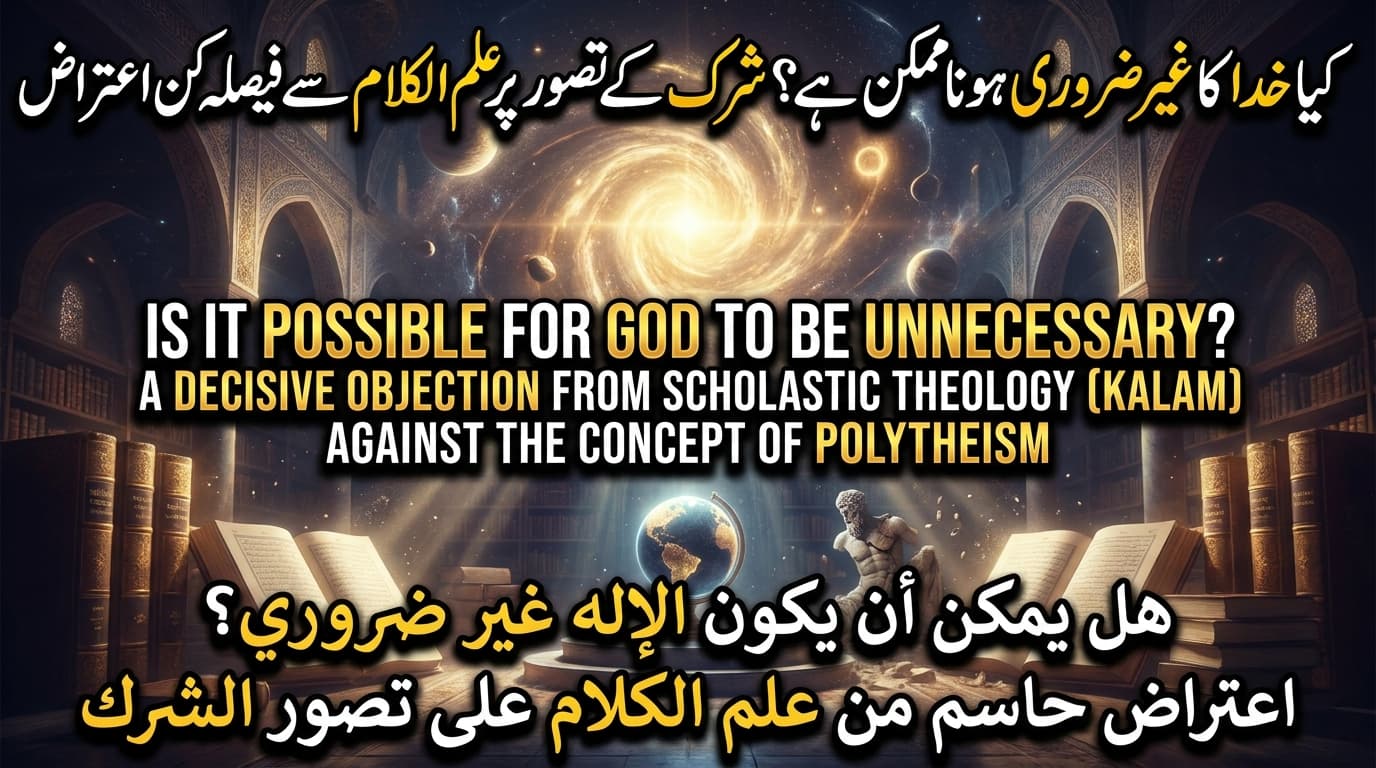
Is it Possible for God to be Unnecessary? A Decisive Objection from Scholastic Theology (Kalam) Against the Concept of Polytheism
The history of human thought bears witness that the evolution of consciousness has always been characterized by the pursuit of a single, cohesive, and ultimate principle operating behind scattered phenomena. Whether it is the vastness of the material universe or the canvas of the human mind, the primary demand of sound intellect is that every branch must terminate at a single origin, and every contingent being must rest upon a Necessary Being. In the parlance of philosophy and metaphysics, this ultimate and final reality is termed the 'First Cause' or the 'Necessary Being' (Wajib al-Wujud), whose existence is intrinsic and upon whose divine will the entire system of the cosmic workshop depends. However, when human reason falls prey to material labyrinths or intellectual distortions and loses this singular focal point, it sinks into the logical contradictions of polytheism and the plurality of deities, where metaphysical principles collapse like a deck of cards.
Monotheism (Tawhid) is not merely a religious dogma or a traditional claim; rather, it is the only rational, logical, and scholarly explanation of the cosmic order. If the Ultimate Cause of the universe is not recognized as One, human thought falls into a quagmire of logical contradictions from which no intellectual journey can proceed. To unveil the intellectual fallacies of polytheism and establish the truth of Divine Unity, scholastic theologians (Mutakallimun) have established robust rational proofs that elevate human reason to the highest echelons of contemplation and submission. Below is a detailed philosophical analysis of three such classical and profound theological arguments, which decisively invalidate the concept of a plurality of gods at the rational and metaphysical levels.
1. The Implication of an Infinite Number in Polytheism
A highly robust rational argument for Divine Unity is grounded in the metaphysical principle that if we do not accept the Ultimate Cause or the True Creator of the universe as 'One and Unique,' the intellect is left with no logical boundary to stop at any specific number.
· The Logical Dilemma: Suppose someone rejects the concept of a unique God and professes two, three, or four gods; they will be questioned in the court of metaphysics: Why exactly 'two' or 'four'? What rational principle limits the number of gods to two or four and prevents it from expanding into a larger number?
· The Infinite Mirage: The truth is that the very logic or illusion used to carve out the concept of more than one god can be utilized by another person to increase the number of deities to hundreds, thousands, or an infinite extent.
If this door to the plurality of gods is opened even once, human thought falls into a terrifying instability where it becomes mandatory to accept a separate deity for every particle, every motion, every rest, and every event in the universe. If the god of the blowing wind is distinct, the god of water is separate, and the god of man's partial movements and rests is independent, the human intellect can never arrive at a unified law of nature that integrates the universe into a cohesive whole (Universe). In such a scenario, the universe would cease to be an orderly system and instead become a battleground of conflicting wills.
The other facet of this intellectual crisis is linked to human psychology and the concept of servitude (Ibadah). The essential demand of servitude is that the servant (Abd) must manifest absolute surrender, singular devotion, and love before his Deity. By its very design, the human heart is a focal point that cannot maintain absolute attention in two opposing directions simultaneously. If the number of deities becomes infinite or more than one, it becomes impossible for the worshiper to know whose obedience to prioritize and whose pleasure to place first. This concept of obeying infinite deities actually subjects the human soul to an impossible obligation (Taklif ma la yutaq)—an unbearable burden that transcends human capacity and nature. The concept of a Deity is the ultimate sanctuary where human anxiety finds tranquility. If that very sanctuary falls prey to multiplicity, human consciousness will be consumed by the fire of eternal chaos. Thus, this cohesive balance of the universe and the singular devotion of the human soul are manifest proofs that the Master of cosmic governance is only One.
2. The Epistemic Contradiction Between Proof and Individuation
Another profound battle of scholastic theology is fought on the plane of metaphysical affirmation and the principle of individuation (Tashakhkhus). If it were assumed—for the sake of the impossible—that two or more creators of the universe exist, it would become epistemically and logically impossible for each god to establish a unique and exclusive proof for his specific existence.
To comprehend this subtle rational point, it is necessary to contemplate the existence of the universe (the temporal origination of the world / Huduth-e-Alam). The temporary, originated, and borrowed existence of the universe absolutely indicates that it has a Maker and Originator, but this origination carries no indication whatsoever of a plurality of makers (Ta'addud-e-Sani'). Every imprint in the workshop of nature dictates that there is a Maker, but it never dictates that the makers are many.
Now, if two gods exist, each would face the logical challenge of establishing a proof for his specific existence that establishes his own essence while completely excluding the other god. However, no such proof is possible on the fabric of the universe. The very proof that one god presents in favor of his existence (such as the creation of the heavens and the earth, the revolution of the stars, or the system of life) can be presented identically by the second god as proof of his own existence. When the evidence and proofs of both gods are completely identical, the 'Specific Identity' (Tashakhkhus-e-Khas) of neither can logically be established.
It is an accepted rule of philosophy that two entities can only be counted as distinct when there is an attribute or distinction present in one and absent in the other. If two existences are completely identical in every attribute and every proof, they are not two, but in reality, a single existence. Therefore, under the hypothesis of a plurality of makers, every god would fail to establish an exclusive proof for his specific self. An entity that cannot prove its specific existence through a clear and distinguishing proof may exist as a mere mental hypothesis, but it can never be a metaphysical reality. Thus, this contradiction of proof demonstrates that the Necessary Being is unique and entirely pure from any partner.
3. The Argument from Necessity, Independence, and Dependence
The third robust proof of Divine Unity is established upon the logical analysis of the mutual relationship between the foundational attributes of divinity: 'Necessity' (Wujub), 'Independence/Self-sufficiency' (Istighna), and 'Dependence' (Ihtiyaj). If we assume that two gods exist in the universe, rationally and theologically, only three scenarios are possible regarding their mutual relationship:
1. Both gods are dependent upon and in need of each other for their existence, survival, and authority.
2. One god is completely independent and self-sufficient, while the second god is dependent upon and subordinate to him.
3. Both gods are completely independent, self-sufficient, and detached from each other.
When sound intellect evaluates these three scenarios one by one, the entire tower of polytheism collapses like a deck of cards:
· If the first scenario is accepted—meaning both gods are dependent on each other—theologically, neither remains a god. The foundational definition of God is that He must be the Necessary Being, meaning His existence is intrinsic and He is dependent on none. Dependence, need, and deficiency are completely antithetical to divinity and are inherently invalid. How can a being who is himself dependent on another be the Creator of the universe?
· If the second scenario is accepted—meaning one is dependent and the other is independent—the one who is dependent ceases to be God. God can only be that Being who is entirely independent and self-sufficient of all. And the Being who is proven to be completely self-sufficient will uniquely be One. Thus, the metaphysical claim of Tawhid is automatically validated, and the second deity is excluded from the rank of divinity.
· This brings us to the final and most complex scenario—the assumption that both gods are completely independent and self-sufficient from each other, possessing no mutual relationship or dependence. Apparently, this scenario seems plausible, but when we unravel its internal fabric, it falls into a blatant contradiction.
The principle of metaphysics states that 'independence and self-sufficiency' are always exercised with respect to something that is unnecessary for existence. If one god is entirely independent of the second god, it inevitably implies that—far be it from Him—the second god is completely 'unnecessary' and 'redundant' for the first god and his realm of existence.
The Essence of God is the definition of Absolute Necessity for the universe. To conceive of an entity that is unnecessary within the existential framework of the universe is an explicit negation of the rank of divinity. If there were two gods and each were independent of the other, it would necessitate that both be unnecessary in relation to each other, which is entirely contrary to the sublime station of divinity. God is He from whom no one can be independent, and whose existence is indispensable for every corner of the universe. Therefore, this rational trilemma proves that the concept of divinity and absolute independence can only be sustained if the Divine Essence is One without any partner, just as the eternal declaration of the Majestic Quran states: Exalted is Allah above all the defects and illusions they attribute to Him.
Conclusion
These arguments of scholastic theology are not mere dry logical gymnastics; rather, they elevate the human mind to that station of absolute certainty where the illusions of polytheism and atheism are completely uprooted. Whether it is the infinite mirage of multiplicity, the epistemic contradiction of proof, or the metaphysical analysis of dependence and independence, all these paths lead the sound intellect toward that single, unique, and everlasting Reality to whom every particle of the universe prostrates. When man's intellectual journey reaches this sun of pure monotheism, the soul attains that tranquility and singular focus which is the true purpose of human life and the guarantor of salvation in both worlds.
Have a question about this post?
Ask a QuestionAbout the Author
Dr. Mufti Muhammad Ibrahim
Dr. Mufti Muhammad Ibrahim is a distinguished Islamic scholar, jurist, and researcher known for integrating traditional Islamic scholarship with modern academic standards. He completed his Dars-e-Nizami (Shahadat-ul-Alamia) from Jamia Darul Uloom Karachi and specialized in Islamic Jurisprudence (Fiqh) at Darul Iftaa Makki Masjid, Mansehra, where he has been serving as an Assistant Mufti for over a decade. He holds a Ph.D. in Islamic Studies from the University of Haripur, secured top position in M.Phil, and earned a Gold Medal in M.A. Islamiat. He also holds degrees in M.Sc. Pakistan Studies and B.A. English Literature. Dr. Ibrahim is an HEC-approved Ph.D. supervisor, with numerous postgraduate researchers completing their work under his supervision. He has authored over 30 research papers and several academic books. His research focuses on Quran and Hadith studies, as well as addressing modern intellectual challenges, particularly atheism. Through the platform "Tafheem-e-Nau," he actively engages in presenting reasoned responses to contemporary ideological questions.