
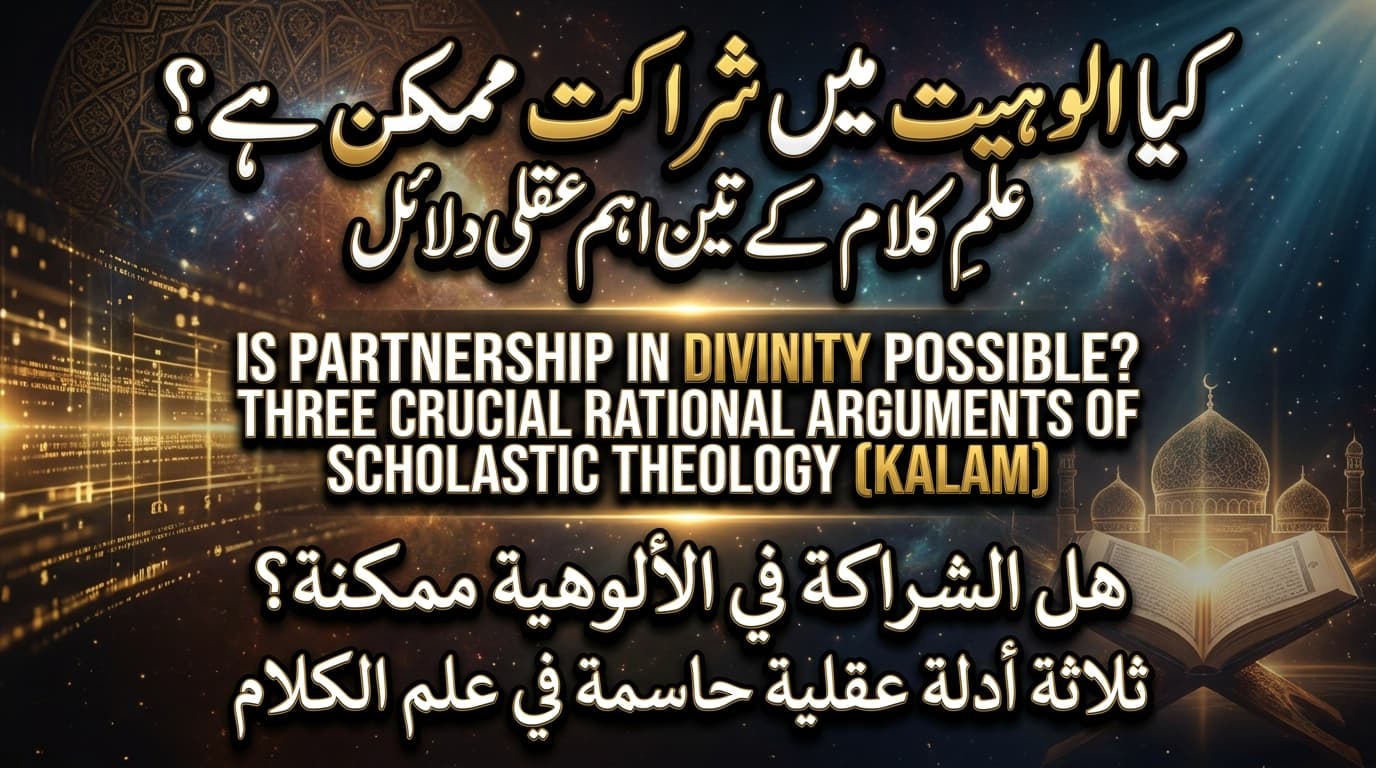
Is Partnership in Divinity Possible? Three Crucial Rational Arguments of Scholastic Theology (Kalam)
Whether it is the material structure of the universe or the unfathomable depths of human consciousness, every particle of existence possesses a profound meaning, an astonishing order, and an extraordinary coherence. The history of science and philosophy bears witness that the human mind has always been striving to discover a single, cohesive, and comprehensive principle operating behind scattered phenomena. This pursuit is not merely a scientific necessity, but a deep metaphysical demand. When we contemplate the concept of the Ultimate Cause, the Creator of the universe, or Absolute Sovereignty, sound intellect compels us to terminate our search at a definitive, indivisible, and unique point.
If this ultimate reality is not acknowledged as coherent and singular, human thought becomes imprisoned in an endless loop of logical contradictions and complexities where knowledge, reason, and meaning utterly perish. The concept of a plurality of gods, or the hypothesis of another entity sharing supreme sovereignty, is not just a superstitious belief, but an intellectual flaw that fails the test of metaphysical principles. To fortify intellectual certainty and elucidate the veracity of Divine Unity (Tawhid), scholastic theologians (Mutakallimun) have formulated robust rational and logical proofs that completely dismantle the frameworks of polytheism and intellectual chaos. A philosophical and theological analysis of three such profound arguments is presented below.
1.The Theological Argument of Sufficiency and Redundancy: The Metaphysical Realm of Cosmic Governance
The first facet of logical reasoning is grounded in a fundamental principle of metaphysics, which can be termed the "Principle of Sufficiency" and the "Impossibility of Redundancy." When we contemplate the concept of the Necessary Being (Wajib al-Wujud), that is, God, the most foundational attribute of God according to human reason is His being "Absolutely Perfect" and solely "Sufficient" for the creation and governance of the universe. Using this premise as a foundation, if we evaluate the hypothesis of a plurality of gods, an inevitable logical question emerges: Is one God alone sufficient for the governance, creation, and sustenance of the cosmic order or not?
As a result of this question, only two scenarios are possible, both of which rationally invalidate the concept of a plurality of gods:
· The First Scenario: If a single God is uniquely sufficient and omnipotent to manage all affairs of the universe, maintain the solar and lunar systems, and unfold the entire fabric of life, then metaphysically, the existence of a second god becomes entirely "superfluous," "useless," and "redundant." In theological terminology, this is called Laghviyat (Absurdity/Redundancy). Sound intellect is utterly incapable of accepting the existence of a being who is entirely redundant and unnecessary for the universe. How can an entity that is not indispensable to the universe in any degree, and for whom no need or necessity remains, occupy the attribute of necessity (Wujub) and the rank of divinity? The glory of God is that He is As-Samad (The Eternal Refuge/Self-Sufficient)—meaning He is entirely independent of all, while the entire universe depends on Him every moment for its existence and survival. When one God suffices for all, the assumption of a second entity remains a mere intellectual absurdity.
· The Second Scenario: If it is argued that a single God is not sufficient on His own to manage the governance and order of the universe, but rather requires the help, partnership, or cooperation of another entity to run this workshop, then this admission in itself negates His divinity. An entity that is not self-sufficient in its governance is "deficient and dependent" (Aajiz aur Muhtaj). Deficiency and dependence may be characteristics of a creature, but they can never be attributes of the Necessary Being. A being that relies on another to manage the universe is incomplete in its own existence.
Thus, this theological argument uproots polytheism from both sides: if one is sufficient, the second is redundant; and if one is not sufficient, he is deficient. Since the Essence of the Almighty is pure from both redundancy and deficiency, it becomes mandatory to accept that the Governor and Owner of the universe is one and one alone.
2. Arguing for Tawhid Through Epistemic Sovereignty
The next stage of logical reasoning discusses the expansiveness of Divine Knowledge and its autonomy. It is mandatory for God to be "Omniscient" (Alim-e-Mutlaq), meaning not even an insignificant particle, a hidden thought, or an approaching moment can fall outside His all-encompassing knowledge. Now, if it were assumed—for the sake of the impossible—that two independent and autonomous gods exist in the universe, a profound paradox emerges before the human intellect regarding their mutual relationship and Epistemic Sovereignty.
The question arises: Is one of these assumed gods capable of keeping certain secrets, designs, intentions, and mysteries hidden and concealed from the other god or not? This question metaphysically brings down the entire palace of polytheism, because its answer also yields only two logical paths, both of which contradict the very concept of divinity:
· The First Path: If it is accepted that the first god can hide certain intentions and secrets of his heart from the second god, and the second god remains unaware of these hidden mysteries, it plainly implies that the second god is "unaware" and "ignorant" (Jahil). The attribute of ignorance, or unawareness of any reality, reflects a flaw in all-encompassing knowledge. How can an entity that is oblivious even to the intentions and secrets of another co-existing being be omniscient? Even the slightest deficiency in knowledge is completely antithetical to the sublime station of divinity; hence, that second entity loses any right to be called God.
· The Second Path: If it is argued that the first god lacks the power to hide any intention, secret, or design from the second god, and his existence is completely transparent and helpless before the other, it means that the first god is "impotent" and "compelled" (Aajiz aur Majboor) in his own essence and the privacy of his will (Hakimiyat-e-Sirri). Lacking complete control over oneself and the power to secure one's own secrets is a weakness that blemishes Absolute Autonomy. God is He who is the master of His own essence and can conceal His designs from whomever He wills, whenever He wills. If he is incapable of hiding his intentions before the epistemic encompassing of another, his sovereignty becomes limited.
This proof beautifully demonstrates that the coexistence of two absolute intellects or two absolute knowledges on the same level is logically impossible. All-encompassing knowledge demands that nothing remain hidden, while absolute will demands the power to conceal one's secrets. These two perfections can only converge if the Ruler of the universe is only One, who is aware of everyone's secrets, but whose secrets cannot be accessed by anyone.
3. The Aesthetic and Ontological Perspective: The Flaw of Partnership and the Beauty of Uniqueness
The third proof is based on Ontological Aesthetics and the mutual distinction between perfection and deficiency. In the universe, perfection (Kamal) is always associated with unity, uniqueness, and peerlessness, whereas deficiency (Naqs) always indicates division, partnership, and dependence. It is a universally accepted rule of human intellect and language that whenever the highest praise, adoration, and commendation of any entity are expressed, it is always hailed as "peerless in its era," "matchless," and "unique." Not having a partner in an attribute is considered the hallmark of that attribute's zenith and perfection.
Conversely, "partnership" (Shirkah) is fundamentally an attribute that manifests the division of labor, the designation of boundaries, and the limitation of one's jurisdiction. When two entities share a station, it becomes necessary that where the domain of one ends, the domain of the other begins. This demarcation of boundaries (Tahdid) is the greatest flaw for the Essence of the Necessary Being. The Necessary Being is He who is infinite, whose power has no frontier, and whose essence is not beholden to any other existence.
Once this principle is established—that it is rationally mandatory and necessary for the Divine Presence to be pure from every kind of flaw, deficiency, limitation, and weakness—it becomes necessary that the Essence of God be completely pure and exalted from this "flaw of partnership." If partnership were deemed permissible in the Essence of God, it would necessitate attributing a trait to the grandest Being of the universe which humans themselves consider a defect in their own perfections. Partnership is, in reality, an admission that a solitary existence lacks the capacity to bear the burden alone.
The Blessed Essence of the Lord of Glory is the highest pinnacle of unique beauty where the mere conception of another existence is an insult to Divine Perfection. Thus, the final and definitive verdict of sound intellect is that this immortal beauty of the cosmic system, its cohesive balance, and its perfection of creation are only possible when its Founder and Creator is pure from the attribute of partnership, unique, and matchless—because uniqueness is perfection, and partnership is absolute deficiency.
Scholarly Conclusions and the Contemporary Intellectual Horizon
The depth of these theological and rational proofs is not confined merely to the debates of the past; rather, in the contemporary intellectual and scholarly horizon, these arguments provide a robust intellectual shield against atheistic and materialistic trends. The way modern cosmology and physics are attempting to weave all the scattered laws of the universe into a single "Grand Law" (Theory of Everything) is a subconscious admission of this very theological reality: that multiple conflicting forces are not operating behind the universe, but rather the will of a single, unique, and wise Mind is at work.
When the human mind emerges from the mirage of multiplicity and journeys along these rational paths of sufficiency, omniscience, and ontological uniqueness, all clouds of intellectual chaos dissipate. The creed ofTawhidceases to be a mere traditional narrative and manifests as the ultimate, logical, and scholarly sanctuary of human reason. These arguments loudly proclaim that every particle of the universe bears witness to that single, unique Essence whose power is boundless, whose knowledge is endless, and whose uniqueness is the actual beauty of this universe.
Have a question about this post?
Ask a QuestionAbout the Author
Dr. Mufti Muhammad Ibrahim
Dr. Mufti Muhammad Ibrahim is a distinguished Islamic scholar, jurist, and researcher known for integrating traditional Islamic scholarship with modern academic standards. He completed his Dars-e-Nizami (Shahadat-ul-Alamia) from Jamia Darul Uloom Karachi and specialized in Islamic Jurisprudence (Fiqh) at Darul Iftaa Makki Masjid, Mansehra, where he has been serving as an Assistant Mufti for over a decade. He holds a Ph.D. in Islamic Studies from the University of Haripur, secured top position in M.Phil, and earned a Gold Medal in M.A. Islamiat. He also holds degrees in M.Sc. Pakistan Studies and B.A. English Literature. Dr. Ibrahim is an HEC-approved Ph.D. supervisor, with numerous postgraduate researchers completing their work under his supervision. He has authored over 30 research papers and several academic books. His research focuses on Quran and Hadith studies, as well as addressing modern intellectual challenges, particularly atheism. Through the platform "Tafheem-e-Nau," he actively engages in presenting reasoned responses to contemporary ideological questions.