
Miracles and Modern Science: A Logical and Scientific Examination of the Objections
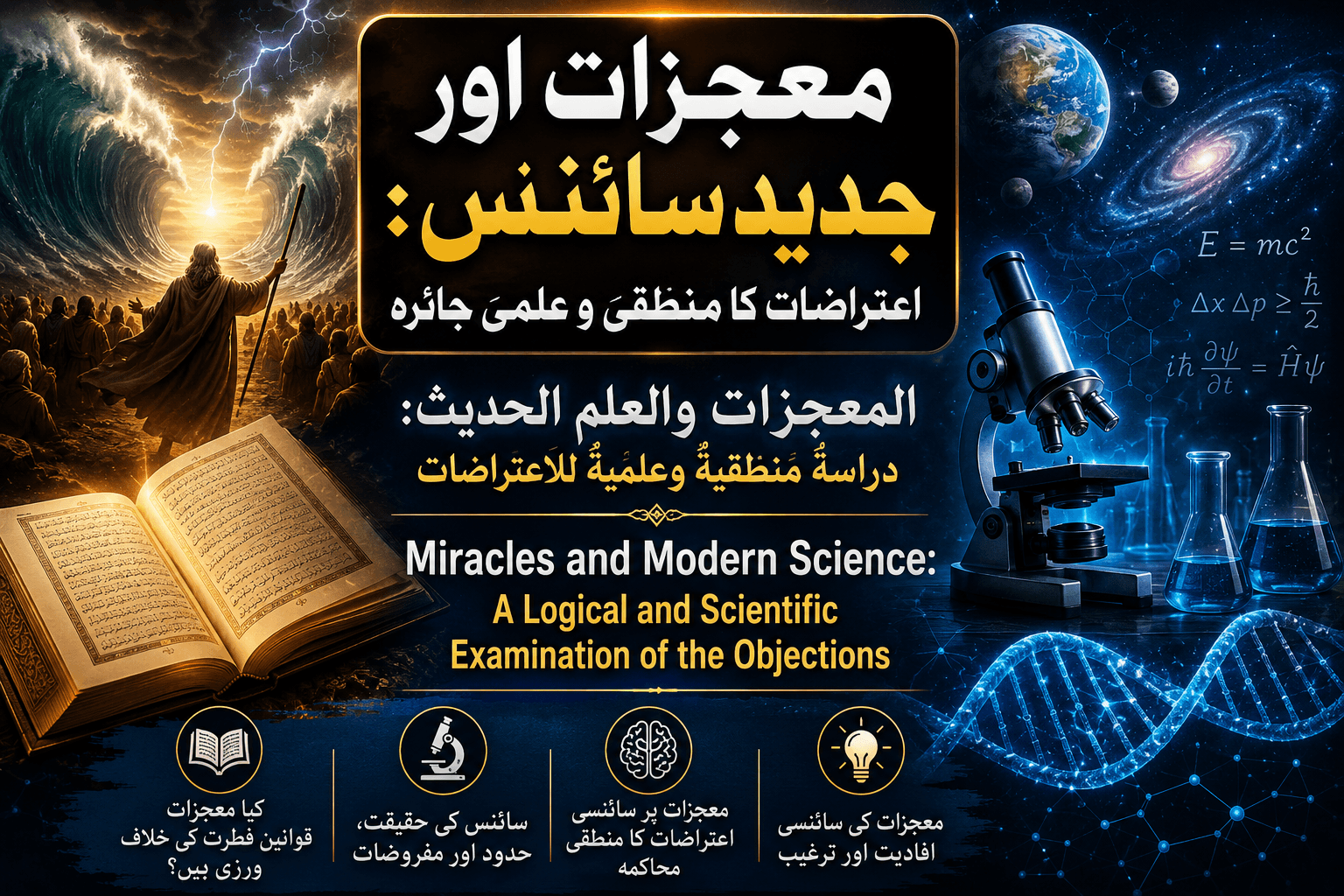
For the modern mind, which is accustomed to thinking in terms of science and logic, the concept of miracles can sometimes be difficult to comprehend. However, when we examine both the nature of science and the reality of miracles objectively and rationally, they appear not as contradictory, but as complementary aspects of a broader reality.
What Is a Miracle?
A miracle is fundamentally an extraordinary event that transcends the ordinary course of nature. It is brought about by Allah through one of His prophets in a manner that lies beyond human capability and is intended to authenticate the prophet's claim to divine revelation.
Broadly speaking, miracles may be classified into the following categories:
1. Miracles as Proofs of Prophethood
These are miracles granted to establish the truthfulness of a prophet's mission, such as the miracles of Prophet Moses, Prophet Jesus, and Prophet Ṣāliḥ (peace be upon them).
2. Miracles of Divine Support and Assistance
These miracles occur as manifestations of Allah's support for His prophets, such as the Night Journey and Ascension (Al-Isrāʾ wa Al-Miʿrāj) and the divine assistance granted to the Prophet Muhammad ﷺ during the Battle of Badr.
3. Composite Miracles
These miracles simultaneously serve as evidence of prophethood and as divine support, such as Allah's command that the fire become "coolness and peace" for Prophet Abraham (peace be upon him).
The Nature, Limits, and Assumptions of Science
To understand scientific objections to miracles, one must first understand what science is—and equally important, what it is not.
Modern science is fundamentally based on observation and experimentation. Scientific conclusions are expected to be verified through repeated observation and reproducible experiments. Moreover, science operates under a methodological assumption that the universe functions as a closed system, meaning that natural phenomena are explained through causes found within the physical universe itself.
Science also relies heavily on inductive reasoning, whereby general principles are inferred from a finite number of observations. Such conclusions, however, are never absolutely certain; they remain open to revision whenever new evidence emerges. The history of science clearly illustrates this point. Newton's law of gravitation was once regarded as a complete explanation of gravitational phenomena, yet Einstein's General Theory of Relativity and later developments in quantum physics revealed its limitations under certain conditions. Scientific laws, therefore, are explanatory models rather than immutable and final truths.
A Logical Examination of Scientific Objections to Miracles
Do Miracles Violate the Laws of Nature?
One of the most common objections is that miracles violate the laws of nature.
This assumption deserves careful examination.
Imagine an intelligent extraterrestrial visiting Earth for the first time. It observes that vehicles stop when the traffic light turns red and move when it turns green. Based solely on observation, it might conclude that the red light itself possesses the power to stop vehicles. Yet this conclusion would be mistaken. The traffic signal merely indicates the driver's decision; it does not itself exert any causal power.
The same principle applies to the laws of nature. Scientific laws describe regular patterns in the universe; they do not independently produce or sustain those patterns. From the Islamic perspective, natural causes possess no independent efficacy. They operate only because Allah has willed them to do so.
Quantum Physics and Miracles
Certain interpretations of quantum mechanics suggest that, before measurement, physical systems are described by a range of probabilities rather than a single definite state. Measurement results in what physicists call the collapse of the wave function, producing one observable outcome.
Although the interpretation of quantum mechanics remains a subject of ongoing debate among physicists, it demonstrates that reality is considerably more subtle and complex than classical physics once assumed.
From this perspective, miracles need not be understood as violations of natural law. Rather, they may be viewed as manifestations of deeper dimensions of reality that remain beyond our current scientific understanding, brought about through the will of the Creator, who possesses complete knowledge and authority over all the laws of the universe—both known and unknown.
Why Can't Miracles Be Reproduced in a Laboratory?
Skeptics sometimes argue that miracles should be demonstrated under controlled scientific conditions before they can be accepted.
This demand, however, misunderstands the very nature of a miracle.
A miracle is not a natural phenomenon that can be repeated at will. It is a unique act of divine intervention that occurs at a specific time for a specific purpose. No prophet ever claimed the ability to perform miracles independently whenever he wished. Rather, miracles occurred solely by the permission and will of Allah. Consequently, demanding laboratory repetition of miracles is methodologically misplaced, because experimental science investigates repeatable natural phenomena, whereas miracles belong to an entirely different category of events.
The Scientific Value and Inspirational Role of Miracles
Far from discouraging scientific inquiry, miracles have often inspired humanity to explore the possibilities embedded within creation.
The renowned Islamic scholar Mawlānā Shabbīr Aḥmad ʿUthmānī observed that miracles should not necessarily be viewed as violations of natural law. Rather, they may reflect higher laws of nature that remain unknown to human beings due to the present limitations of human knowledge.
The story of Prophet Abraham (peace be upon him), whose fire became cool and harmless by Allah's command, inspires the pursuit of technologies capable of protecting human beings from extreme heat. Today, fire-resistant materials and protective clothing—including those used by firefighters and astronauts—reflect humanity's continuous effort to overcome the destructive effects of fire.
Similarly, the miraculous healings performed by Prophet Jesus (peace be upon him) encouraged humanity's continued search for medical knowledge and advanced therapeutic treatments rather than discouraging scientific medicine.
Likewise, the subjugation of the wind to Prophet Solomon (peace be upon him) has long inspired humanity's dream of mastering flight, eventually contributing to remarkable developments in aviation and transportation.
In the present age, Islam's invitation rests not primarily upon sensory miracles, but upon the enduring miracle of the Qur'an, together with reason, reflection, and the innate human disposition toward truth.
Science remains one of humanity's greatest tools for understanding the physical universe, yet it does not encompass the whole of reality. Miracles remind us that the Creator of the universe is not constrained by the laws He established within creation. No matter how far human knowledge advances, it will always remain limited in comparison with the infinite knowledge, wisdom, and power of Allah Almighty.
Have a question about this post?
Ask a Question
About the Author
Muhammad Awais
By the boundless grace and guidance of Allah Almighty, Muhammad Awais is associated with the noble journey of teaching, research, and writing. In his quest to quench his thirst for knowledge, he has completed the Dars-e-Nizami (Traditional Islamic Education), an MA in English, an M.Phil in Islamic Studies, and a B.Ed. Currently, he is pursuing his Ph.D. in Islamic Studies at Hazara University. The core of his academic interests primarily revolves around Islamic Sciences, Western Philosophy, contemporary intellectual discourses, Ilm al-Kalam (Islamic Scholastic Theology), and both classical and modern logic—subjects he continuously strives to comprehend more deeply and reflect upon. His association as a 'Master Trainer' with the British Council and other local institutions, coupled with his experience in competitive examinations, has acquainted him with a diverse array of academic disciplines, for which he is profoundly grateful to the Lord of Majesty. With his very limited abilities, he is making a humble effort to contribute a small share towards serving knowledge, offering intellectual guidance, and fostering an environment of positive academic dialogue. It is his heartfelt prayer that the Lord of the Worlds graciously accepts these modest and fragmented efforts in His Divine Presence, and makes this knowledge beneficial for His creation. Ameen.