
Modernism: Definition, Historical Background, and Core Principles
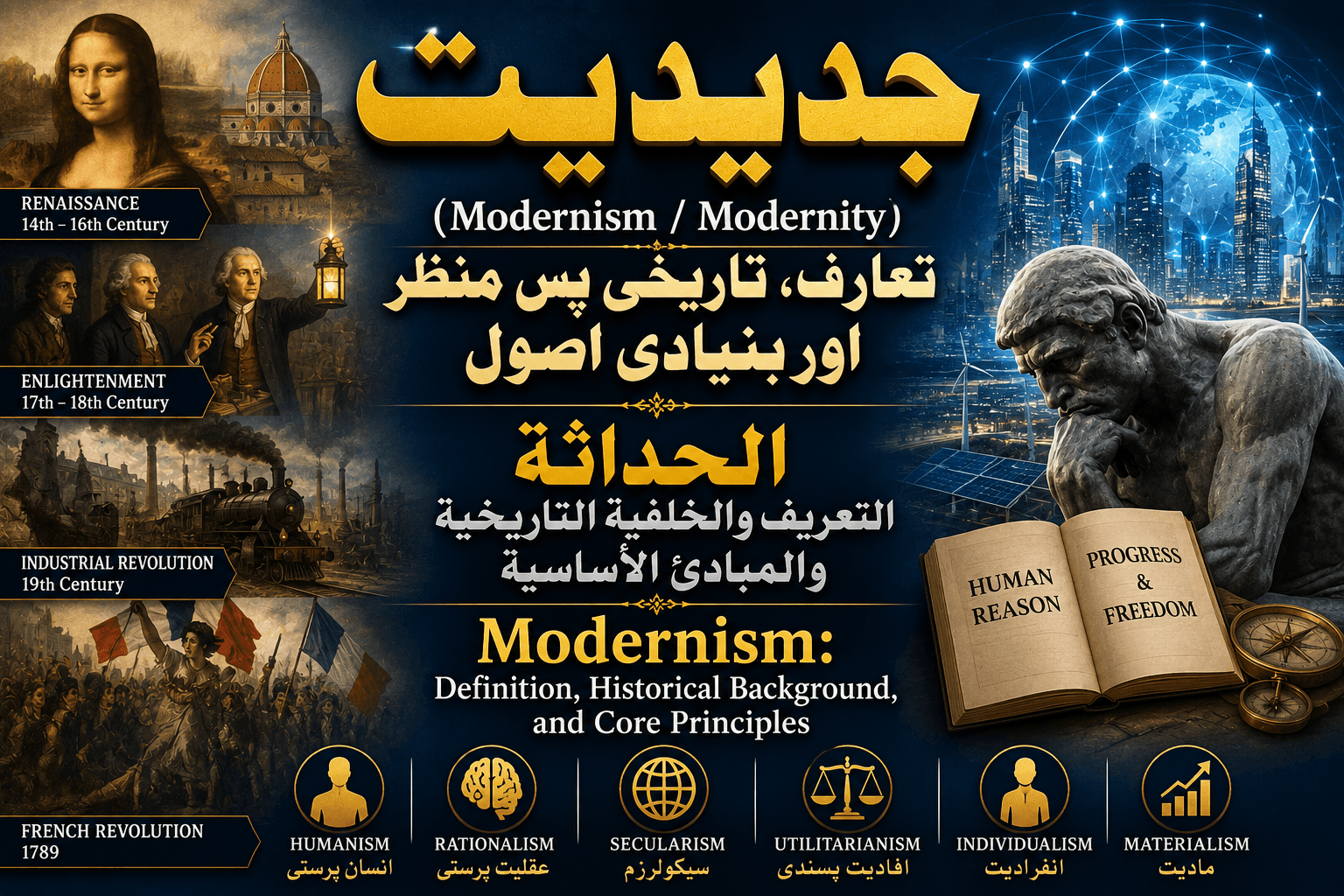
1. Introduction
In intellectual and philosophical discourse, Modernism (or Modernity) is not merely the name of a historical era or a particular period of time. Rather, it represents a comprehensive worldview and a far-reaching civilizational and intellectual project that emerged in Europe after the Renaissance and gradually evolved into the foundational framework of modern Western civilization.
Professor Hasan Askari succinctly described the essence of modernity in the following words:
"Modernity is, in reality, an intellectual pretext for turning away from Heaven in order to gain complete mastery over the Earth."
According to this worldview, the universe, human beings, knowledge, ethics, politics, economics, and society are interpreted solely through material and human-centered standards. Consequently, divine revelation, metaphysical realities, heavenly guidance, and transcendental principles are no longer regarded as authentic or authoritative sources of knowledge and human life.
2. Historical Background
Modernism did not emerge suddenly; rather, it was the outcome of several centuries of intellectual development, religious conflict, and civilizational transformation within Western thought. Its historical evolution may be outlined as follows:
Greek and Roman Periods
The foundations of Western thought were laid by Greek philosophy, which elevated human reason to a central position in understanding reality and the universe. Later, Roman civilization reinforced this intellectual legacy by developing legal systems, state institutions, and a material civilization.
Although Greek philosophers emphasized rational inquiry, they did not completely reject metaphysical and spiritual realities, even during the later periods of intellectual decline.
The Middle Ages
From the fourth to the fourteenth century, Europe was dominated by the Church and Christian religious authority. Although the Church represented religion, its authoritarian practices, intellectual rigidity, doctrinal corruption, and exploitation of the masses created widespread dissatisfaction. This eventually led to a powerful reaction against religious authority and laid the groundwork for the emergence of modern thought.
The Renaissance
The Renaissance, spanning roughly from the fourteenth to the sixteenth century, is generally regarded as the true beginning of modernity.
During this period, Humanism emerged as the dominant intellectual movement. The authority of the Church weakened, religion was increasingly confined to the private sphere, and individuals were encouraged to shape their lives according to their own reason, judgment, and aspirations.
The Age of Enlightenment
During the seventeenth and eighteenth centuries, philosophers such as René Descartes, Baruch Spinoza, John Locke, and Immanuel Kant established human reason as the primary and self-sufficient source of knowledge.
As a consequence, divine revelation and religious knowledge gradually lost their central place within academic and intellectual circles.
The French Revolution
The French Revolution of 1789 transformed the intellectual ideals of modernity into concrete political and institutional realities.
Principles such as liberty, equality, nationalism, democracy, and secularism became defining characteristics of the modern state.
The Nineteenth Century and the Industrial Revolution
The Industrial Revolution accelerated material progress, strengthened capitalism, and promoted scientific thinking.
During this period, influential theories emerged, including Charles Darwin's Theory of Evolution, Karl Marx's Historical Materialism, and Auguste Comte's Positivism, all of which further reinforced the materialistic foundations of modernity.
The Twentieth Century
Although the twentieth century witnessed growing criticism of crude materialism, the alternative was not a return to divine revelation or religion. Instead, new intellectual movements such as psychology, existentialism, and pragmatism gained prominence.
Thinkers including Henri Bergson, William James, Sigmund Freud, and Carl Jung explored the inner dimensions of human existence. Nevertheless, the philosophical foundations of modernity largely remained rooted in materialistic assumptions.
3. Core Principles
The intellectual structure of modernism rests upon several fundamental philosophical principles.
Humanism
Modernism places human beings, rather than God, at the center of the universe. According to this perspective, individuals possess the authority to determine truth and falsehood, right and wrong, and moral values through their own reason, experience, and desires, without dependence upon divine revelation.
Rationalism
Modernism regards human reason as the most reliable—and indeed the primary—means of attaining knowledge and discovering truth. Consequently, even metaphysical questions are subjected to rational analysis and human judgment.
This-Worldliness and Materialism
Modernism directs its primary concern toward worldly existence rather than the Hereafter. Material progress, economic prosperity, technological advancement, and worldly well-being are viewed as the principal goals of human life.
Secularism
Modernism considers religion to be a private matter and advocates the separation of religion from the state, legislation, politics, economics, education, and other public institutions.
Utilitarianism
Within the modernist framework, ethical judgments are not grounded in eternal divine commandments. Instead, morality is evaluated according to utility, pleasure, social benefit, and practical consequences.
Hyper-Individualism
Modernism views the individual as a fully autonomous and sovereign being, liberated from the authority of family, tradition, religion, and collective values. Every individual is considered free to define his or her own identity, values, beliefs, and way of life.
Primary Source
Book Title: Modernity
Author: Professor Hassan Askari
Publisher: Idara Farogh-e-Islam, Lahore
First Edition: October 1997
Have a question about this post?
Ask a Question
About the Author
Muhammad Awais
By the boundless grace and guidance of Allah Almighty, Muhammad Awais is associated with the noble journey of teaching, research, and writing. In his quest to quench his thirst for knowledge, he has completed the Dars-e-Nizami (Traditional Islamic Education), an MA in English, an M.Phil in Islamic Studies, and a B.Ed. Currently, he is pursuing his Ph.D. in Islamic Studies at Hazara University. The core of his academic interests primarily revolves around Islamic Sciences, Western Philosophy, contemporary intellectual discourses, Ilm al-Kalam (Islamic Scholastic Theology), and both classical and modern logic—subjects he continuously strives to comprehend more deeply and reflect upon. His association as a 'Master Trainer' with the British Council and other local institutions, coupled with his experience in competitive examinations, has acquainted him with a diverse array of academic disciplines, for which he is profoundly grateful to the Lord of Majesty. With his very limited abilities, he is making a humble effort to contribute a small share towards serving knowledge, offering intellectual guidance, and fostering an environment of positive academic dialogue. It is his heartfelt prayer that the Lord of the Worlds graciously accepts these modest and fragmented efforts in His Divine Presence, and makes this knowledge beneficial for His creation. Ameen.