
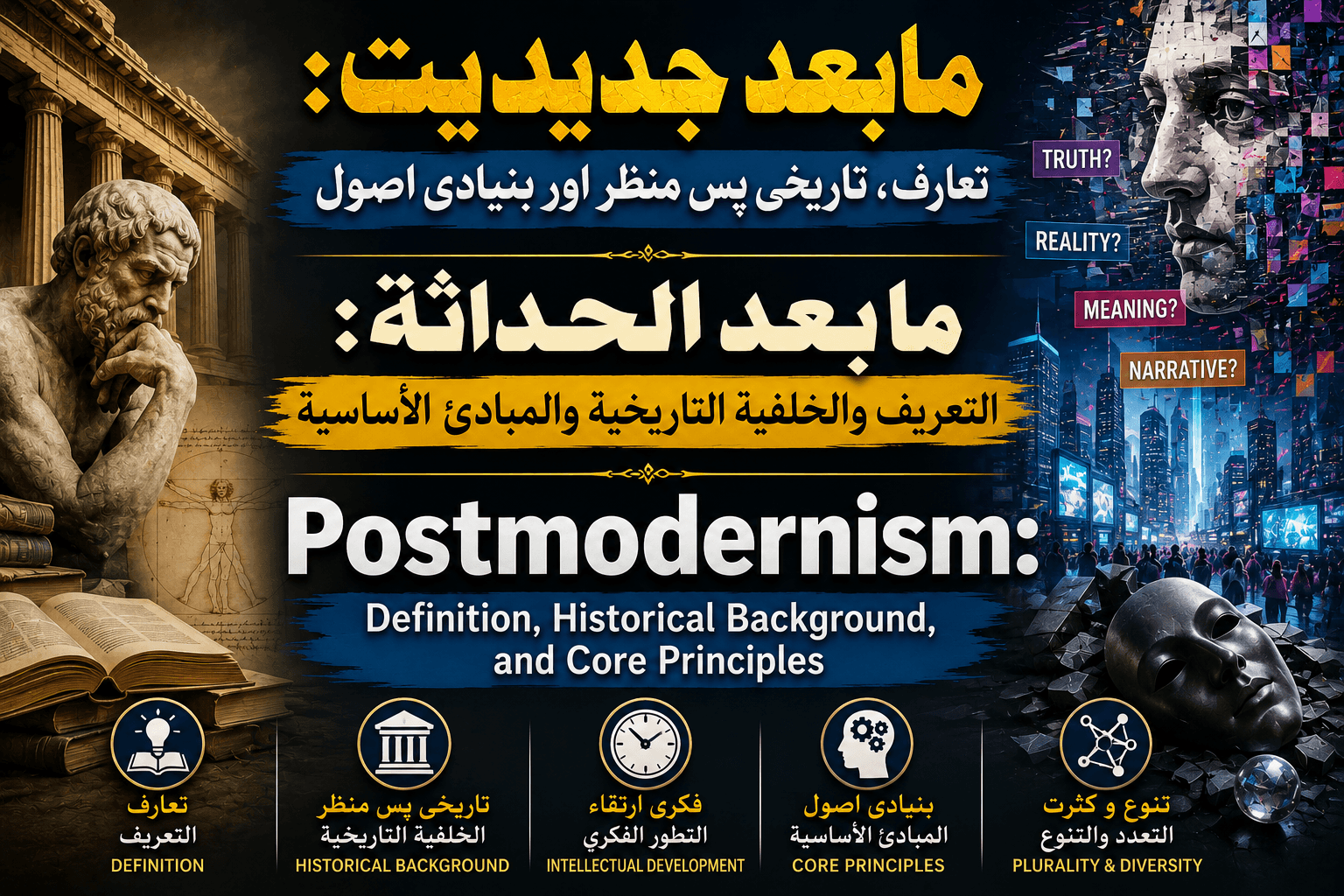
Postmodernism: Definition, Historical Background, and Core Principles
1) Introduction
Postmodernism is composed of two words: "Post", meaning "after" or "subsequent to," and "Modernism." Linguistically, it refers to the intellectual movement that emerged after modernism or developed as a reaction against it.
In philosophical and intellectual discourse, Postmodernism is a cultural, philosophical, and intellectual movement that emerged during the latter half of the twentieth century. It fundamentally challenges the central assumptions of Modernism, including objective truth, universal reason, and comprehensive explanatory systems. One of the most influential definitions was offered by the French philosopher Jean-François Lyotard, who described Postmodernism as:
"An incredulity toward metanarratives."
Accordingly, Postmodernism rejects any religion, philosophy, scientific theory, or ideological system that claims to possess a single, universal, and ultimate truth applicable to all humanity.
2) Historical Background
Postmodernism did not emerge suddenly; rather, it developed as the outcome of the long intellectual evolution of Western thought, particularly as a response to the philosophical and material crises generated by modern civilization. Its historical development may be understood through the following stages:
Disillusionment with Modernity and the Enlightenment
During the eighteenth-century Age of Enlightenment and the nineteenth-century Industrial Revolution, Western intellectuals believed that human reason and scientific progress would inevitably lead humanity toward prosperity, peace, and universal happiness. However, the devastating experiences of the First and Second World Wars, the Holocaust, and the atomic bombings of Hiroshima and Nagasaki shattered this optimism. These catastrophes convinced many thinkers that modern rationality had failed to deliver the promised peace and had instead contributed to unprecedented destruction.
Philosophical Roots
The philosophical origins of Postmodernism can be traced to the ideas of the German philosopher Friedrich Nietzsche, particularly his critique of absolute truth and his revaluation of traditional values. During the mid-twentieth century, French intellectual circles witnessed the rise of Post-Structuralism, which provided the theoretical foundation upon which Postmodernism was subsequently developed.
Structuralism is a methodological approach that argues that language, literature, culture, and society can only be understood within the broader structures of which they are a part.
Post-Structuralism, in contrast, rejects the notion that language or reality possesses a fixed, stable, and objective structure. Instead, it maintains that meanings are fluid, multiple, and continually open to reinterpretation.
Major Thinkers:
Jean-François Lyotard: Declared the end of grand narratives and made skepticism toward metanarratives the defining characteristic of Postmodernism.
Jacques Derrida: Developed the theory of Deconstruction, a method that seeks to expose the instability of language and dismantle fixed meanings within texts.
Michel Foucault: Examined the close relationship between knowledge and power, arguing that what societies regard as "truth" is often shaped by dominant institutions and systems of authority.
Jean Baudrillard: Introduced the concept of Hyperreality, explaining how simulations and media representations increasingly replace direct experience of reality.
3) Core Principles
The philosophical framework of Postmodernism rests upon several fundamental principles.
Rejection of Metanarratives (Incredulity toward Metanarratives):
Postmodernism rejects all comprehensive systems of thought—including religions such as Islam and Christianity, philosophical ideologies such as Marxism, and scientific theories that claim to provide universal explanations of reality. Instead, it favors local or micro-narratives, considering them more authentic than universal frameworks.
Relativism of Truth:
According to Postmodernism, there is no such thing as an objective, universal, or absolute truth. Truth is regarded as relative and contingent upon language, culture, geography, historical context, and social experience. Consequently, different individuals and communities may each possess their own equally valid "truths."
Deconstruction and the Instability of Language:
According to Jacques Derrida, language cannot communicate a single, permanent, or final meaning. Every text is inherently open to multiple interpretations, and readers actively participate in constructing its meanings rather than merely discovering them.
Knowledge–Power Nexus:
Michel Foucault argued that what societies define as "knowledge" or "truth" is often produced by dominant power structures. Knowledge is therefore not entirely neutral but frequently functions as an instrument through which political, cultural, and institutional authorities maintain their influence and control.
Decenterment:
Postmodernism rejects the existence of any fixed or universal center—whether in the universe, society, culture, or human identity. Instead, it emphasizes plurality, diversity, decentralization, and multiple perspectives, opposing every claim to exclusive authority or universal certainty.
Have a question about this post?
Ask a Question
About the Author
Muhammad Awais
By the boundless grace and guidance of Allah Almighty, Muhammad Awais is associated with the noble journey of teaching, research, and writing. In his quest to quench his thirst for knowledge, he has completed the Dars-e-Nizami (Traditional Islamic Education), an MA in English, an M.Phil in Islamic Studies, and a B.Ed. Currently, he is pursuing his Ph.D. in Islamic Studies at Hazara University. The core of his academic interests primarily revolves around Islamic Sciences, Western Philosophy, contemporary intellectual discourses, Ilm al-Kalam (Islamic Scholastic Theology), and both classical and modern logic—subjects he continuously strives to comprehend more deeply and reflect upon. His association as a 'Master Trainer' with the British Council and other local institutions, coupled with his experience in competitive examinations, has acquainted him with a diverse array of academic disciplines, for which he is profoundly grateful to the Lord of Majesty. With his very limited abilities, he is making a humble effort to contribute a small share towards serving knowledge, offering intellectual guidance, and fostering an environment of positive academic dialogue. It is his heartfelt prayer that the Lord of the Worlds graciously accepts these modest and fragmented efforts in His Divine Presence, and makes this knowledge beneficial for His creation. Ameen.