
Primary Creation vs. Secondary Causality: Resolving Rational Challenges to the Creation, Age, and Prophethood of Adam (A.S.)
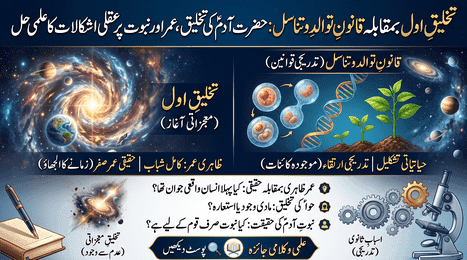
Primary Creation vs. Secondary Causality: Resolving Rational Challenges to the Creation, Age, and Prophethood of Adam (A.S.)
Primary Creation and the law of reproduction (Secondary Causality) are two distinct epistemological and cosmic domains. The core objection of the attached post—that "the calculation of the first human's age in the universe and his status of prophethood contain a rational contradiction"—is fundamentally the result of an intellectual flaw: assuming that prevailing physical laws govern Divine creativity, and reducing the broader theological framework of prophethood to a mere social reform movement. The essence of this post revolves around three matters: first, the age of Adam (peace be upon him); second, the creation of Eve (peace be upon her); and third, the prophethood of Adam (peace be upon him).
1. The Reality of the Objection Regarding the Age of Adam (PBUH)
The objection to the first matter actually arises from a failure to distinguish between "apparent age" and "chronological (actual) age." That is, if Prophet Adam (peace be upon him) was created in a state of youth corresponding to 25 or 30 years of age, he was non-existent (in non-being) for those 25 years, and therefore, counting his age is logically impossible. This claim is the result of conflating time with physical configurations.
Whenever a creator brings something into existence from nothingness for the first time, that object is 'perfect' (fully functioning) in its structure. If one creates a system that is operational from the very first moment, its components must possess a specific biological or physical structure. For example, if science today were to synthetically produce a fully mature tree in a laboratory, the 'apparent state' (biological state) of this tree would resemble that of a hundred-year-old tree, yet its 'chronological age' (actual historical age) would begin from zero.
The theological and philosophical principle is that the calculation of Prophet Adam's age began the moment the soul was breathed into his physical form, rendering him a conscious being. His being in the form of youth is not evidence of the passage of past time, but rather the perfection of the initial configuration of his physical body, ensuring that he was biologically and mentally equipped from day one for vicegerency (Khilafah) and the continuation of the human race on Earth. Therefore, the inclusion of an imaginary or non-existent age into his actual age is not required here at all.
2. The Creation of Eve (Hawa): The Context of Literal and Material Interpretations
As far as the creation of Eve (peace be upon her) from a rib is concerned, two fundamental interpretive approaches exist within the Islamic scholarly tradition:
The Literal and Historical Interpretation: A group of classical commentators (Imams of Tafsir), in light of the literal words of the Hadiths, believe that Allah Almighty created Eve's physical form from a part of Adam's physical body. In the material world, the creation of one living organism from the cells or parts of another organism (akin to modern cloning or cellular reproduction) is not biologically impossible. For the universe's first physical pair, this methodology became the cause of a deep psychological and physical bond between them.
The Theological and Linguistic Interpretation: Another group of theologians (Mutakallimun) and contemporary commentators, arguing from the Quranic words "and created from it its mate" (khalaqa minha zawjaha), state that "rib" here does not denote a physical bone, but rather "the homogeneity of essence and nature." Since the Hadiths compare a woman's disposition and psychology to the curvature of a rib so that men treat her with gentleness, this is an eloquent metaphor rather than a physical defect. In either case, there is no rational or logical contradiction.
3. The Reality of the Objection to the Status of Prophethood
Our respected interlocutor falls prey to a major fallacy: that "prophethood is merely about being sent to a nation, and therefore, prophethood for a solitary human is futile." This is a superficial understanding of prophethood, yet it forms the very foundation of the entire objection.
The Primary Function of Prophethood: In Islam, prophethood is not merely a tool for resolving social disputes; rather, it is fundamentally a legislative and cosmic connection between God and His vicegerent on Earth. Prophet Adam (peace be upon him) was the progenitor of humankind. For human life to begin on Earth without a guidebook, divine recognition (Ma'rifah), and a moral code would contradict Divine Wisdom. Furthermore, Prophet Adam did not remain alone; rather, an entire lineage of descendants immediately came into existence. He was Allah's Prophet and Lawgiver for his wife and his numerous offspring. The purpose of his prophethood was to ground the universe's first human society on the foundations of Monotheism (Tawhid), the concepts of the permissible (Halal) and forbidden (Haram), and ethical boundaries. Had the first human not been made a prophet, the earliest era of humanity would have been defined by savagery, godlessness, and ignorance, which explicitly contradicts the cosmic purpose of "Divine Vicegerency" on Earth. Therefore, appointing the very first human to the office of prophethood was perfectly aligned with reason and the demands of Divine Wisdom.
The Islamic narrative of Adam’s creation is a divine miracle transcending the chain of material causes, and a masterpiece of primary creation. Applying prevailing gradual laws to it is like a scientific theory attempting to apply the laws of current cosmic temperature to the first second of the Big Bang. Even according to the material universe and science, the laws governing 'Primary Creation' or inception are entirely different, and once a system becomes operational, subsequent laws (gradual laws) take over. That is to say, according to modern scientific theories (such as the Big Bang) themselves, the laws of physics and temperature functioning in the universe's initial fraction of a second were not the same as those governing the universe today. In exactly the same manner, the "Primary Creation" of Prophet Adam (peace be upon him) was a miracle; therefore, raising objections by applying today’s ordinary physical or biological laws (the law of reproduction or gradual evolution) to that foundational moment is rationally flawed.
The life of Prophet Adam (peace be upon him) commenced with his living, conscious existence, and his prophethood served as a beacon of light for humanity’s first family and society. Sound intellect finds no contradiction in accepting these realities.
Have a question about this post?
Ask a QuestionAbout the Author
Dr. Mufti Muhammad Ibrahim
Dr. Mufti Muhammad Ibrahim is a distinguished Islamic scholar, jurist, and researcher known for integrating traditional Islamic scholarship with modern academic standards. He completed his Dars-e-Nizami (Shahadat-ul-Alamia) from Jamia Darul Uloom Karachi and specialized in Islamic Jurisprudence (Fiqh) at Darul Iftaa Makki Masjid, Mansehra, where he has been serving as an Assistant Mufti for over a decade. He holds a Ph.D. in Islamic Studies from the University of Haripur, secured top position in M.Phil, and earned a Gold Medal in M.A. Islamiat. He also holds degrees in M.Sc. Pakistan Studies and B.A. English Literature. Dr. Ibrahim is an HEC-approved Ph.D. supervisor, with numerous postgraduate researchers completing their work under his supervision. He has authored over 30 research papers and several academic books. His research focuses on Quran and Hadith studies, as well as addressing modern intellectual challenges, particularly atheism. Through the platform "Tafheem-e-Nau," he actively engages in presenting reasoned responses to contemporary ideological questions.