
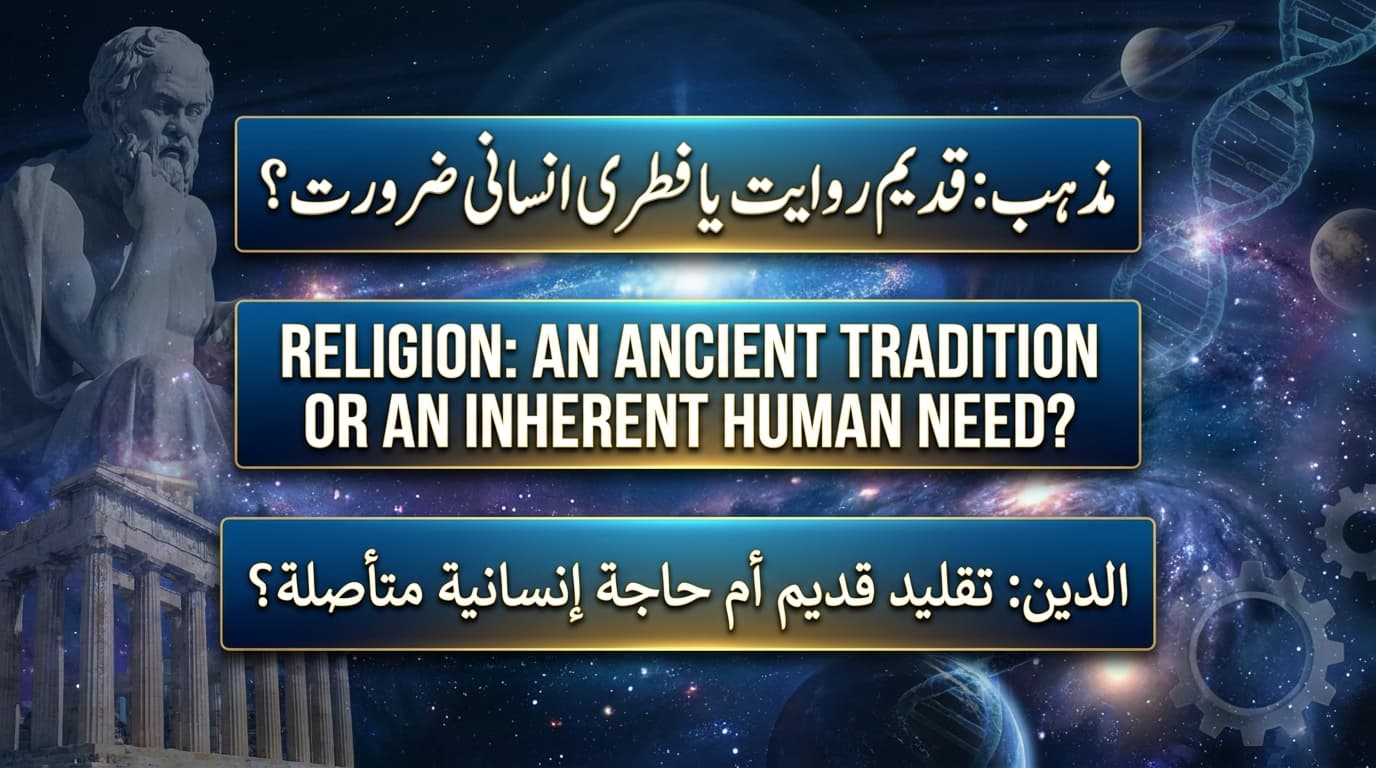
Religion: An Ancient Tradition or an Inherent Human Need?
The Origin of Religion: An Intellectual Review
How Did Religion Begin? This question formally emerged during the last century. In response, various schools of thought presented their respective theories. Particularly after Darwin’s Theory of Evolution, a general presumption arose that the principle of evolution operates across every domain in the same manner as observed in biology.
Regarding the origin of religion, one perspective suggested that it merely began with certain superstitious ideas, which were gradually refined over time until religion reached its present, advanced forms. It was as though scientific and academic analysis attempted to prove that religion, in its essence, is nothing more than a psychological or social illusion.
In this context, the theory of Animism also came to the forefront. Its underlying concept is that primitive man deduced from dreams, hallucinations, and instances of death that an immortal soul existed within him. When a deceased person appeared in a dream, it was assumed that the human soul survives after death. Over time, some of these souls gradually became gods, their worship commenced, and thus religion came into existence.
Another concept put forward was the "God of the Gaps" theory. According to this, whatever primitive man failed to explain, he declared supernatural and began to worship it—such as the adoration of the sun, moon, and stars. However, modern research reveals quite the contrary: the history of religion is as ancient as humanity itself.
Why Has Humanity Continually Discussed Religion?
The point to ponder is: why did humans, during the last century and even before that, continuously discuss religion under various themes? In truth, it is the pursuit of true happiness.
Does true happiness depend solely on wealth and material possessions? Consider the following example to understand this:
Imagine that wherever you are right now, you suddenly lose consciousness. When you open your eyes, you find yourself inside an airplane. Beside you is a bag filled with dollars, and a variety of delicious food is available. But think for a moment: will you genuinely be happy? Or will you be consumed by anxiety, wondering, "I was just in my room at home, how did I end up in a flying airplane? And where am I heading?"
Without satisfactory answers to these questions, you can neither be at peace nor truly happy. In exactly the same way, certain fundamental questions are embedded in human nature, and the search for their answers keeps man restless. For instance:
Where has he come from?
Where is he going?
He observes around him that people are being born and people are dying—what is the ultimate background of this entire scenario?
What is the beginning of this magnificent universe, and what is its end?
In today's modern world, man has unlocked the doors to great cosmic discoveries, yet at the foundation of these discoveries lies the original search for those very same ancient questions. Even today, modern research remains incapable of answering them.
Has Science Eliminated the Need for Religion?
The notion that modern science and vast treasuries of information have left no need for religion is now itself a relic of the previous century. Following modern scientific breakthroughs, humanity is once again knocking on the door of religion. In reality, while these scientific investigations have revealed a few more links in the chain of events to man, they have failed to provide the ultimate discovery for which his inner nature yearns.
Reflect upon this! Primitive man, looking at water with the naked eye, believed that this was all there was to it. Later, modern instruments revealed bacteria within the water, and modern chemistry defined water as a substance composed of a combination of hydrogen and oxygen.
But what did this information achieve? It merely expanded human knowledge. Previously, man only knew the outward appearance of water; now he also knows about the bacteria inside it. Previously, he simply observed an object falling to the ground; now he is also well-acquainted with the Law of Gravity.
However, consider carefully: all of this is merely an accumulation of information, not an explanation of ultimate reality.
The questions still remain:
Why does a mixture of hydrogen and oxygen not produce fire?
Why does gravity exist at all?
Is knowing the laws of nature within the universe equivalent to explaining the universe itself?
No. Just as knowing the components of a machine does not explain the reason for its existence, knowing the laws of nature does not mean understanding the ultimate reality of the universe. Man has figured out "how" the laws of nature operate, but "why" do they operate? This question remains unresolved to this day.
This is precisely why, despite such advanced discoveries, modern man remains anxious and restless. He is unable to attain true happiness.
The Situation in the West
In the West, which currently spends billions of dollars on advanced research, economists repeatedly object, asking, "Where is this money going?" Because on many occasions, results are achieved only after decades, and spending or freezing such massive sums of money becomes a matter of dispute.
In response to this objection, the American professor Roger Penrose remarked:
"Are economists not curious to know where we came from? How we were born? Or why we are here on Earth? Beyond economic benefit, does the desire to know these things not arise within them?"
Even the person who does not wish to explain the universe on the basis of God is intensely desperate to find something upon which he can explain himself and the cosmos.
The Prophetic Answer and Human Resistance
The reality is that the answer to these questions does not exist anywhere except in "Prophetic Revelation." Only the Creator of the universe can unlock this secret, and He has indeed unlocked it through His prophets.
The question then arises: when the prophets unveiled these secrets—and have continuously done so—why did man, despite his search, refuse to listen to their answer? And why did he refuse to accept it?
The reason is that the prophetic answer brings with it the concept of reward and punishment, and heaven and hell. It demands that man relinquish his unbridled freedom and lead a disciplined, accountable life on Earth.
This is why man is reluctant to accept the prophetic answer to his own quest. He constantly strives to discover a solution to the mysteries of nature that answers his curiosity, yet imposes no restrictions on his life—one that does not leave him anxious about future consequences. Conversely, the answer of the prophets instills a lifelong accountability regarding the Hereafter.
Conclusion
Thus, it becomes clear that religion is not merely the name of ancient traditions; rather, it is an "inherent need of human nature"—it is the ultimate quest of the human soul.
Have a question about this post?
Ask a Question
About the Author
Dr. Mufti Muhammad Ibrahim
Dr. Mufti Muhammad Ibrahim is a distinguished Islamic scholar, jurist, and researcher known for integrating traditional Islamic scholarship with modern academic standards. He completed his Dars-e-Nizami (Shahadat-ul-Alamia) from Jamia Darul Uloom Karachi and specialized in Islamic Jurisprudence (Fiqh) at Darul Iftaa Makki Masjid, Mansehra, where he has been serving as an Assistant Mufti for over a decade. He holds a Ph.D. in Islamic Studies from the University of Haripur, secured top position in M.Phil, and earned a Gold Medal in M.A. Islamiat. He also holds degrees in M.Sc. Pakistan Studies and B.A. English Literature. Dr. Ibrahim is an HEC-approved Ph.D. supervisor, with numerous postgraduate researchers completing their work under his supervision. He has authored over 30 research papers and several academic books. His research focuses on Quran and Hadith studies, as well as addressing modern intellectual challenges, particularly atheism. Through the platform "Tafheem-e-Nau," he actively engages in presenting reasoned responses to contemporary ideological questions.