
Scientific Theory, Scientific Law, and Divine Revelation
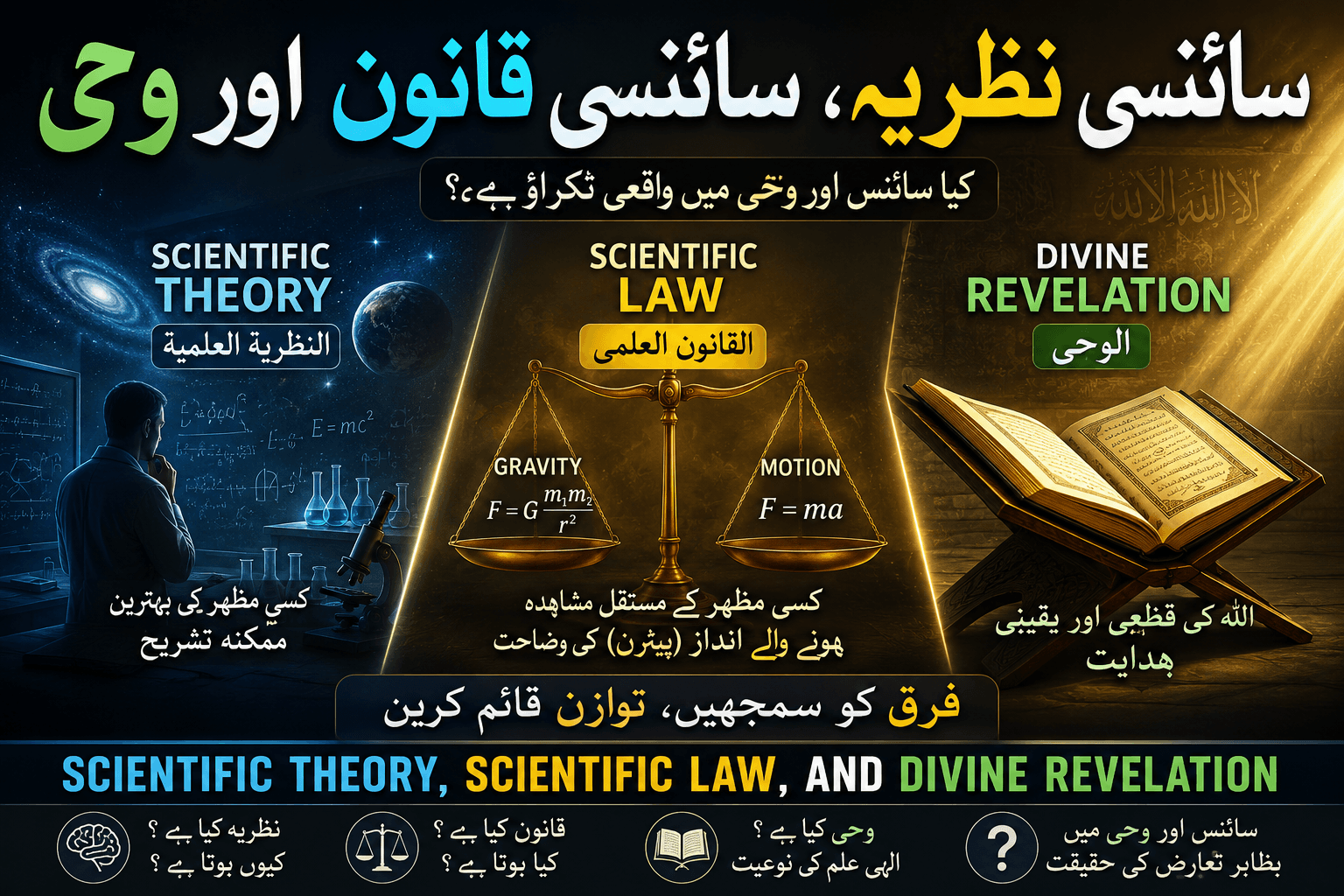
A Common Misconception about Scientific Theory and Scientific Law
Many of the perceived conflicts between science and Islam in the modern world are not genuine conflicts at all. Rather, they arise from a misunderstanding of fundamental scientific terminology—particularly the concepts of Scientific Theory and Scientific Law. Unfortunately, this misunderstanding is not confined to the general public; it is also widespread among many educated individuals, including students, media commentators, and even some academics.
A common misconception is that a scientific theory is merely a guess or an uncertain opinion, whereas a scientific law represents an absolute and unquestionable truth. Consequently, when a scientific theory is presented alongside the Qur'an or the Prophetic Sunnah, some people assume that because it belongs to the domain of "science," it must take precedence over divine revelation.
This assumption is inconsistent not only with the philosophy of science but also with the fundamental principles of modern scientific methodology. In reality, science, scientific theory, scientific law, and divine revelation belong to different domains of knowledge, each with its own epistemological foundations and criteria of truth. Understanding these distinctions is essential for any meaningful discussion of the relationship between science and Islam.
What Is a Scientific Theory?
A scientific theory is far more than a simple idea or educated guess. It is a comprehensive explanatory framework that accounts for a natural phenomenon on the basis of systematic observations, carefully designed experiments, empirical evidence, and logical reasoning. In contemporary science, a theory emerges only after a substantial body of consistent evidence has accumulated, pointing toward a coherent explanation of observed phenomena.
Nevertheless, every scientific theory remains, in principle, revisable. Should stronger evidence become available in the future, a theory may be refined, expanded, or even replaced by a more comprehensive explanation. For this reason, philosophers of science often describe scientific theories not as final truths, but as the best current explanations supported by the available evidence.
How Does a Scientific Theory Develop?
The development of a scientific theory generally follows a systematic process:
Observation
↓
Question
↓
Hypothesis
↓
Experimentation
↓
Data Analysis
↓
Independent Verification and Replication
↓
Scientific Theory
↓
Continuous Testing, Refinement, and Revision
This process clearly demonstrates that science is a self-correcting enterprise.
The renowned philosopher of science Karl Popper argued that a theory qualifies as scientific only if it is falsifiable—that is, capable of being tested and potentially proven wrong. According to Popper, the possibility of refutation is what distinguishes scientific knowledge from dogma. Science therefore does not claim absolute certainty; rather, it continuously subjects its explanations to critical examination and empirical testing.
The history of science offers numerous examples of this self-correcting nature. Newtonian mechanics, which successfully explained physical phenomena for centuries, was later expanded by Albert Einstein's Theory of Relativity. Today, modern physics continues to develop through advances in quantum mechanics, revealing that even Einstein's framework has limitations under certain conditions. These developments illustrate that scientific knowledge evolves through refinement rather than through claims of absolute finality.
What Is a Scientific Law?
A scientific law does not explain a natural phenomenon; rather, it describes the consistent pattern or regularity with which that phenomenon is observed. In other words, a scientific law tells us what happens, whereas a scientific theory seeks to explain why it happens.
A simple analogy may help clarify this distinction. Consider a clock. A scientific law merely describes the movement of its hands—for example, that the minute hand completes one full revolution every hour. This is a consistent and observable pattern. A scientific theory, however, explains why and how the hands move. It investigates the internal mechanism of the clock, such as its gears, spring, battery, and other components that make the movement possible.
Clearly, the observable movement of the clock's hands (the law) can never evolve into an explanation of the internal mechanism (the theory). The two serve different scientific purposes.
A classic example is Newton's Law of Universal Gravitation, which describes the mathematical relationship according to which masses attract one another. However, the law itself does not explain why gravity exists. The explanation belongs to the realm of scientific theory. Later, Albert Einstein's General Theory of Relativity provided a new theoretical explanation of gravitation by describing it as the curvature of spacetime. This did not mean that Newton's law became a theory or that Einstein's theory became a law. Rather, each continues to serve a distinct role within scientific inquiry.
The Greatest Misconception about Scientific Theory and Scientific Law
One of the most widespread misconceptions is the belief that scientific knowledge progresses through the following sequence:
Hypothesis → Theory → Law
According to this popular view, a hypothesis eventually becomes a theory, and a theory ultimately matures into a scientific law. This understanding is scientifically incorrect.
A scientific theory and a scientific law are two fundamentally different concepts, not successive stages of scientific development.
A scientific law describes what happens in nature by identifying consistent patterns and regularities.
A scientific theory, on the other hand, explains why and how those patterns occur by providing a coherent explanatory framework supported by empirical evidence.
Consequently, scientific theories do not become scientific laws, nor do scientific laws evolve into theories. Each serves a unique and complementary function within the scientific method.
Divine Revelation and Scientific Knowledge
According to the Islamic conception of knowledge, divine revelation (Wahy) is absolute and certain guidance revealed by Allah, the One whose knowledge encompasses the past, the present, and the future, the seen and the unseen, and every aspect of the universe.
Scientific knowledge, by contrast, is based upon human observation, experimentation, and rational inquiry. As a result, it is necessarily limited, cumulative, and open to revision in light of new evidence.
The Qur'an states:
"And you have been given of knowledge only a little."(Qur'an 17:85)
This verse does not discourage scientific investigation; rather, it reminds humanity of the inherent limits of human knowledge. No matter how remarkable scientific progress may become, human understanding remains finite when compared with the infinite knowledge of the Creator.
Recognizing this distinction is essential for establishing a balanced and intellectually rigorous relationship between science and revelation.
Is There Really a Conflict Between Science and Divine Revelation?
Not every apparent conflict between science and divine revelation represents a genuine contradiction. In many cases, the perceived conflict arises from misunderstanding either the scientific evidence or the religious text. Generally speaking, apparent conflicts fall into one of the following three categories.
First, scientific knowledge may still be in its developmental stage. As scientific research progresses, new discoveries may modify, refine, or even replace previous explanations.
Second, the apparent contradiction may result from an incorrect interpretation of the religious text. A misunderstanding of the Qur'anic verse or Prophetic tradition may create an illusion of conflict where none actually exists.
Third, a scientific theory may mistakenly be treated as though it were an established and final fact, even though it remains provisional and subject to further investigation and revision.
For this reason, it is methodologically unsound to treat a probabilistic scientific theory as the ultimate criterion by which certain and definitive divine revelation is judged.
The Islamic Principle: Distinguishing Between Definitive and Probabilistic Knowledge
Islamic epistemology draws a clear distinction between definitive (Qaṭʿī) and probabilistic (Ẓannī) forms of evidence.
The Qur'an, when both its transmission (Qaṭʿī al-Thubūt) and meaning (Qaṭʿī al-Dalālah) are definitive, provides certain and infallible knowledge because it originates from Allah, the All-Knowing.
By contrast, most scientific theories are built upon empirical observation, experimentation, and inductive reasoning. Although they often provide highly reliable explanations of natural phenomena, they remain, by their very nature, open to revision and refinement in the light of new evidence.
Consequently, placing definitive revelation and provisional scientific theories on the same epistemological level constitutes a fundamental methodological error.
A Fundamental Misconception Among Some Atheist and Secular Thinkers
Some atheist and secular writers present scientific theories as though they were immutable and final truths, and then use those theories as grounds for challenging divine revelation.
Ironically, this approach contradicts the very philosophy of science they claim to uphold. Modern philosophy of science recognizes that scientific knowledge is provisional, cumulative, and self-correcting. Scientific explanations evolve continuously as new evidence emerges and existing models are refined.
Therefore, elevating any scientific theory above definitive revelation is inconsistent with both scientific integrity and sound epistemological principles.
How Should an Apparent Conflict Be Addressed?
The proper scholarly approach is one of careful and balanced investigation.
If an apparent contradiction arises between an established scientific fact and the accepted interpretation of a Qur'anic text, the first step should be to re-examine both the scientific evidence and the interpretation of the religious text. A reassessment may reveal that the conflict is merely apparent rather than real.
However, if the scientific claim in question is merely a scientific theory rather than a conclusively established fact, it should be treated according to its actual epistemic status. Such a theory should not be elevated to the level of definitive revelation or used as the ultimate standard by which revelation is evaluated.
Scientific theory, scientific law, and divine revelation belong to three distinct domains of knowledge, each with its own objectives, methodology, and criteria of certainty.
A scientific theory offers the best currently available explanation of natural phenomena. A scientific law describes the consistent patterns according to which those phenomena occur. Divine revelation (Wahy), on the other hand, constitutes certain and infallible guidance revealed by Allah.
A balanced understanding of the relationship between Islam and science is impossible without recognizing these fundamental distinctions. Scientific theories should be appreciated within their proper methodological limits, while divine revelation must retain its unique status as absolute and certain guidance. This approach alone is consistent with scientific integrity, the philosophy of science, and the Islamic theory of knowledge.
Have a question about this post?
Ask a Question
About the Author
Muhammad Awais
By the boundless grace and guidance of Allah Almighty, Muhammad Awais is associated with the noble journey of teaching, research, and writing. In his quest to quench his thirst for knowledge, he has completed the Dars-e-Nizami (Traditional Islamic Education), an MA in English, an M.Phil in Islamic Studies, and a B.Ed. Currently, he is pursuing his Ph.D. in Islamic Studies at Hazara University. The core of his academic interests primarily revolves around Islamic Sciences, Western Philosophy, contemporary intellectual discourses, Ilm al-Kalam (Islamic Scholastic Theology), and both classical and modern logic—subjects he continuously strives to comprehend more deeply and reflect upon. His association as a 'Master Trainer' with the British Council and other local institutions, coupled with his experience in competitive examinations, has acquainted him with a diverse array of academic disciplines, for which he is profoundly grateful to the Lord of Majesty. With his very limited abilities, he is making a humble effort to contribute a small share towards serving knowledge, offering intellectual guidance, and fostering an environment of positive academic dialogue. It is his heartfelt prayer that the Lord of the Worlds graciously accepts these modest and fragmented efforts in His Divine Presence, and makes this knowledge beneficial for His creation. Ameen.