Secularism: Introduction and Types
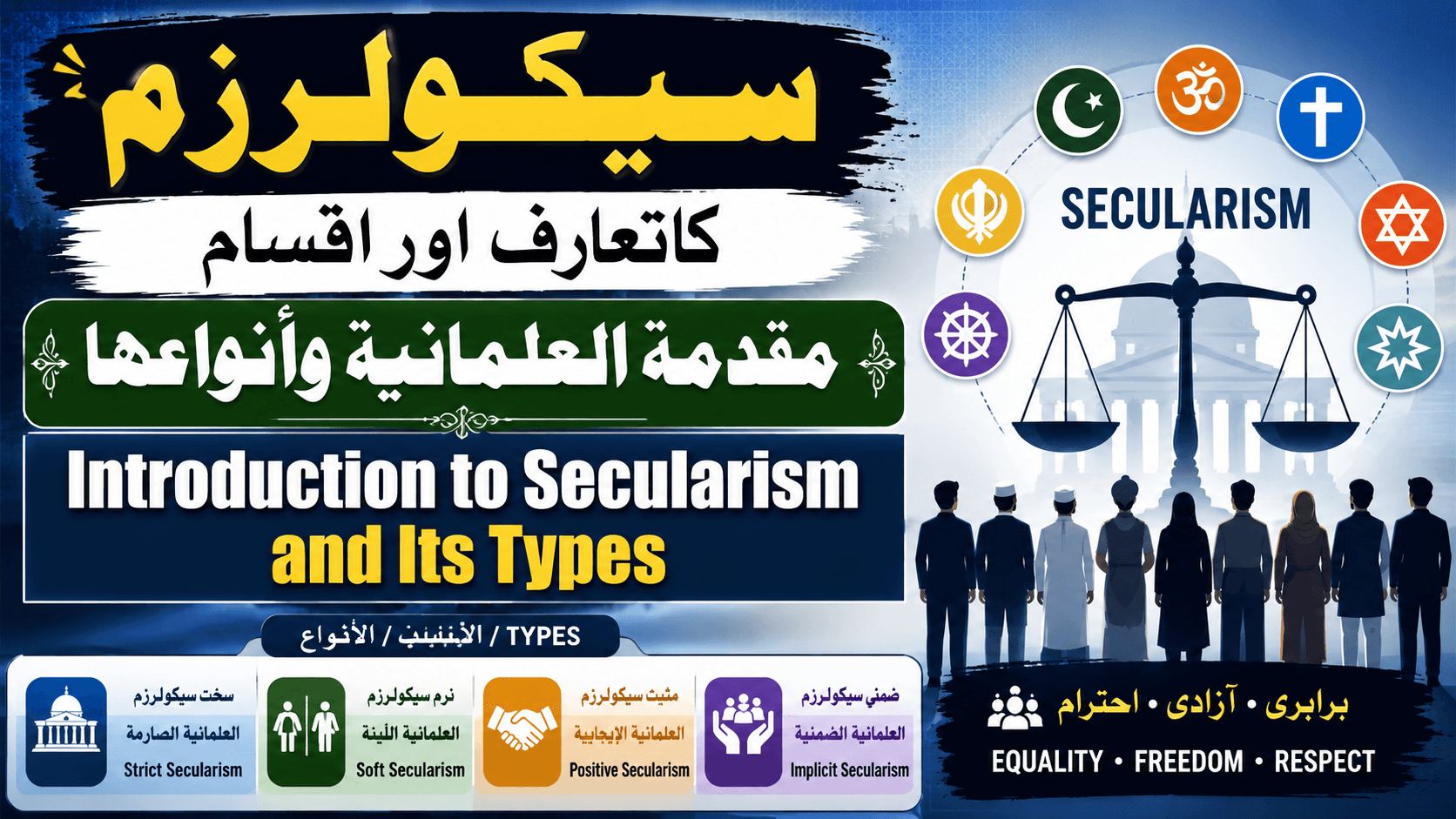
Secularism must not be understood in an emotional or superficial manner. A proper comprehension requires examining its historical background, philosophical foundations, political evolution, and practical manifestations. Secularism is not a monolithic doctrine; rather, it has assumed different meanings across various eras and societies. The secularism of France, the United States, Turkey, and India are not identical in character or application. Therefore, a balanced and scholarly study of this subject is indispensable.
Literal and Technical Definitions of Secularism
The term Secularism is derived from the Latin word Saeculum, which means “an age,” “a worldly period,” or “that which pertains to this world.” Over time, the term came to denote matters that are worldly or non-religious, particularly in contrast to ecclesiastical or sacred concerns.
According to Merriam-Webster Dictionary:
“Indifference to or rejection or exclusion of religion and religious considerations.”
In other words, secularism refers to ignoring, rejecting, or excluding religion and religious considerations from collective affairs. This definition highlights a dimension of secularism in which religion is separated from the social and political sphere. However, in contemporary academic discourse, softer interpretations of secularism also exist.
According to Encyclopaedia Britannica:
“Secularism is a worldview or political principle that separates religion from other realms of human existence, especially from the political realm.”
Here, the emphasis lies on the separation of religion and state. Religion is considered to have no authority in politics or state affairs.
The Politics of Terminology
The selection of terminology and the subtle distinctions between words carry immense importance. Through deliberate linguistic choices, entire systems can be made more palatable to the public. A clear example can be observed in the Arab world, where secularism was not directly translated according to its original implications. Instead, specific terminologies were crafted to present it in a more acceptable and positive light.
In Arabic, the term “العلمانية” became prevalent. It is pronounced in two ways: with a kasrah on the letter ‘ayn (suggesting a connection with knowledge—implying intellectualism or scientific inclination), and with a fathah (deriving from “ʿālam,” meaning worldliness). Through such linguistic framing, the system appeared constructive and enlightened, whereas in its original sense it pointed toward a non-religious or irreligious framework.
Similarly, in the Indo-Pak subcontinent, the words “secular” and “secularism” were retained in Urdu usage, while terms such as “irreligion” or their equivalents were deliberately avoided. This strategy concealed the full historical and ideological background of the system, enabling it to be perceived as merely academic or socially progressive. Thus, terminology, historical framing, and semantic nuance were employed to construct a more acceptable public image.
Historical Background of Secularism
The historical roots of secularism are deeply intertwined with Europe’s religious, political, and intellectual history. During the Middle Ages, the Church wielded extraordinary political and religious authority. The Pope and ecclesiastical institutions dominated not only spiritual life but also education, law, politics, and social structures. The Church declared its interpretations as absolute truth, and dissenters often faced severe punishment.
Within this context, a conflict emerged between science and ecclesiastical authority. The case of Galileo Galilei is particularly illustrative; he faced trial by the Church for advocating the heliocentric theory that the Earth revolves around the Sun.
This confrontation gradually entrenched in the Western mind the perception that religion was an obstacle to human progress. Consequently, the Renaissance and the Enlightenment emphasized human reason, empirical inquiry, scientific thought, and worldly advancement. Religion was increasingly separated from the various domains of life.
The First Modern Use of the Term
Although the word “secular” existed earlier, the term “secularism” in its modern sense was first used in 1851 by the British agnostic writer George Holyoake. Holyoake preferred the term “secularism” over “atheism” so that religious individuals would feel less threatened and might cooperate with the movement rather than resist it outright.
Types of Secularism
1. Political Secularism
Political secularism refers to the separation between the state and religious institutions. In this model, government, parliament, judiciary, and legislation are not subject to religious authority but operate on the basis of constitutional frameworks and popular representation.
Religion is not necessarily abolished; rather, it is separated from state power. No religious group is permitted to dominate the state, nor is any single religion forcibly imposed upon all citizens.
From an Islamic perspective, the fundamental issue concerns sovereignty. In Islam, ultimate legislative authority belongs to divine revelation, whereas in political secularism, final authority resides in the state, parliament, or popular will. Islam rejects religious coercion but does not accept the complete separation of religion from law and governance.
2. Social Secularism
Social secularism refers to a gradual decline of religious influence in collective social life. Religion becomes confined to personal rituals, ceremonies, or festivals, while education, dress, family structures, media, economy, and moral standards operate on non-religious foundations.
Even if the state is not overtly anti-religious, society may practically distance itself from religion. Religious injunctions are regarded as personal preferences rather than collective standards. This form is particularly subtle and potentially more consequential, as religion slowly shifts from the center of life to its margins. In Islam, religion encompasses not only worship but also social relations, ethics, commerce, marriage, divorce, inheritance, and politics.
3. Philosophical Secularism
Philosophical secularism represents the deepest intellectual dimension of secularism. It holds that human reason, experience, and empirical observation are the primary sources of knowledge, ethics, and law. Revelation and prophethood are not recognized as final sources of collective legislation.
Religion is often viewed as a historical, cultural, or psychological phenomenon rather than ultimate truth. Human beings determine independently what is right or wrong, lawful or unlawful.
From the Islamic viewpoint, this is where the essential conflict arises. Islam does not reject reason; rather, it considers reason a divine blessing. However, it does not deem reason self-sufficient apart from revelation. In Islamic thought, reason is a guide, but revelation remains the ultimate criterion. Philosophical secularism places humanity at the center; Islam places God as the Supreme Sovereign.
4. Hard or Assertive Secularism
Hard secularism is characterized by the state actively limiting or excluding religion from public life. Religious symbols, attire, education, or laws may be restricted in public institutions.
The French model of Laïcité is a well-known example, where restrictions have been placed on visible religious symbols such as the hijab in certain public contexts. According to this view, the public sphere must be free from religious expression.
This model is often criticized because, in the name of neutrality, it restricts religious freedom. If a woman chooses to wear the hijab and the state prohibits her, such action becomes not neutrality but interference.
5. Soft or Passive Secularism
Soft secularism does not adopt an aggressive stance against religion. It permits individuals of various faiths to practice their beliefs freely and does not impose one religion as the official authority of the state. At the same time, it does not entirely expel religion from public life.
Some Western democracies and the constitutional framework of India are often cited as examples, where equal treatment of religions is theoretically emphasized. Though relatively more accommodating than hard secularism, legislative authority ultimately rests not on revelation but on constitutional and judicial interpretation.
6. Neutral Secularism
In this form, the state presents itself as neutral in religious matters. It claims neither to support nor oppose any religion and promises equal rights to all citizens.
While this notion appears highly positive—invoking equality, justice, and civic freedom—the practical question arises: when religious law conflicts with state law, which prevails? In secular systems, state law typically takes precedence. From an Islamic perspective, neutrality ultimately elevates the state above religion as the final authority.
7. Anti-Religious Secularism
This form does not merely privatize religion but regards it as an obstacle to progress, freedom, and rationality. Religion is portrayed as backward, prejudiced, or intellectually regressive.
Often associated with atheistic or materialist ideologies, this approach seeks to weaken religious beliefs, institutions, and moral systems. From an Islamic standpoint, such a model is categorically unacceptable, as it constitutes not mere separation but an ideological struggle against faith itself.
8. Secularism as Religious Freedom
Some thinkers interpret secularism not as hostility toward religion but as a guarantor of religious freedom. According to this view, a secular state allows every individual to practice their faith and maintain their religious identity without coercion.
In this interpretation, secularism aims to ensure peaceful coexistence among diverse religions. There appears to be a superficial resemblance here to Islam’s rejection of compulsion in religion. However, the foundational difference remains: Islam grounds religious freedom in divine command and justice, whereas secularism grounds it in human rights discourse or constitutional authority.
9. Cultural Secularism
Cultural secularism refers to a transformation in which society’s culture—arts, literature, media, fashion, festivals, family structures, and moral values—becomes detached from religion. Individuals may retain a nominal religious identity while adopting non-religious or Westernized lifestyles in practice.
This form often enters societies quietly. Before laws change, tastes, language, entertainment, family concepts, and ethical sensibilities evolve. It is particularly consequential because it reshapes daily life. Once culture transforms, religion is often confined to places of worship, detached from the broader civilizational framework.
Have a question about this post?
Ask a Question
About the Author
Muhammad Awais
By the boundless grace and guidance of Allah Almighty, Muhammad Awais is associated with the noble journey of teaching, research, and writing. In his quest to quench his thirst for knowledge, he has completed the Dars-e-Nizami (Traditional Islamic Education), an MA in English, an M.Phil in Islamic Studies, and a B.Ed. Currently, he is pursuing his Ph.D. in Islamic Studies at Hazara University. The core of his academic interests primarily revolves around Islamic Sciences, Western Philosophy, contemporary intellectual discourses, Ilm al-Kalam (Islamic Scholastic Theology), and both classical and modern logic—subjects he continuously strives to comprehend more deeply and reflect upon. His association as a 'Master Trainer' with the British Council and other local institutions, coupled with his experience in competitive examinations, has acquainted him with a diverse array of academic disciplines, for which he is profoundly grateful to the Lord of Majesty. With his very limited abilities, he is making a humble effort to contribute a small share towards serving knowledge, offering intellectual guidance, and fostering an environment of positive academic dialogue. It is his heartfelt prayer that the Lord of the Worlds graciously accepts these modest and fragmented efforts in His Divine Presence, and makes this knowledge beneficial for His creation. Ameen.