
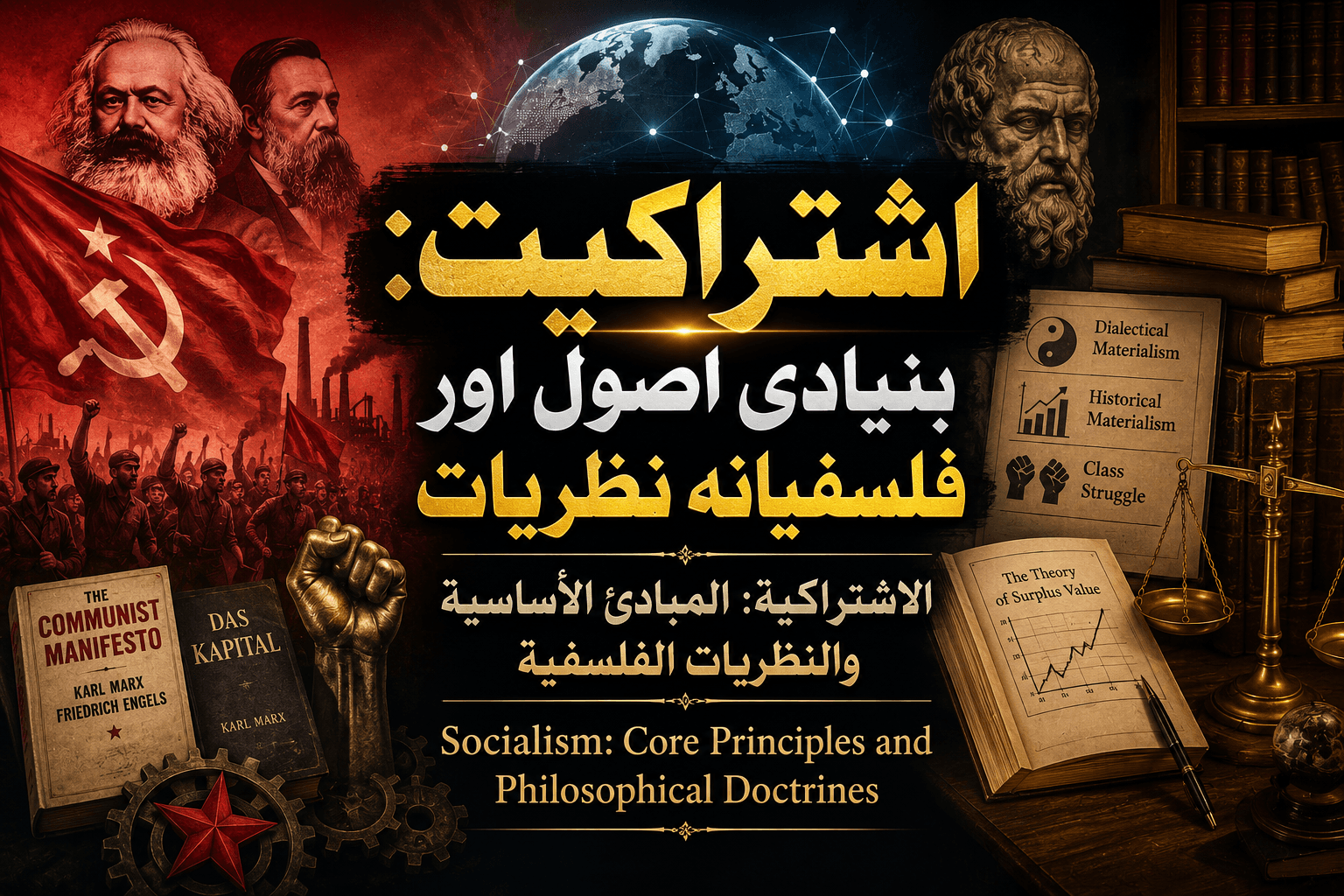
Socialism: Core Principles and Philosophical Doctrines
1. Definition
Socialism is an economic, political, and social ideology whose primary objective is to achieve a more equitable distribution of wealth, reduce economic inequality, and eliminate class divisions within society. According to socialist thought, the principal means of production—including land, industries, factories, capital, and other productive resources—should not remain the private property of a limited number of individuals. Instead, they should be collectively owned and administered by society or the state in order to prevent the concentration of wealth and ensure a more equitable distribution of economic resources among all members of society.
The revolutionary and more radical form of socialism is commonly known as Communism, a doctrine systematically developed by Karl Marx and Friedrich Engels. Communism envisions the establishment of a classless society in which private ownership of the means of production is abolished, and the distinction between capitalists and workers ultimately disappears. In such a society, all individuals are regarded as social equals, each contributing according to his or her abilities while receiving according to individual needs.
From a philosophical perspective, socialism generally understands the human being as a material and social entity whose ideas, values, beliefs, and institutions are fundamentally shaped by economic conditions and social structures. Consequently, the individual is not viewed as an entirely autonomous unit but rather as an integral part of the broader community, whose interests are ultimately subordinated to the collective welfare of society or the state. The long-term objective of socialism is therefore the creation of a classless society free from capitalist exploitation, feudal privilege, and structural economic inequality.
2. Historical Background
Modern socialism emerged in Europe during the eighteenth and nineteenth centuries as a response to the profound economic and social transformations brought about by the Industrial Revolution. Although industrialization dramatically increased productivity and economic growth, it also concentrated wealth in the hands of industrial capitalists while exposing millions of workers to extremely low wages, long working hours, and harsh living conditions. These inequalities created the intellectual and social environment in which socialist thought developed.
Utopian Socialism
Before the rise of Karl Marx, several reformers, including Robert Owen, Henri de Saint-Simon, and Charles Fourier, proposed models of society based on cooperation, social justice, and the fair distribution of wealth. Their proposals were largely ethical and humanitarian in nature, lacking a comprehensive philosophical framework or a practical strategy for revolutionary social transformation. For this reason, their ideas became known collectively as Utopian Socialism.
Scientific Socialism
During the nineteenth century, Karl Marx and Friedrich Engels transformed socialism into a systematic philosophical and economic doctrine. In 1848 they published The Communist Manifesto, followed later by Marx's monumental work Das Kapital, in which he offered a comprehensive critique of the capitalist economic system. According to Marx, the driving force of human history is the struggle between competing social classes, rooted in changing economic conditions and modes of production. He argued that capitalism contains inherent contradictions that would eventually lead to its collapse and pave the way for the emergence of socialism.
Practical Implementation
The first large-scale implementation of socialist principles occurred in 1917 following the Bolshevik Revolution under the leadership of Vladimir Lenin, resulting in the establishment of the Soviet Union, the world's first socialist state. During the twentieth century, socialist governments also emerged in China, Cuba, North Korea, Vietnam, and several Eastern European countries. However, the dissolution of the Soviet Union in 1991 and the collapse of most socialist regimes in Eastern Europe raised fundamental questions regarding the long-term viability and practical sustainability of the socialist model.
3. Core Principles
The intellectual foundation of socialism rests upon a number of interconnected philosophical and economic principles that collectively define its theoretical framework. Among the most significant are the following:
Dialectical Materialism
Dialectical Materialism maintains that matter constitutes the ultimate reality of the universe and that all natural and social phenomena evolve through an ongoing process of internal contradiction and conflict. According to this theory, historical and social change occurs through the interaction of opposing forces, each stage giving rise to a new stage of development. Consequently, metaphysical concepts such as the soul, divine revelation, and the existence of God are not regarded as essential explanatory principles; rather, reality is interpreted exclusively through material laws and processes.
Historical Materialism
According to Karl Marx, the driving force behind human history is neither religion nor moral ideals, but the economic conditions and modes of production that characterize each historical period. Political institutions, legal systems, cultural values, religious beliefs, and social structures are viewed as reflections of the underlying economic base of society. In this sense, economic forces constitute the primary engine of historical development.
Class Struggle
Class struggle occupies a central position in socialist theory. Marx argued that the entire history of human civilization is fundamentally a history of conflict between those who own the means of production—the bourgeoisie—and those who possess only their labor power—the proletariat. This continuing struggle between opposing economic classes is regarded as the principal force driving historical transformation and social change.
Theory of Surplus Value
Marx maintained that the true value of every commodity originates from the labor invested in its production. However, under capitalism, workers receive only a portion of the value they create, while the capitalist appropriates the remaining portion as profit. Marx described this difference as surplus value, arguing that capitalist profit is fundamentally derived from the exploitation of labor rather than from productive contribution alone.
Abolition of Private Property
Socialist theory identifies private ownership of the means of production as the principal source of economic inequality and class exploitation. Consequently, it advocates transferring ownership of land, industries, factories, capital, and other productive assets from private individuals to the state or to collective ownership in order to promote economic justice and prevent the concentration of wealth in the hands of a privileged minority.
Dictatorship of the Proletariat
Marx argued that the transition from capitalism to socialism requires an intermediate revolutionary phase known as the Dictatorship of the Proletariat. During this transitional period, political power would be exercised by the working class to dismantle capitalist institutions, eliminate bourgeois dominance, and reorganize society along socialist lines. This stage was viewed as a temporary process leading ultimately to the establishment of a fully communist society in which both social classes and the state itself would eventually disappear.
Have a question about this post?
Ask a Question
About the Author
Muhammad Awais
By the boundless grace and guidance of Allah Almighty, Muhammad Awais is associated with the noble journey of teaching, research, and writing. In his quest to quench his thirst for knowledge, he has completed the Dars-e-Nizami (Traditional Islamic Education), an MA in English, an M.Phil in Islamic Studies, and a B.Ed. Currently, he is pursuing his Ph.D. in Islamic Studies at Hazara University. The core of his academic interests primarily revolves around Islamic Sciences, Western Philosophy, contemporary intellectual discourses, Ilm al-Kalam (Islamic Scholastic Theology), and both classical and modern logic—subjects he continuously strives to comprehend more deeply and reflect upon. His association as a 'Master Trainer' with the British Council and other local institutions, coupled with his experience in competitive examinations, has acquainted him with a diverse array of academic disciplines, for which he is profoundly grateful to the Lord of Majesty. With his very limited abilities, he is making a humble effort to contribute a small share towards serving knowledge, offering intellectual guidance, and fostering an environment of positive academic dialogue. It is his heartfelt prayer that the Lord of the Worlds graciously accepts these modest and fragmented efforts in His Divine Presence, and makes this knowledge beneficial for His creation. Ameen.