
The Big Bang: What Does Science Say, and What Do Atheists Think It Means?
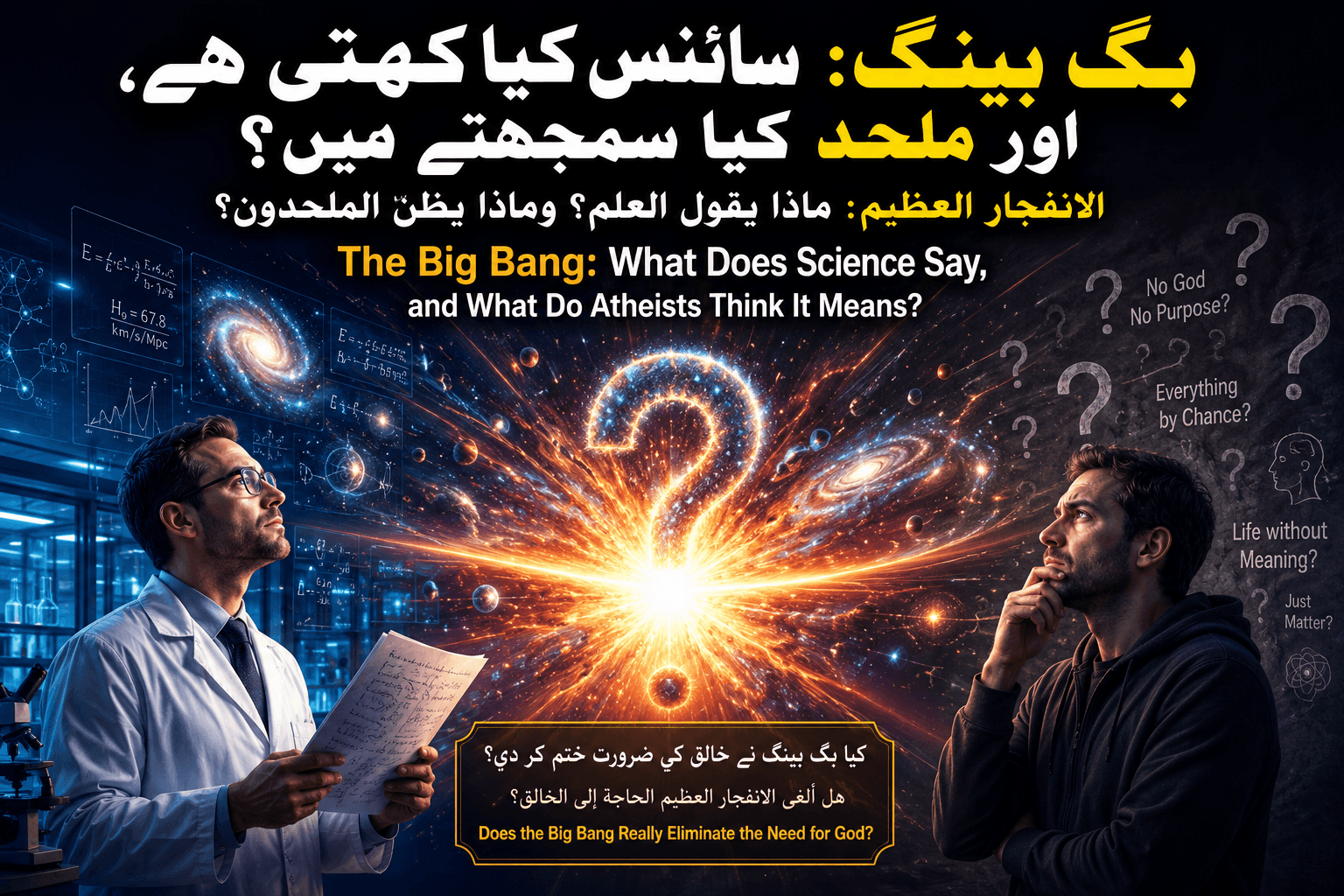
Today, whenever the existence of God is discussed with young people, two terms almost inevitably appear: the Big Bang and evolution. Many have come to believe that once the Big Bang theory was proposed, belief in a Creator became unnecessary. Across social media, YouTube, and various atheist platforms, it is often claimed that science has demonstrated that the universe came into existence on its own, making the idea of a Creator obsolete.
This impression has become so widespread that many people now accept it as an unquestionable scientific fact.
(1) But Did Science Really Say That?
This is the fundamental question that deserves careful consideration.
The first mistake many people make when discussing this subject is confusing science with atheism, even though the two belong to entirely different domains.
Science is a method of inquiry. It seeks to understand how the universe works through observation, experimentation, mathematical models, and empirical evidence.
Atheism, on the other hand, is a philosophical position concerning the existence of God. It is not a scientific theory, nor is it a conclusion produced by the scientific method.
Confusing these two domains is an intellectual error. Scientific findings should not be transformed into philosophical conclusions without independent philosophical justification.
(2) What Is the Big Bang Theory?
Contrary to a common misconception, the Big Bang theory does not claim that the universe exploded like a bomb in empty space.
Rather, it proposes that the observable universe originated from an extremely hot, extremely dense initial state and has been expanding ever since. This expansion is supported by several well-established observations, including the recession of galaxies, the Cosmic Microwave Background (CMB), and the observed abundance of light elements throughout the universe.
In other words, the Big Bang is a scientific model describing the evolution of the universe from its earliest observable stages to its present form.
However, one crucial point must not be overlooked:
The Big Bang theory does not explain why the universe exists, nor does it prove that the universe came into existence by itself.
(3) Where Do Some Atheists Go Wrong?
Some atheists argue that because the Big Bang describes the beginning of the universe, belief in God is no longer necessary.
From a logical standpoint, however, this conclusion does not follow.
Imagine that an engineer successfully reconstructs every stage in the construction of a magnificent building. He explains the materials, the architectural design, and the sequence of construction in complete detail.
Would this prove that the building had no architect?
Certainly not.
Likewise, even if science explains how rapidly the universe expanded, what its temperature was, and how matter formed during its earliest moments, it does not logically follow that there was no Creator behind the entire system.
Explaining a process is not the same as explaining its ultimate cause.
Science Answers "How," Not "Why"
This distinction is both subtle and fundamental.
Science asks:
"How did this happen?"
Philosophy asks:
"Why does it exist in the first place?"
For example, science can explain how rain forms through evaporation, cloud formation, condensation, and atmospheric pressure.
But if we ask why the laws of nature exist in such a way that rain is even possible, we have moved beyond empirical science into the realm of philosophy and metaphysics.
The same applies to the Big Bang.
It attempts to explain how the universe evolved—but it does not answer the question of why the universe exists at all or what its ultimate cause may be.
(4) Is "It Happened by Itself" a Scientific Explanation?
A frequently repeated claim is:
"The universe came into existence by itself."
But this immediately raises another question:
What exactly does "by itself" mean?
If it means that the universe came into existence without any cause whatsoever, then the claim conflicts with one of the most fundamental principles of rational thought—the Principle of Causality, which holds that every contingent event requires an adequate explanation.
If, instead, it is argued that the laws of physics created the universe, another question naturally follows:
Where did those laws themselves come from?
A law does not create anything.
A law merely describes how things behave once they exist.
For example, the law of gravity does not create an apple; it simply explains why an existing apple falls toward the ground.
(5) Is the Big Bang Evidence Against God?
If we approach the issue strictly from a scientific perspective, the answer is clear:
No.
The Big Bang theory does not disprove the existence of God.
It merely provides a physical description of the universe's earliest observable state and its subsequent expansion.
This is precisely why many of the world's most distinguished physicists and cosmologists have accepted the Big Bang theory while also believing in God.
The reason is simple:
The Big Bang theory, by itself, does not compel any particular philosophical conclusion.
It neither proves atheism nor proves theism.
It is a scientific model describing the physical history of the universe.
Whether the universe ultimately requires a Creator is a philosophical and metaphysical question—one that lies beyond the scope of the scientific method itself.
Have a question about this post?
Ask a Question
About the Author
Muhammad Awais
By the boundless grace and guidance of Allah Almighty, Muhammad Awais is associated with the noble journey of teaching, research, and writing. In his quest to quench his thirst for knowledge, he has completed the Dars-e-Nizami (Traditional Islamic Education), an MA in English, an M.Phil in Islamic Studies, and a B.Ed. Currently, he is pursuing his Ph.D. in Islamic Studies at Hazara University. The core of his academic interests primarily revolves around Islamic Sciences, Western Philosophy, contemporary intellectual discourses, Ilm al-Kalam (Islamic Scholastic Theology), and both classical and modern logic—subjects he continuously strives to comprehend more deeply and reflect upon. His association as a 'Master Trainer' with the British Council and other local institutions, coupled with his experience in competitive examinations, has acquainted him with a diverse array of academic disciplines, for which he is profoundly grateful to the Lord of Majesty. With his very limited abilities, he is making a humble effort to contribute a small share towards serving knowledge, offering intellectual guidance, and fostering an environment of positive academic dialogue. It is his heartfelt prayer that the Lord of the Worlds graciously accepts these modest and fragmented efforts in His Divine Presence, and makes this knowledge beneficial for His creation. Ameen.