
The Intellectual Evolution of Humanism: Introduction, Historical Background, and Contemporary Context
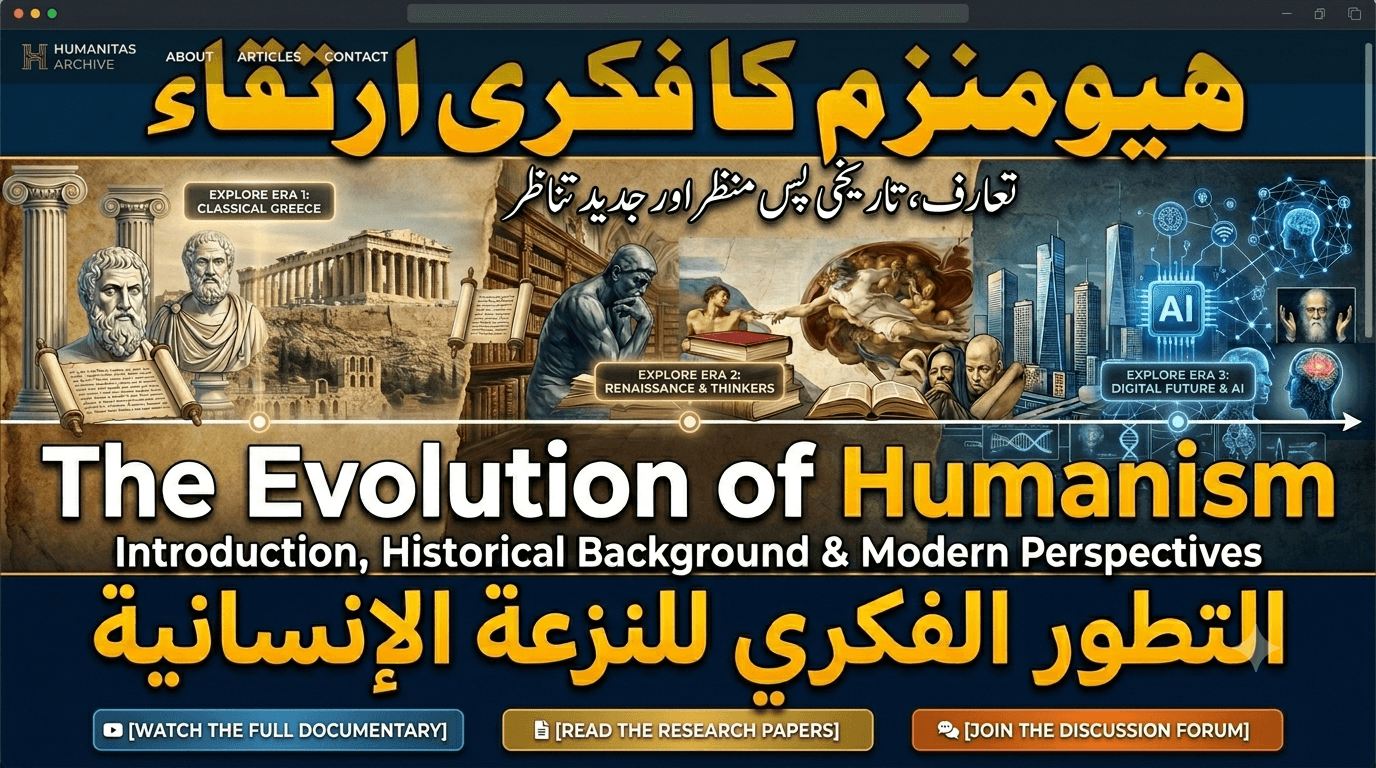
Humanism is based on a fundamental claim: that human beings, through their reason, experience, and moral consciousness, are capable of constructing the meaning of life on their own. In this conception, the individual is invited to rely on his own awareness and understanding rather than any external metaphysical authority.
The term "humanism" is generally translated in Urdu as “anthropocentrism” or “a system of thought based on human-centered values.” The word “Human” refers to the human being, while the suffix “ism” indicates an ideological or conceptual system. Thus, Humanism refers to a system of thought in which the human being occupies a central position.
First Use of the Term Humanism
It is important to understand that "humanism" is neither an ancient Greek nor a medieval term. Rather, it was formed in a later intellectual period. Its formal conceptual shape emerged at the beginning of the nineteenth century when the German educational scholar Friedrich Immanuel Niethammer used the term "Humanismus" in 1808 within an educational discourse.
Initially, this term was not associated with religion or philosophical atheism; rather, it referred to an educational system based on classical Greek and Latin literature. The aim of this system was to enhance the intellectual, moral, and literary development of human beings.
During the Renaissance period, teachers and scholars who taught classical languages and literature were called Humanista. However, they did not consider themselves part of a movement called Humanism. Later, their intellectual tendencies were collectively described under this broader term. Thus, the word emerged later, but its intellectual elements had existed much earlier.
Definition of Humanism
Humanism has been defined differently across intellectual traditions. However, all definitions share a common point: the centrality of human reason, morality, and autonomy.
According to the American Humanist Association:
“Humanism is a progressive philosophy of life that, without theism or other supernatural beliefs, affirms our ability and responsibility to lead ethical lives of personal fulfillment that aspire to the greater good.”
This definition implies that Humanism is a progressive intellectual system which, even without religious or supernatural beliefs, recognizes human beings as morally responsible, purposeful, and actively engaged in the pursuit of social good.
In general philosophical tradition, Humanism is described as the theory that allows human beings to construct reality, morality, and meaning based on reason, experience, and critical consciousness. It does not consider any external divine revelation or metaphysical source as a necessary condition.
This definition particularly represents modern secular Humanism, in which human beings are considered autonomous moral agents.
Historical Background and Intellectual Evolution
Humanism did not emerge in a single moment; rather, it is the result of thousands of years of intellectual development. Its history is spread across different eras, each of which influenced its meaning in some way.
First Phase: Pre-Greek Intellectual Era
(3000 BCE – 600 BCE)
In ancient Eastern civilizations such as Egypt, Mesopotamia, and Persia, human life was entirely governed by a religious order. Law, ethics, and knowledge were all attributed to gods or divine forces. Human beings were considered responsible servants within a cosmic system, but not creators or independent authorities of it.
In this period, concepts of dignity and justice certainly existed, but they were always expressed within a religious framework. The human being was never regarded as an independent intellectual center.
Second Phase: Classical Greek Era
(5th – 4th Century BCE)
This was the period in which a fundamental transformation began in human thought. Mythological narratives and traditional explanations were gradually replaced by philosophical reasoning.
Protagoras declared that man is the measure of all things, which clearly reflects the idea of human centrality. Socrates directed attention toward moral self-examination and emphasized that an unexamined life is not worth living. Plato attempted to understand reality at a rational and metaphysical level, while Aristotle defined man as a “rational animal,” highlighting reason as his defining feature.
In this era, religion was not completely rejected; rather, an effort was made to balance reason and tradition.
Third Phase: Greco-Roman and Early Christian Era
(1st Century BCE – 5th Century CE)
In Roman civilization, practical ethics, law, and state order were highly valued. However, with the rise of Christianity, the intellectual center shifted back to God.
Augustine of Hippo described human beings as sinful and entirely dependent on divine grace. According to this view, salvation was only possible through divine assistance. Consequently, human autonomy weakened, and theological centrality became dominant.
Fourth Phase: Renaissance Humanism
(14th – 16th Century CE)
This was a period of intellectual revival and educational reform in Europe. Against ecclesiastical rigidity and intellectual restriction, a scholarly movement emerged that rediscovered human creative potential.
Francesco Petrarch is considered the founder of this movement because he revived interest in classical Greek and Roman literature and highlighted human intellectual dignity. Erasmus emphasized religious reform, education, and moral consciousness.
This period was not a rejection of religion but rather a phase of institutional reform and intellectual freedom.
Fifth Phase: Enlightenment Humanism
(17th – 18th Century CE)
In this era, human reason came to be considered the ultimate standard. Religious authority was challenged, and individual freedom was placed at the center.
Voltaire strongly criticized religious intolerance and oppression. Immanuel Kant argued that human beings possess the capacity to formulate moral laws through their own reason.
For the first time, human beings appeared as fully autonomous intellectual entities.
Sixth Phase: Modern Secular Humanism
(19th – 20th Century CE)
At this stage, Humanism became fully separated from religious frameworks.
Ludwig Feuerbach described God as a projection of the human mind. Karl Marx viewed religion as a product of social and economic structures. Friedrich Nietzsche declared that “God is dead,” a statement often interpreted as a symbol of modern intellectual autonomy.
In this period, human beings were regarded not only as agents but also as the ultimate standard of morality.
Seventh Phase: Contemporary Era
(21st Century – Present)
In the contemporary era, Humanism is no longer merely a philosophical theory; it has become a broad intellectual system, ethical language, and cultural framework. While earlier it was largely limited to philosophy and academic discourse, today it is deeply embedded in politics, law, human rights, education, media, and international institutions. At this stage, Humanism has evolved from a “pure theoretical form” into an active cultural force.
Modern Humanism is based on the idea that human beings are the creators of their own meanings, morals, and values. It does not consider supernatural authority as a necessary standard. According to this view, human beings can develop a better ethical system through reason, scientific experience, and collective deliberation.
In this era, Humanism revolves around three major concepts:
1) Human Freedom
2) Human Rights
3) Moral Autonomy
These three principles form the foundation of the modern global system, and the intellectual spirit of Humanism operates behind them.
Humanism and Secularism
In the contemporary world, Humanism is closely linked with secularism. In secular state systems, religion is separated from state affairs, and legislation is based on human reason, social necessity, and universal ethical principles.
Humanism provides a philosophical justification for the idea that:
1) Ethical systems can exist without religion
2) State laws can be based on human experience and reason
3) Religion is a personal matter, not the foundation of public systems
Thus, in modern state models, Humanism functions as a silent intellectual foundation.
Humanism and Liberalism
The relationship between Humanism and liberalism is deeply interconnected. Modern liberal thought places individual freedom, the right of choice, and personal autonomy at the center of value systems. Humanism provides the philosophical basis for the idea that human beings are fully autonomous in making decisions about their lives.
Under this conception:
1) Freedom of the individual is considered the highest political value
2) Traditional religious or moral restrictions are considered secondary
3) Every individual has the right to define their identity and lifestyle
Thus, Humanism and liberalism reinforce each other and form the intellectual foundation of modern Western civilization.
Modern Atheism and Agnostic Thought
In the contemporary world, Humanism is widely used in non-religious and secular intellectual traditions. Many atheistic and agnostic thinkers present Humanism as an alternative ethical system.
According to this view:
1) Moral principles can be constructed without religion
2) Human beings can define good and evil independently
3) Human reason and experience can replace religion
Therefore, Humanism is sometimes used as an intellectual shield through which alternative moral systems are presented in response to religious arguments.
Humanism in International Institutions
In the modern global order, Humanism is reflected in the language and policies of various international institutions. For example, the American Humanist Association promotes Humanism as a complete philosophy of life in which ethical living without religious belief is considered possible.
Similarly, concepts within the United Nations human rights framework also align with ideas of human centrality and autonomy.
Science and Humanism
In the 21st century, scientific advancement has further strengthened Humanism. Fields such as biotechnology, artificial intelligence, genetics, and neuroscience have opened new possibilities for understanding and transforming human nature. In this environment, the belief has become stronger that human beings can reshape their destiny and even aspects of their nature.
Modern Humanism is a broad intellectual umbrella containing different tendencies, yet despite this diversity, one element remains constant: the centrality and autonomy of the human being.
Have a question about this post?
Ask a Question
About the Author
Muhammad Awais
By the boundless grace and guidance of Allah Almighty, Muhammad Awais is associated with the noble journey of teaching, research, and writing. In his quest to quench his thirst for knowledge, he has completed the Dars-e-Nizami (Traditional Islamic Education), an MA in English, an M.Phil in Islamic Studies, and a B.Ed. Currently, he is pursuing his Ph.D. in Islamic Studies at Hazara University. The core of his academic interests primarily revolves around Islamic Sciences, Western Philosophy, contemporary intellectual discourses, Ilm al-Kalam (Islamic Scholastic Theology), and both classical and modern logic—subjects he continuously strives to comprehend more deeply and reflect upon. His association as a 'Master Trainer' with the British Council and other local institutions, coupled with his experience in competitive examinations, has acquainted him with a diverse array of academic disciplines, for which he is profoundly grateful to the Lord of Majesty. With his very limited abilities, he is making a humble effort to contribute a small share towards serving knowledge, offering intellectual guidance, and fostering an environment of positive academic dialogue. It is his heartfelt prayer that the Lord of the Worlds graciously accepts these modest and fragmented efforts in His Divine Presence, and makes this knowledge beneficial for His creation. Ameen.