
The Soul and Science: Correcting a Common Misconception
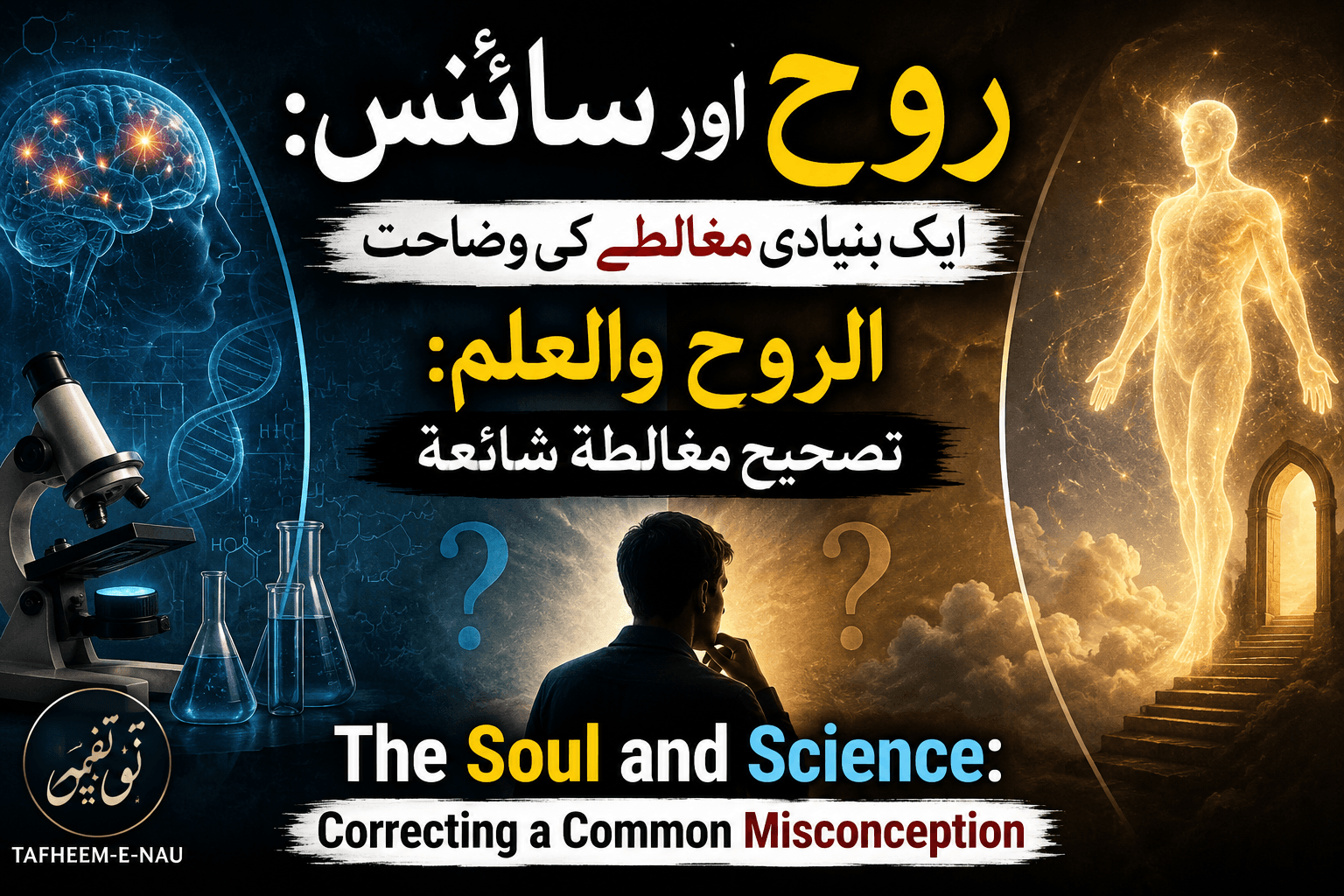
When discussing the relationship between the soul and science, the first and most important point to understand is that science and the soul do not belong to the same domain of knowledge. They address fundamentally different kinds of questions. Modern science is built upon observation, experimentation, measurement, and empirical verification. Its conclusions are limited to phenomena that can be observed, tested, measured, and repeatedly verified. The soul, however, has traditionally been understood—by virtually all major religious traditions and by many philosophers—as a non-material reality. If something is, by its very nature, beyond material observation, expecting science to prove or disprove its existence is not a scientific demand; it is a misunderstanding of what science is designed to do.
Consider a simple analogy. Imagine someone holding a metal detector and searching an entire garden for valuable objects. After scanning every corner, the device fails to detect a diamond, a piece of glass, or a wooden sculpture. The person then confidently concludes, "There is nothing valuable in this garden." Would such a conclusion be reasonable? Certainly not. The device was designed only to detect metals. Its inability to detect diamonds, wood, or glass does not prove that these objects do not exist; it merely demonstrates that they lie outside the instrument's range of detection. The limitation belongs to the instrument, not to reality itself.
The same principle applies to the relationship between science and the soul. Science is an extraordinarily powerful method for investigating the physical universe, but it is not a universal instrument capable of explaining every aspect of reality. It studies matter, energy, the brain, the nervous system, and the laws governing nature. But if the soul is genuinely non-material, then searching for it under a microscope or attempting to measure it with laboratory equipment is as misplaced as trying to weigh justice on a scale, measure love with a thermometer, or calculate beauty with a ruler. The problem is not the existence of the soul; the problem is using the wrong tool to investigate it.
For this reason, when someone claims that "science has disproved the soul," they are not presenting a scientific conclusion but rather a philosophical assertion disguised as science. Science has never conducted an experiment whose conclusion was, "The soul does not exist." At most, science can say that the soul cannot currently be examined using empirical methods. These are two fundamentally different statements. Saying, "We cannot detect it with scientific instruments," is not equivalent to saying, "It does not exist." Confusing these two claims is both a logical and methodological error.
What makes this discussion even more fascinating is that modern science itself continues to struggle with some of the deepest questions about human existence. Concepts such as consciousness, free will, subjective experience, and personal identity remain among the greatest unsolved mysteries in both neuroscience and the philosophy of mind. Neuroscience can identify which regions of the brain become active during perception, memory, language, or decision-making. It can describe electrical impulses, chemical neurotransmitters, and neural networks with remarkable precision. Yet it still cannot answer the most profound question: How does physical brain activity give rise to conscious experience? Why does a pattern of neural firing produce the feeling of pain, the experience of joy, the appreciation of beauty, or the awareness of one's own existence? This challenge—often called the Hard Problem of Consciousness—remains one of the most significant unresolved questions in contemporary philosophy and science.
Intellectual honesty therefore requires us to recognize both the power and the limits of science. Science is humanity's most reliable method for understanding the material world, but not every meaningful question is a scientific one. Questions concerning the soul, the ultimate purpose of existence, moral values, consciousness, and the existence of God belong largely to the domains of philosophy and metaphysics, where different methods of reasoning and inquiry apply.
Consequently, the statement "Science has not proven the existence of the soul; therefore, the soul does not exist" is no more logical than saying, "A telescope has never observed justice; therefore, justice does not exist," or "A thermometer cannot measure love; therefore, love is an illusion." Every discipline has its own subject matter, every question requires the appropriate method of investigation, and no single tool—no matter how sophisticated—can be expected to uncover every dimension of reality. Science is an extraordinary window into the physical universe, but it is not the only window through which truth may be discovered.
Have a question about this post?
Ask a Question
About the Author
Muhammad Awais
By the boundless grace and guidance of Allah Almighty, Muhammad Awais is associated with the noble journey of teaching, research, and writing. In his quest to quench his thirst for knowledge, he has completed the Dars-e-Nizami (Traditional Islamic Education), an MA in English, an M.Phil in Islamic Studies, and a B.Ed. Currently, he is pursuing his Ph.D. in Islamic Studies at Hazara University. The core of his academic interests primarily revolves around Islamic Sciences, Western Philosophy, contemporary intellectual discourses, Ilm al-Kalam (Islamic Scholastic Theology), and both classical and modern logic—subjects he continuously strives to comprehend more deeply and reflect upon. His association as a 'Master Trainer' with the British Council and other local institutions, coupled with his experience in competitive examinations, has acquainted him with a diverse array of academic disciplines, for which he is profoundly grateful to the Lord of Majesty. With his very limited abilities, he is making a humble effort to contribute a small share towards serving knowledge, offering intellectual guidance, and fostering an environment of positive academic dialogue. It is his heartfelt prayer that the Lord of the Worlds graciously accepts these modest and fragmented efforts in His Divine Presence, and makes this knowledge beneficial for His creation. Ameen.