
Why Do We Worship Allah?
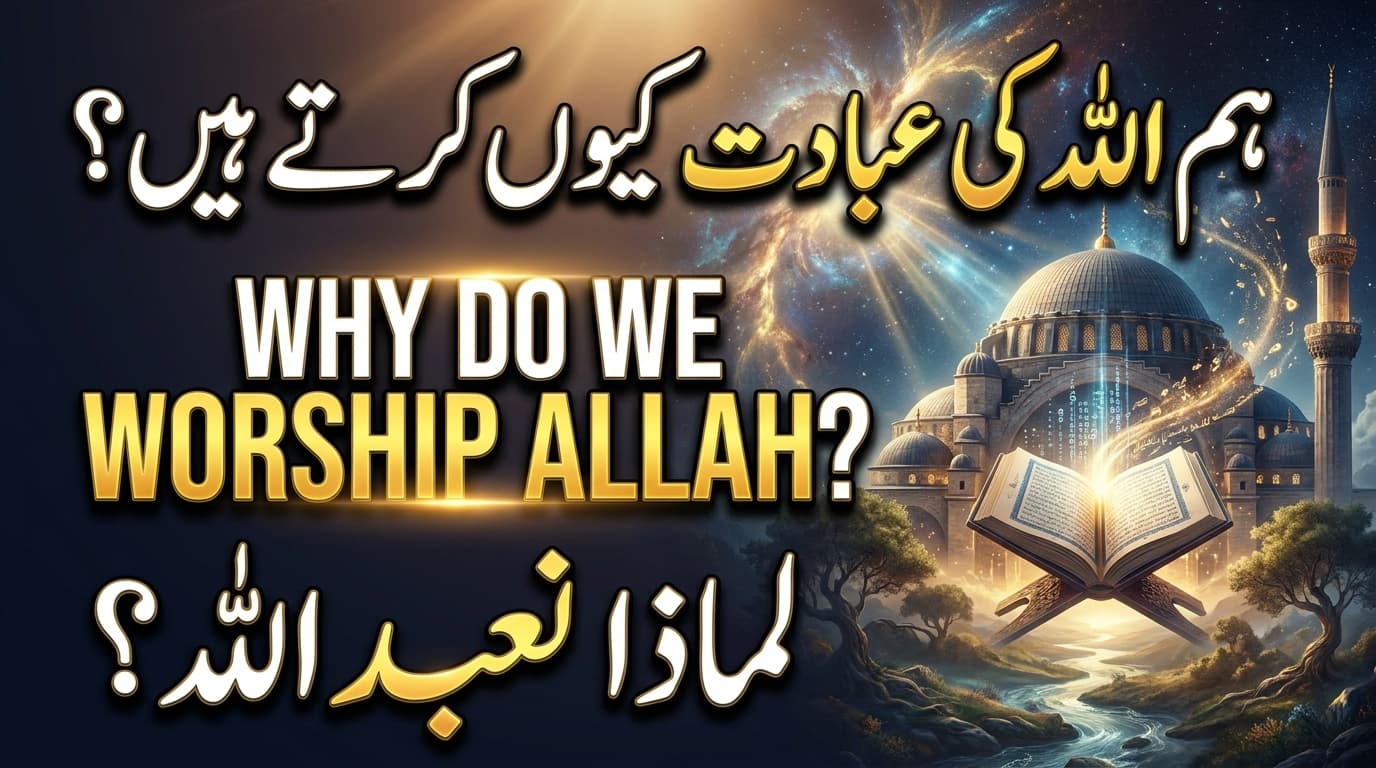
Have you ever sat in solitude and wondered why humans pray or bow down before God? Most people perceive worship merely as a collection of traditional rituals, or assume it to be nothing more than a repayment for the blessings we receive in this world. However, if we step outside conventional religious frameworks and analyze this question through the scales of profound reason, human psychology, and existential philosophy, it takes on an entirely different dimension. In the light of theological thought (Kalam), God’s worthiness of worship is not a matter of blind faith, but an inescapable demand of pure reason and logic.
1. The Unsolicited Gift of Life and the Rational Demand of Conscience
There is a foundational and universal law of human conscience: when someone gives you a valuable gift, your inner moral being naturally demands that you be grateful. Now, apply this law to your own self. This life, this consciousness, and the entire spectacle of the universe are priceless gifts being bestowed upon us every single moment without any cost or effort on our part—even though we neither performed prior labor to earn them nor are we their actual owners.
To grasp this, consider a simple yet jarring example: if a person were to discover that they had only a few hundred heartbeats left, they would be willing to stake their lifetime earnings, property, and all material wealth just to secure a few more moments of life. When this unsolicited life is so extraordinarily precious that we cannot purchase a single moment of it even by surrendering our entire world, then bowing in gratitude before its Giver—which is the true essence of worship—becomes a purely rational and moral demand.
2. The Definition of God: Worship is Not a Commercial Contract
Many people view the relationship between God and man as a commercial transaction, as if He were a 'business partner' whom we provide with acts of worship so that He, in return, may grant us blessings. This conception is utterly absurd. The reality is that being worthy of worship is an intrinsic and mandatory part of the very definition of God.
To illustrate, the definition of the sun is incomplete without light, and the definition of honey cannot be separated from its sweetness. In precisely the same way, the absolute perfection of Allah’s attributes naturally demands that He be inherently worthy of servitude and praise. Even if this Supreme Being of the universe were not to grant us a single particle of the heavens and the earth, He—by virtue of His intrinsic majesty, eternal perfection, and glory—alone remains worthy of having His praise and glorification proclaimed.
3. The Worship of Perfection and the Truth of Human Psychology
We humans are naturally admirers and worshipers of perfection (Kamal). When we hear the extraordinary poetry of a poet, witness the astonishing skill of an athlete, or behold the masterpiece of an artist, we spontaneously offer praise, utter words of admiration, and find ourselves compelled to give a standing ovation. This is an innate inclination of human psychology.
Yet, pause here for a moment and reflect:
· Are those human beings whose perfection we are infatuated with truly perfect? No, they themselves are incomplete, flawed, and their capabilities are extremely limited.
· What, then, about the Being who Himself endowed these humans with such talents, who brought human consciousness into existence, and who established the magnificent balance of the awe-inspiring and intricate laws of the universe? Being entirely pure from all deficiency and decline, how much more is He entitled to the ultimate grandeur (Allahu Akbar) and true adoration?
4. Al-Wadud: The Source of Pure and Disinterested Love
Man fundamentally loves his own self; he remains a seeker of happiness and flees from anything that causes him pain or distress. Basing his argument on this very human psychology, Imam al-Ghazali presents an unparalleled rational point. He states that if you truly love your own self, you must necessarily love Allah, because your own existence and all the material and immaterial causes of your happiness are solely created by Him.
One of Allah’s attributive names is Al-Wadud—The Affectionate, the One who loves deeply and purely. Behind all worldly love, there lies some hidden motive, psychological need, or material interest; however, Allah’s love is entirely disinterested (altruistic), because His Essence can neither benefit from our love and worship nor be harmed by our neglect. The inclination of the heart toward such an unconditional and sincere Being is a natural and rational process.
5. The Journey from Psychological Slavery to True Freedom
The structure of the human soul is such that it cannot exist without bowing before something, without acknowledging some entity as its absolute sovereign. This is the 'nature' (Fitrah) of man. If a person refuses to submit before the true Master of the universe, they subconsciously place the noose of slavery to their own ego, wealth, social status, fame, or other mortal humans around their neck.
The Holy Quran presents a profound parable of this psychological dilemma: on one hand is a slave owned by multiple quarreling partners who constantly contend with one another (symbolizing man's conflicting and unbridled desires), and on the other hand is a slave who belongs entirely to one kind, clear master. Man’s true freedom is actually hidden within his becoming a servant of Allah (Ubudiyyah), because this servitude liberates him forever from every minor or major cognitive, material, and psychological slavery of the world.
6. Sound Intellect and Obedience to the Ultimate Authority
In our daily lives, we unhesitatingly follow the advice of experts in various fields. If our health is failing, we use the prescription written by a doctor without cross-examination, and during a flight, we place complete trust in the pilot’s instructions, because we believe in their knowledge and authority.
Under this common rational principle, bowing before the Being who brought this entire universe into existence from sheer non-existence—and whose knowledge and wisdom are absolute and perfect—is the most logical and intellectual form of servitude. He is not in need of our worship; rather, we ourselves are in need of His grace at every moment, and He created us precisely so that we may perceive and experience His boundless mercy.
Conclusion
Worship of Allah is not a burden, tax, or duty forcefully imposed upon man; rather, it is the acknowledgment of the true reality of our own existence, an enthusiastic thanksgiving for His infinite and priceless blessings, and the ultimate tranquility of the human soul that can never be found in any other mortal thing of this world. The final verdict of reason is that upon witnessing this magnificent and integrated design of the cosmos, one must sincerely acknowledge servitude before its Grand Designer. As Allama Iqbal beautifully expressed this philosophy in his immortal style:
وہ ایک سجدہ جسے تو گراں سمجھتا ہے
ہزار سجدے سے دیتا ہے آدمی کو نجات!
[That single prostration which you deem a heavy burden, liberates man from a thousand other prostrations!]
Have a question about this post?
Ask a QuestionAbout the Author
Dr. Mufti Muhammad Ibrahim
Dr. Mufti Muhammad Ibrahim is a distinguished Islamic scholar, jurist, and researcher known for integrating traditional Islamic scholarship with modern academic standards. He completed his Dars-e-Nizami (Shahadat-ul-Alamia) from Jamia Darul Uloom Karachi and specialized in Islamic Jurisprudence (Fiqh) at Darul Iftaa Makki Masjid, Mansehra, where he has been serving as an Assistant Mufti for over a decade. He holds a Ph.D. in Islamic Studies from the University of Haripur, secured top position in M.Phil, and earned a Gold Medal in M.A. Islamiat. He also holds degrees in M.Sc. Pakistan Studies and B.A. English Literature. Dr. Ibrahim is an HEC-approved Ph.D. supervisor, with numerous postgraduate researchers completing their work under his supervision. He has authored over 30 research papers and several academic books. His research focuses on Quran and Hadith studies, as well as addressing modern intellectual challenges, particularly atheism. Through the platform "Tafheem-e-Nau," he actively engages in presenting reasoned responses to contemporary ideological questions.