
Ali Dashti's Book "23 Years" on the Seerah: A Literary Deception
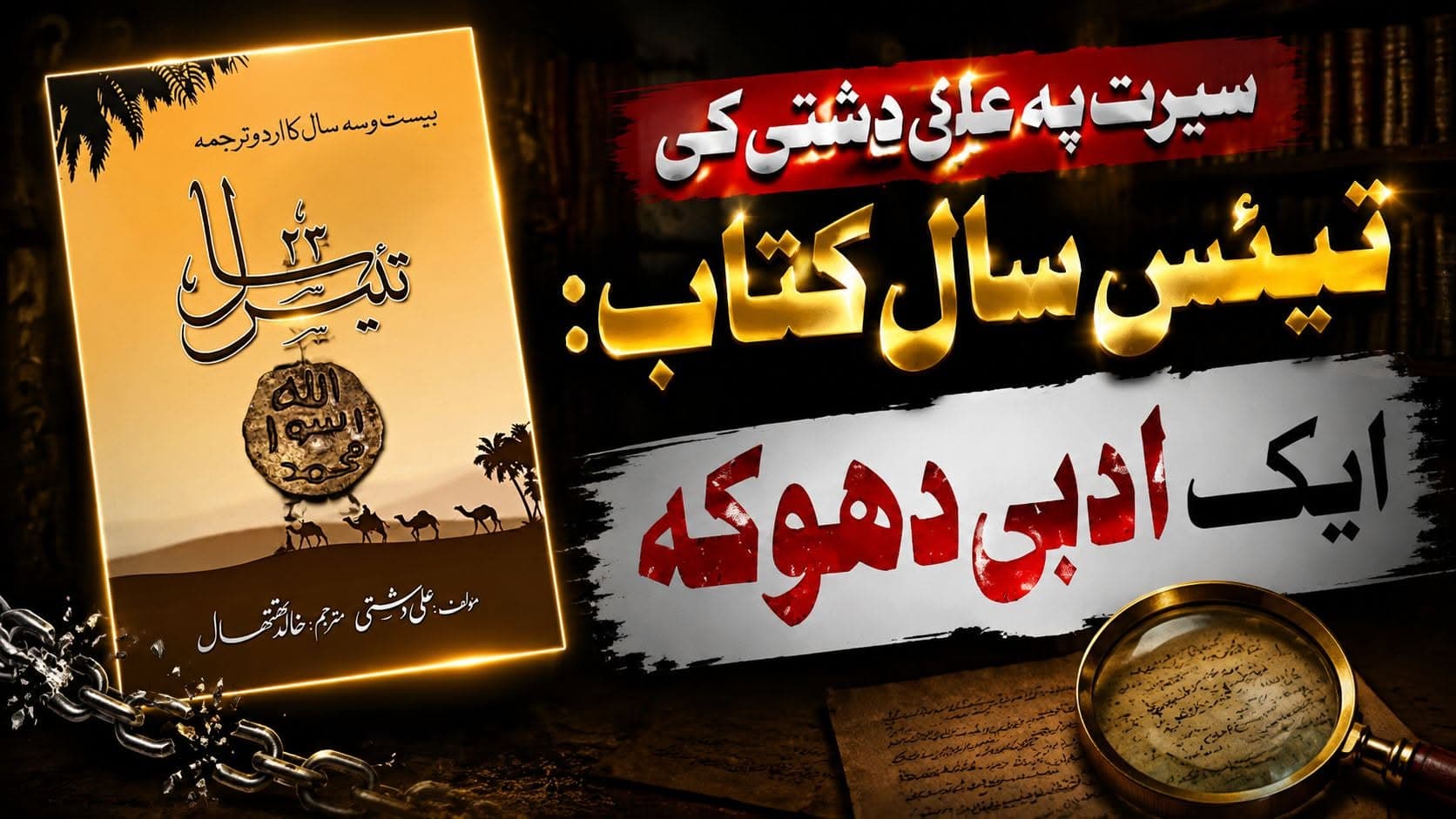
The book "23 Years," authored by the Iranian writer Ali Dashti, raises objections against the blessed life of the Holy Prophet (ﷺ) in a highly irresponsible and unscholarly manner across multiple passages.
The entire book lacks authentic references and solid arguments. Yet, it remains a favorite among secularists, liberals, and atheists. The author has merely used his literary style and wordplay as crutches in an attempt to steer the readers' thoughts in a specific direction.
The first chapter of this book begins with the title "Birth of a Hero - Maulvi." I am presenting a short excerpt from it, which Hashir Irshad has also quoted in his introductory remarks praising the author. Ali Dashti has attempted to play with words as follows:
"In their written history, Muslims have constantly attempted to present him as an imaginary and superhuman being, or rather as a god in human form. In such attempts, not only are his human characteristics ignored, but the law of cause and effect—which is the fundamental principle of life—is also cast aside. It has become a habit of these writers to present the flights of their imagination as miracles."
These objections may seem highly appealing on the surface, but a few moments of objective analysis are enough to dismantle them.
The Humanity of the Prophet (ﷺ) in the Quran
First of all, it is essential to understand: if the goal of Muslims was truly to prove the Holy Prophet (ﷺ) as a god or a demigod, why would they preserve all those verses in the Quran that state his human nature in the clearest terms?
As stated in Surah Al-Kahf (Verse 110):
"Say, 'I am only a man like you, to whom has been revealed that your god is one God.'"
Whenever any nation wants to mythologize a personality, the very first thing they do is erase their human aspects from history.
Human Aspects in the Prophetic Biography (Seerah)
Furthermore, if one studies the Seerah, there are countless incidents in the life of the Holy Prophet (ﷺ) that highlight his human status. He (ﷺ) experienced poverty, endured hunger, was wounded in battles, grieved over the deaths of his loved ones, shed tears upon the passing of his son Ibrahim, and consulted the noble Companions (may Allah be pleased with them all) in collective matters.
If the historians' goal—as the author repeatedly claims in this book—was to create a superhuman and imaginary character, they would have expunged all these human aspects. However, the reality is entirely the opposite.
Testimonies of Non-Muslim Historians
It is also worth noting that the extraordinary personality of the Holy Prophet (ﷺ) has been acknowledged not only by Muslim historians but also by numerous non-Muslim researchers. Western writers such as Montgomery Watt, Michael Hart, and others have described his leadership, character, integrity, and historical impact as exceptionally unique. Even if they do not agree with the religious interpretation of miracles, they too acknowledge the fact that history has never produced a multidimensional and influential figure like the Holy Prophet (ﷺ).
The Reality of "Cause and Effect"
As for the argument regarding the law of cause and effect:
The law of cause and effect is a law of the universe; it applies to the universe, not to Allah Almighty. To consider the Being who created the entire system of cause and effect as a prisoner of that very system is ignorance and prejudice, not rational argumentation. The system of causes and effects is subordinate to God's will; God is not bound by this system.
A miracle is neither contrary to the intellect nor a negation of cause and effect. Rather, it is the manifestation of a higher, extraordinary cause that lies outside the known, ordinary circle of causes.
There are two main points to consider:
First: The very meaning of a "miracle" (Mu'jizah) is to incapacitate or overwhelm; it is an event that transcends ordinary human intellect and the physical laws of nature.
Second: Since some "worshippers of intellect" refuse to step outside the bounds of cause and effect, it can be explained to them simply: do not consider a miracle as something detached from cause and effect, but rather as a "change in the cause."
An Illustrative Example:
For instance, a person recovers from an illness. Under normal circumstances, the "cause" is medicine. But if Allah Almighty grants healing through the hands of a Prophet without medicine, the event of healing is still present. The only difference is that the cause is not common, but extraordinary. Here, a miracle is not an event "without a cause," but an event with an "extraordinary cause."
The fundamental point remains that Allah Almighty Himself is the Creator of the entire system of cause and effect. Therefore, He is not bound to inevitably use ordinary causes in every situation. Whenever He wills, He can manifest an event without the usual causes or through extraordinary ones.
Conclusion
In this book, the author "Ali Dashti" has let the horses of his imagination run wild. He has relied on assumptions and wordplay. There is neither a logical argument nor an authentic reference. It is merely an attempt to project his internal prejudice in the style of fictional storytelling.
Have a question about this post?
Ask a Question
About the Author
Muhammad Awais
By the boundless grace and guidance of Allah Almighty, Muhammad Awais is associated with the noble journey of teaching, research, and writing. In his quest to quench his thirst for knowledge, he has completed the Dars-e-Nizami (Traditional Islamic Education), an MA in English, an M.Phil in Islamic Studies, and a B.Ed. Currently, he is pursuing his Ph.D. in Islamic Studies at Hazara University. The core of his academic interests primarily revolves around Islamic Sciences, Western Philosophy, contemporary intellectual discourses, Ilm al-Kalam (Islamic Scholastic Theology), and both classical and modern logic—subjects he continuously strives to comprehend more deeply and reflect upon. His association as a 'Master Trainer' with the British Council and other local institutions, coupled with his experience in competitive examinations, has acquainted him with a diverse array of academic disciplines, for which he is profoundly grateful to the Lord of Majesty. With his very limited abilities, he is making a humble effort to contribute a small share towards serving knowledge, offering intellectual guidance, and fostering an environment of positive academic dialogue. It is his heartfelt prayer that the Lord of the Worlds graciously accepts these modest and fragmented efforts in His Divine Presence, and makes this knowledge beneficial for His creation. Ameen.