Shah Waliullah and the Belief in the Finality of Prophethood
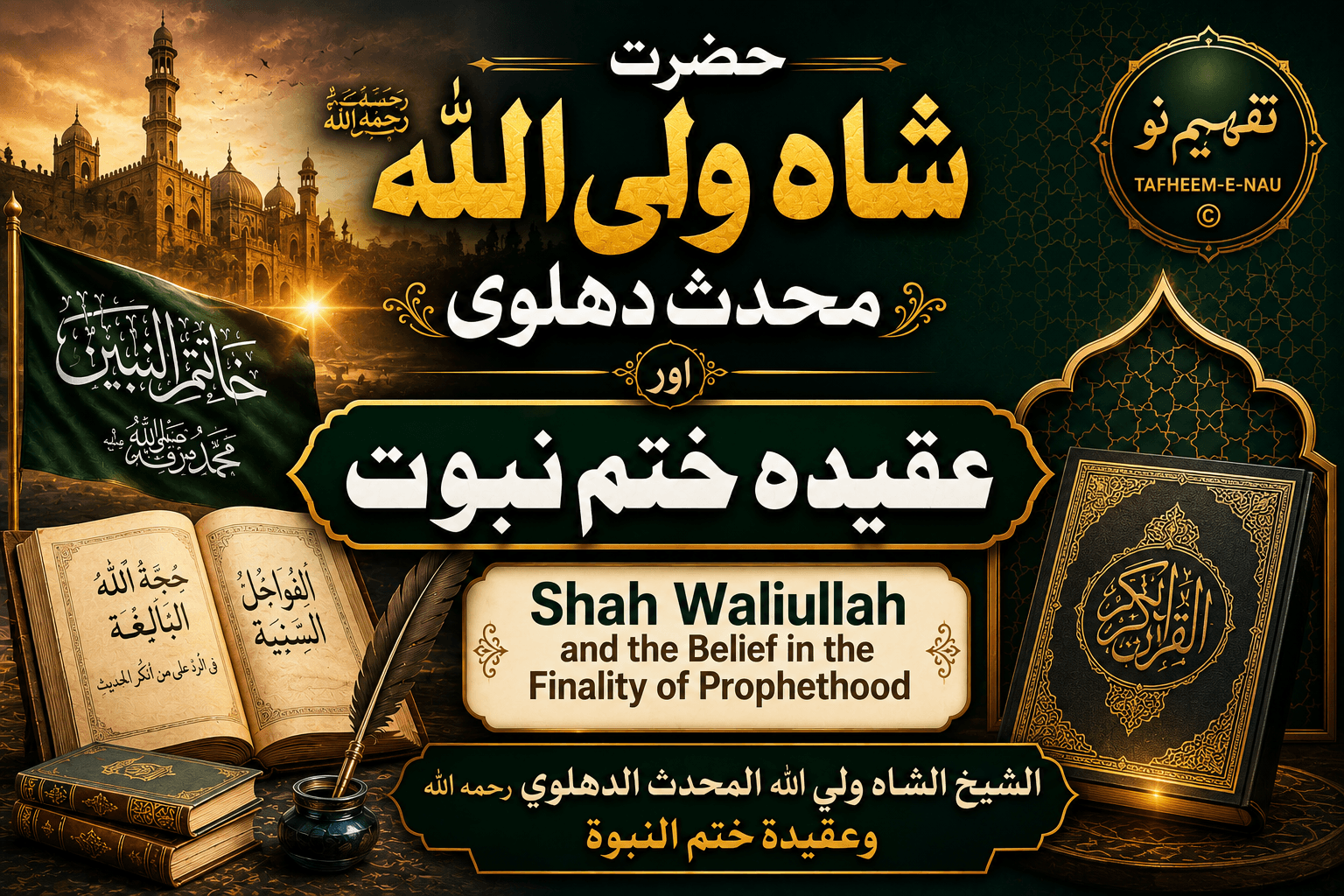
Shah Waliullah held a firm and unwavering belief in the Finality of Prophethood (Khatm-e-Nabuwat). According to his views, the door to every kind of prophethood has been permanently closed after the Holy Prophet ﷺ.
In his book "Tafhimat al-Ilahiyya", he writes:
"ومحمد صلی اللہ علیہ وسلم خاتم النبیین لانبی بعدہ ودعوتہ عامۃ لجمیع الانس والجن وھو افضل الانبیاء بھذہ الخاصیۃ وبخواص اخری"
Translation: "And Muhammad ﷺ is the Seal of the Prophets; there is no prophet after him, and his call is universal for all of mankind and jinn. He is the most superior of the prophets by this characteristic and by other characteristics." (Al-Tafhimat al-Ilahiyya, Vol. 1, Page 147)
In this passage, the Shah outlined three important points:
1. Seal of the Prophets: First, that the Prophet ﷺ is the "Seal of the Prophets," which he explicitly interpreted himself as "there is no prophet after him."
2. Universality of the Call: Second, the call of previous prophets was generally limited to a specific nation or region, but the prophethood of the Prophet ﷺ has been made universal for all humans and jinn until the Day of Judgment.
3. Superiority and Excellence: Third, this very "Finality" and "Universality of the Call" are the magnificent characteristics that grant the Prophet ﷺ superiority and excellence over all other prophets.
He further writes:
"فصار خاتم ھذہ الدورۃ فلذلک لایمکن ان یوجد بعدہ نبی صلوات اللہ علیہ وسلامہ"
Translation: "Thus, he became the seal of this cycle (of prophethood); therefore, it is entirely impossible for any prophet to exist after him, peace and blessings of Allah be upon him." (Al-Tafhimat al-Ilahiyya, Vol. 2, Page 137)
The Shah used the word "cycle" (meaning chain or series) here, which signifies that the long chain of sending prophets that Allah Almighty initiated for the guidance of mankind has been sealed with the person of the Prophet ﷺ. For this reason, instead of simply saying "will not come," the Shah ؒ used the words "it is impossible" (layumkin), meaning that logically, textually, and legally, it is now impossible and out of the question for anyone to be granted the office of prophethood until the Day of Judgment.
In his famous book "Hujjat Allah al-Baligha", he states in unequivocal terms:
"اقول : فالنبوۃ انقطعت بوفاۃ النبی صلی اللہ علیہ وسلم"
Translation: "I say: Prophethood was severed (came to an end) with the passing of the Prophet ﷺ." (Hujjat Allah al-Baligha, Vol. 2, Page 329)
"Severed" (Inqata'at) means to be cut off or disconnected. In this sentence, the Shah has cut off the roots of any concept of shadowy (Zilli), projective (Buruzi), legislative, or non-legislative prophethood. He states that as soon as the Holy Prophet ﷺ physically departed from this world, the door to prophethood was closed forever. Now, until the Day of Judgment, no one will receive the revelation of prophethood, nor will anyone be elevated to the office of a prophet.
Conclusion:
From these passages, it becomes as clear as daylight that according to the Imam of the Subcontinent, Hazrat Shah Waliullah Muhaddith Dehlawi ؒ, the Holy Prophet ﷺ is the final Prophet of Allah without any reinterpretation (Ta'weel) or specification (Takhsees). Furthermore, claiming prophethood after him ﷺ or believing in any new claimant to prophethood is strictly invalid and impossible according to Islamic law (Shariah).
Have a question about this post?
Ask a Question
About the Author
Muhammad Awais
By the boundless grace and guidance of Allah Almighty, Muhammad Awais is associated with the noble journey of teaching, research, and writing. In his quest to quench his thirst for knowledge, he has completed the Dars-e-Nizami (Traditional Islamic Education), an MA in English, an M.Phil in Islamic Studies, and a B.Ed. Currently, he is pursuing his Ph.D. in Islamic Studies at Hazara University. The core of his academic interests primarily revolves around Islamic Sciences, Western Philosophy, contemporary intellectual discourses, Ilm al-Kalam (Islamic Scholastic Theology), and both classical and modern logic—subjects he continuously strives to comprehend more deeply and reflect upon. His association as a 'Master Trainer' with the British Council and other local institutions, coupled with his experience in competitive examinations, has acquainted him with a diverse array of academic disciplines, for which he is profoundly grateful to the Lord of Majesty. With his very limited abilities, he is making a humble effort to contribute a small share towards serving knowledge, offering intellectual guidance, and fostering an environment of positive academic dialogue. It is his heartfelt prayer that the Lord of the Worlds graciously accepts these modest and fragmented efforts in His Divine Presence, and makes this knowledge beneficial for His creation. Ameen.