An Introduction to Qadianism and its Historical Background
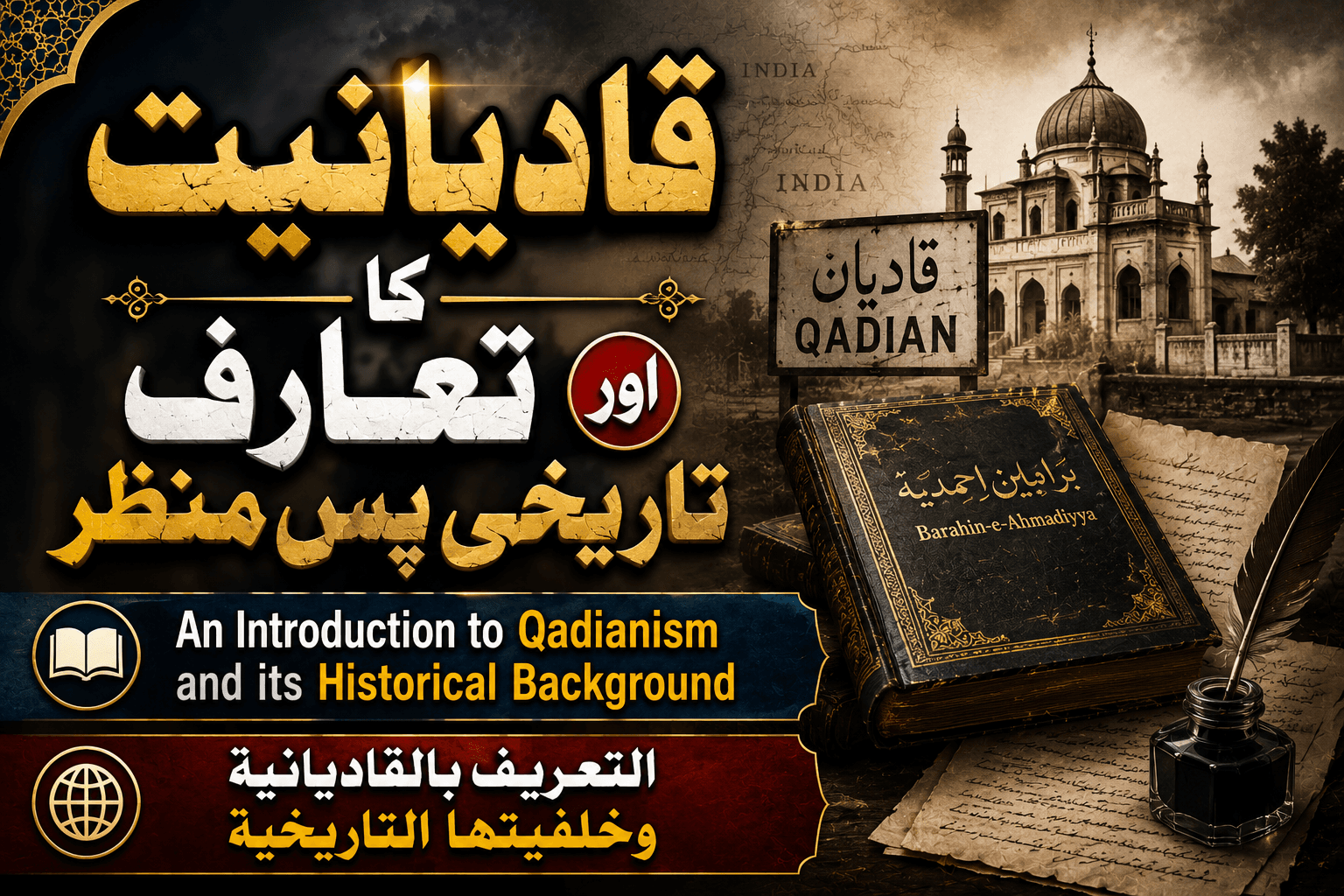
Qadianism (internationally also known as the Ahmadiyya Movement) is a movement that emerged during the British colonial era in India. Its founder was Mirza Ghulam Ahmad Qadiani (1835-1908). He was born into a Mughal family (Barlas tribe) in the town of Qadian, Gurdaspur district, Punjab. Mirza Ghulam Ahmad formally laid the foundation of this community on March 23, 1889, by taking a pledge of allegiance (Bay'ah) from his followers.
Mirza Ghulam Ahmad's Claims and Their Evolution
Over time, a gradual evolution occurred in Mirza Ghulam Ahmad's claims, which can be understood in the following stages:
1. Claim to be Mujaddid and Muhaddith: Initially, he declared himself the 'Mujaddid' (reformer) of the 14th century AH and 'Muhaddith' (one with whom God speaks).
2. Claim to be the Promised Messiah and Imam Mahdi (1891): Contrary to the traditional beliefs of Muslims and Christians, he presented the view that Jesus (peace be upon him) was neither raised to heaven nor died physically on the cross, but had migrated to Kashmir and died a natural death, and that his physical descent would not occur. Concurrently, he claimed that he himself was spiritually the Promised Messiah (the like of Messiah) and the prophesied Imam Mahdi.
3. Claim to Prophethood: His most controversial claim was that of prophethood. He declared himself a 'Zilli' (shadow/reflexive), 'Buruzi' (manifestation), and 'Ummati' (follower) prophet. His stance was that he did not bring a new Sharia (law) but was granted the status of prophethood by God due to his perfect obedience to the Prophet Muhammad (PBUH).
The Belief in the Finality of Prophethood and the Different Interpretation of Qadianis
The consensus belief among mainstream Muslims is that Prophet Muhammad (PBUH) is the final Prophet, and no kind of prophet, new or old, can come after him. In contrast, according to Qadiani belief, the term 'Khatam-un-Nabiyyin' mentioned in the Quran means the 'Seal of Prophets' or the most perfect prophet. They believe that the Prophet’s (PBUH) Sharia is final, but through perfect obedience and following him, a 'non-law-bearing' prophet can come.
Ideological Split in the Movement: Qadiani and Lahori Factions
After the death of Mirza Ghulam Ahmad in 1908, Hakim Nur-ud-Din was appointed as the community's first Caliph (Khalifa). After the death of the first Caliph in 1914, the movement split into two factions due to ideological differences:
1. Qadiani Group (Ahmadiyya Muslim Community): Formed under the leadership of Mirza Bashir-ud-Din Mahmood Ahmad, this group accepts Mirza Ghulam Ahmad as a real (non-law-bearing) prophet. They consider all Muslims who do not believe in him to be outside the fold of Islam (Kafir). An organizational system of Caliphate is prevalent among them.
2. Lahori Group (Ahmadiyya Anjuman Isha'at-e-Islam Lahore): Under the leadership of Maulana Muhammad Ali, this group believes that Mirza Sahib never claimed real prophethood, but was only a Mujaddid (reformer), rightful guide, and an allegorical Messiah. This faction believes in the traditional meaning of the Finality of Prophethood, opposes declaring other Muslims as Kafirs, and their system runs through an Anjuman (association/committee).
The 1974 Constitutional and Legal Proceedings in Pakistan and Arguments
In May 1974, when a delegation of students from Nishtar Medical College passed through Rabwah (which was the center of Qadianis) by train, they were organizedly attacked by Qadianis, leaving several students severely injured. This incident triggered a wave of severe anger across the country, leading to nationwide protests and the launch of the Tehreek-e-Khatam-e-Nabuwwat (Movement for the Finality of Prophethood).
Prime Minister at that time, Zulfikar Ali Bhutto, in view of severe public pressure, referred this sensitive issue to the National Assembly for resolution. The entire National Assembly was converted into a special committee, and in-camera (closed-door) proceedings began.
During these proceedings, the Qadiani group, under the leadership of their third Caliph Mirza Nasir Ahmad, presented a detailed defensive document called "Mahzar Nama" (Memorandum), attempting to prove that they were within the fold of Islam and that no assembly or parliament has any right to decide upon the faith of an individual or group.
However, long and detailed cross-examination was conducted on Mirza Nasir Ahmad for 11 consecutive days in the National Assembly by the then Attorney General Yahya Bakhtiar and eminent religious scholars like Mufti Mahmood and Professor Ghafoor Ahmad, among others. During this cross-examination, references from his books were presented in which non-Ahmadi Muslims were declared hell-bound, Kafirs, or outside the fold of Islam, for which he could not offer any satisfactory defense. Representing the head of the Lahori group, Sadr-ud-Din, Masood Baig and Abdul Mannan Omar also presented their stance, but they too failed to defend their contradictory views.
Qadianis Declared a Non-Muslim Minority
After hearing the arguments of all parties and a long debate, on September 7, 1974, the National Assembly of Pakistan unanimously passed the Second Amendment to the Constitution, through which Article 260(3) was added to the Constitution. By virtue of this historic constitutional amendment, both factions following Mirza Ghulam Ahmad (Qadiani and Lahori groups) were fully declared a non-Muslim minority.
Subsequently, in 1984, during the era of President General Zia-ul-Haq, 'Ordinance XX' was promulgated. It legally prohibited Qadianis from directly or indirectly calling themselves Muslims, calling their place of worship a 'Mosque', reciting the Adhan (call to prayer), and using other religious features and titles of Muslims so that they could not use Muslim identity.
Have a question about this post?
Ask a Question
About the Author
Muhammad Awais
By the boundless grace and guidance of Allah Almighty, Muhammad Awais is associated with the noble journey of teaching, research, and writing. In his quest to quench his thirst for knowledge, he has completed the Dars-e-Nizami (Traditional Islamic Education), an MA in English, an M.Phil in Islamic Studies, and a B.Ed. Currently, he is pursuing his Ph.D. in Islamic Studies at Hazara University. The core of his academic interests primarily revolves around Islamic Sciences, Western Philosophy, contemporary intellectual discourses, Ilm al-Kalam (Islamic Scholastic Theology), and both classical and modern logic—subjects he continuously strives to comprehend more deeply and reflect upon. His association as a 'Master Trainer' with the British Council and other local institutions, coupled with his experience in competitive examinations, has acquainted him with a diverse array of academic disciplines, for which he is profoundly grateful to the Lord of Majesty. With his very limited abilities, he is making a humble effort to contribute a small share towards serving knowledge, offering intellectual guidance, and fostering an environment of positive academic dialogue. It is his heartfelt prayer that the Lord of the Worlds graciously accepts these modest and fragmented efforts in His Divine Presence, and makes this knowledge beneficial for His creation. Ameen.