
The Qadiani Misinterpretation of the Qur'anic Term “Tawaffī التوفي ”
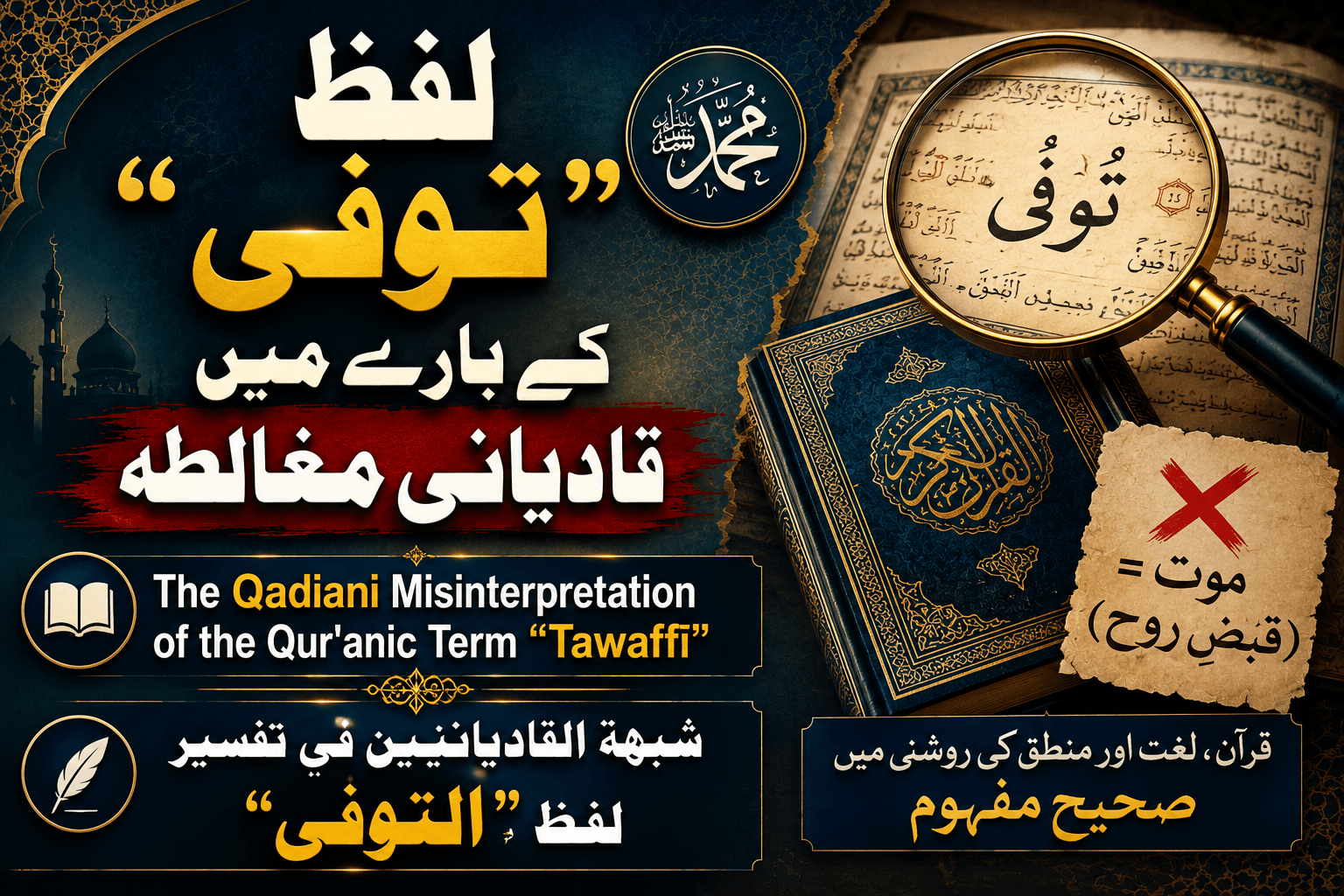
The Qadiani Misconception:
To deny the continuous (Mutawatir) Ahadith and the consensus (Ijma) regarding the descent of the Messiah, Qadianis interpret the Quranic word "تَوَفِّي" (Tawaffa — which means to take or receive in full by Allah) as strictly meaning 'inevitable death' and 'the taking of the soul.' They do this in an attempt to prove the death of Prophet Isa (Jesus), peace be upon him.
The Answer:
The interpretation of the Quranic word "تَوَفِّي" presented by Qadianis to prove the death of Prophet Isa (AS) and to deny the continuous Islamic belief of his physical ascension (Raf') is completely contrary to lexicology, morphology, syntax, Quranic evidence, and logic. A comprehensive academic, morphological, syntactic, and analytical refutation is as follows:
1. Linguistic and Morphological Analysis
According to Arabic grammar, the root letters of the word "تَوَفِّي" are (و ف ي) (Waw-Fa-Ya), and it is a verbal noun (Masdar) of the Tafa'ul (تَفَعُّل) form. Its literal and real meaning in the Arabic lexicon is not 'death', but rather "to take something in full" (أَخْذُ الشَّيْءِ وَافِيًا) and completion (اِسْتِيفَاء).
In Arabic, it is commonly said, "تَوَفَّيْتُ مِنْهُ حَقِّي" or "تَوَفَّيْتُ مِنْهُ مَالِي", which translates to: "I received my right or my wealth from him in full."
The most authentic Arabic lexicon, Taj al-Arus (تَاج العَرُوس), and leading linguists like Allamah Al-Zamakhshari explicitly state that the real meaning of "تَوَفِّي" is to take a thing in its entirety. However, since a person's lifespan and breaths are completed at the time of death, it is sometimes used metaphorically or metonymically to mean death.
2. Refutation of the Qadiani Rule through Syntactic and Quranic Evidence
Qadianis have fabricated a syntactic rule claiming that whenever the subject (Fa'il) of the verb "تَوَفِّي" is Allah and the object (Maf'ul) is a living human being, its meaning is obligatorily 'death'. The Noble Quran itself refutes this self-made rule in several places:
Surah Al-An'am, Verse 60: "وَهُوَ الَّذِي يَتَوَفَّاكُم بِاللَّيْلِ" (And it is He who takes you by night). In this verse, the subject is Allah and the object is man, but the meaning here is 'sleep', not 'death'.
Surah Az-Zumar, Verse 42: "اللَّهُ يَتَوَفَّى الْأَنفُسَ حِينَ مَوْتِهَا وَالَّتِي لَمْ تَمُتْ فِي مَنَامِهَا" (Allah takes the souls at the time of their death, and those that do not die [He takes] during their sleep). This verse explicitly divides "تَوَفِّي" into two distinct types (death and sleep). If the inherent, literal meaning of "تَوَفِّي" was death, applying it to sleep and dividing it into two categories would be absurd.
3. Contrast Between Life and Death and the Research of Ibn Taymiyyah
Wherever life (حَيَاة) is mentioned in the Noble Quran, it is always contrasted with the word "death" (مَوْت) (e.g., يُحْيِي وَيُمِيتُ — He gives life and causes death). Nowhere in the entire Quran is "تَوَفِّي" used as an antonym for life. This proves that death and "تَوَفِّي" are two entirely separate concepts.
Hafiz Ibn Taymiyyah (may Allah have mercy on him), in the light of the Arabic lexicon, categorized "تَوَفِّي" into three types: (1) The "تَوَفِّي" of sleep, (2) The "تَوَفِّي" of death, and (3) The "تَوَفِّي" of taking both the body and soul together in full. The "تَوَفِّي" mentioned in the context of Prophet Isa (AS) belongs strictly to this third category.
The blessed verse, "إِنِّي مُتَوَفِّيكَ وَرَافِعُكَ إِلَيَّ" (Indeed, I will take you and raise you to Myself) was revealed when the Jews were attempting to arrest, crucify, and kill Prophet Isa (AS). Amidst this severe siege by his enemies, Allah Almighty consoled His Prophet. If the Qadiani interpretation is accepted—that Allah said, "I will give you death"—this would not be a consolation at all, because the Jews also wanted exactly that. Therefore, logical deduction demands that Allah Almighty meant: "O Isa! Do not fear, I will rescue you from the clutches of these disbelievers and take you up to Myself completely safe (with both body and soul)."
4. Contradiction with Their Own Leader
The very rule Qadianis base their argument upon was broken by their own leader, Mirza Ghulam Ahmad Qadiani, in his book Barahin-e-Ahmadiyya. Mirza Qadiani claimed the verse "يَا عِيسَىٰ إِنِّي مُتَوَفِّيكَ وَرَافِعُكَ إِلَيَّ" as a revelation upon himself and personally translated it as follows:
"O Isa, I will give you the complete bounty and raise you to Myself."
This clearly shows that Mirza Qadiani himself admitted that the real meaning of "تَوَفِّي" is not death; otherwise, he would have translated his claimed revelation as "I will kill you."
Have a question about this post?
Ask a Question
About the Author
Muhammad Awais
By the boundless grace and guidance of Allah Almighty, Muhammad Awais is associated with the noble journey of teaching, research, and writing. In his quest to quench his thirst for knowledge, he has completed the Dars-e-Nizami (Traditional Islamic Education), an MA in English, an M.Phil in Islamic Studies, and a B.Ed. Currently, he is pursuing his Ph.D. in Islamic Studies at Hazara University. The core of his academic interests primarily revolves around Islamic Sciences, Western Philosophy, contemporary intellectual discourses, Ilm al-Kalam (Islamic Scholastic Theology), and both classical and modern logic—subjects he continuously strives to comprehend more deeply and reflect upon. His association as a 'Master Trainer' with the British Council and other local institutions, coupled with his experience in competitive examinations, has acquainted him with a diverse array of academic disciplines, for which he is profoundly grateful to the Lord of Majesty. With his very limited abilities, he is making a humble effort to contribute a small share towards serving knowledge, offering intellectual guidance, and fostering an environment of positive academic dialogue. It is his heartfelt prayer that the Lord of the Worlds graciously accepts these modest and fragmented efforts in His Divine Presence, and makes this knowledge beneficial for His creation. Ameen.