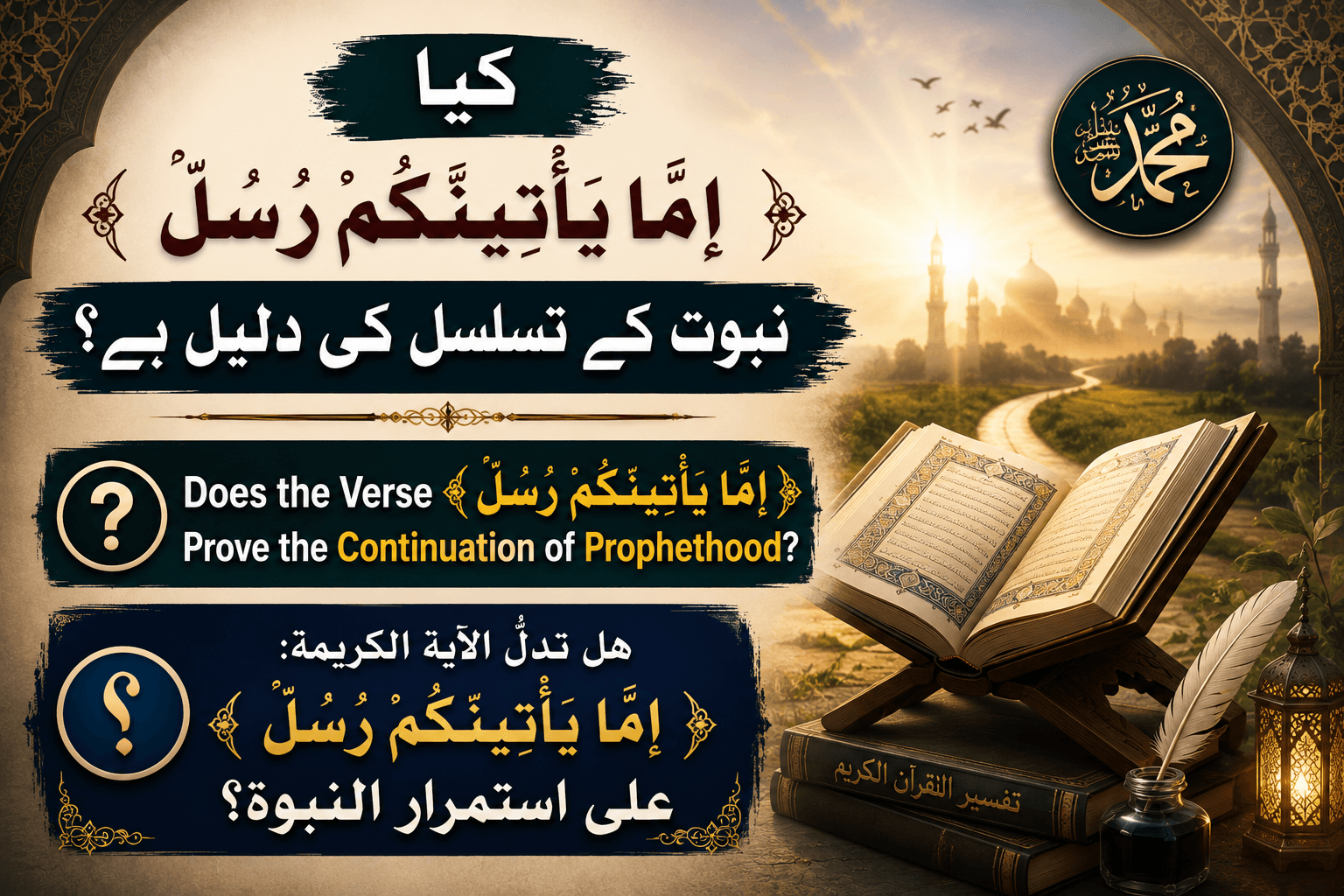
Does the Verse إِمَّا يَأْتِيَنَّكُمْ رُسُلٌ Prove the Continuation of Prophethood?
A Doubt Raised by Qadianis:
Regarding the verse: "O children of Adam, if there come to you messengers from among you" (Al-A'raf: 35): By pointing to the use of "Imma Ya'tiyannakum" (a future tense verb coupled with a heavy emphatic Nun / Nun al-Tawkid al-Thaqilah), they create the misconception that the arrival of new messengers will continue until the Day of Judgment, even after the Holy Prophet (ﷺ).
The Answer:
The deduction made by Qadianis regarding the continuation of prophethood (Ijra-e-Nubuwwat) from Surah Al-A'raf, Verse 35, is completely baseless in terms of Quranic context, Arabic grammar (morphology and syntax), and logic.
(Translation of the verse): "O children of Adam, if there come to you messengers from among you relating to you My verses, then whoever fears Allah and reforms - there will be no fear concerning them, nor will they grieve."
1) Exegetical and Analytical Review Based on Context:
Narration of the Realm of Souls and Adam's Descent: This argument is exegetically invalid because this verse is actually a narration from the very beginning of human creation, in the Realm of Souls (Alam-e-Arwah), at the time of Prophet Adam's (AS) descent to earth. In this exact section (Ruku) of the Surah, the address "O Children of Adam" is used three times prior to this verse, and it directly relates to the event of Adam and Eve (AS) being sent down to earth ("Go down, some of you an enemy to some others"). At that time, Allah Almighty addressed all the children of Adam generally, stating that whenever messengers come to you, you must follow them.
Deduction from a Past Tense Context: Since this address reflects an era of the past, the future tense here is used merely as a "Narration of the Past" (Hikayat-e-Mazi — narrating a past event as it unfolded), and not as an announcement for the arrival of new messengers until the Day of Judgment after the Holy Prophet (ﷺ).
The Quranic Style of Address: It is evident from the expressive style of the Noble Quran that the believing Ummah of the Messenger of Allah (ﷺ) is generally addressed with "O you who have believed" (Ya Ayyuhal Lazeena Aamanu). Nowhere in the entire Quran is His (ﷺ) Ummah addressed solely as "O Children of Adam," which serves as strong contextual evidence that the initial offspring of Adam are being addressed here.
2) Morphological and Syntactic Analysis:
The Qadiani fallacy relies heavily on the phrase "Imma Ya'tiyannakum" being a future tense verb, which is a baseless argument according to Arabic grammar.
The Usage of "Imma": Grammatically, "Imma" is a compound of the conditional particle "In" (If) and an extra "Ma". A conditional particle ("If") denotes a possibility, and its occurrence never implies that the action will continue perpetually until the Day of Judgment.
Application of the Present/Future Tense (Mudhari) and Heavy Emphatic Nun: It is true that "Ya'tiyannakum" is a Mudhari verb ending with an emphatic Nun, but it is not a grammatical rule that every Mudhari conveys perpetual continuity (Istimrar).
A Quranic Precedent: A clear precedent for this rule exists in Surah Maryam, where it was said to Mary (AS): "Fa-imma Tarayinna minal bashari ahada" (So if you see any human being). Here too, the Mudhari with a heavy emphatic Nun is used after "Imma". Does this mean that Mary (AS) will remain alive until the Day of Judgment and continue seeing people? Certainly not! Therefore, the future tense used at the time of Adam's descent was for the future relative to that specific time, not until the end of the world.
Furthermore, if this Qadiani logic is considered correct, their own self-fabricated beliefs are proven false:
Rusul (Plural Form): The word "Rusul" (messengers) is used in the plural form in this verse, which necessitates the arrival of many messengers. However, according to Qadianis, only one prophet (Mirza Qadiani) has come after the Holy Prophet (ﷺ). Thus, applying a plural form to a single individual contradicts and negates their own claim.
Requirement of a New Shariah: The verse contains the words "Yaqussoona alaykum Ayati" (who will relate to you My verses), which means the coming messengers would bring new commandments and a new Shariah. Meanwhile, Qadianis themselves admit that no law-bearing (Tashree'i) prophet can come after the Holy Prophet (ﷺ). Thus, this verse completely invalidates their claim of "Zilli" (shadowy) and "Buroozi" (manifestative) prophethood.
The Generality of "Bani Adam" and its Contradiction: "Children of Adam" includes all human beings in the world, including Hindus, Christians, Jews, Sikhs, women, and transgender individuals. If the door of prophethood is considered open until the Day of Judgment based on the absolute generality of this verse, can women, transgender people, or non-Muslims also become prophets according to Qadianis? Obviously, this is impossible. This proves that due to specific circumstances and contextual indicators, many groups are excluded from this generality, and this address was strictly specific to the beginning of humanity.
In short, when weighed on any academic, linguistic, or logical scale, this Qadiani deduction proves to be weaker than a spider's web. The very verse they attempt to use as a foundation to build the edifice of their false belief completely uproots their self-fabricated principles (Zilli and Buroozi prophethood) by virtue of its grammatical forms, words (Rusul and Yaqussoona), and context. The truth is that those who abandon the clear, definitive commandments of Allah's final and perfect Book, relying merely on grammatical possibilities and baseless misinterpretations, possess no evidence of truth. The religion of Islam is complete, and the concept of any new prophet, messenger, or Shariah after the Seal of Prophets, Hazrat Muhammad Mustafa (ﷺ), is a blatant negation of fundamental Islamic beliefs.
Have a question about this post?
Ask a Question
About the Author
Muhammad Awais
By the boundless grace and guidance of Allah Almighty, Muhammad Awais is associated with the noble journey of teaching, research, and writing. In his quest to quench his thirst for knowledge, he has completed the Dars-e-Nizami (Traditional Islamic Education), an MA in English, an M.Phil in Islamic Studies, and a B.Ed. Currently, he is pursuing his Ph.D. in Islamic Studies at Hazara University. The core of his academic interests primarily revolves around Islamic Sciences, Western Philosophy, contemporary intellectual discourses, Ilm al-Kalam (Islamic Scholastic Theology), and both classical and modern logic—subjects he continuously strives to comprehend more deeply and reflect upon. His association as a 'Master Trainer' with the British Council and other local institutions, coupled with his experience in competitive examinations, has acquainted him with a diverse array of academic disciplines, for which he is profoundly grateful to the Lord of Majesty. With his very limited abilities, he is making a humble effort to contribute a small share towards serving knowledge, offering intellectual guidance, and fostering an environment of positive academic dialogue. It is his heartfelt prayer that the Lord of the Worlds graciously accepts these modest and fragmented efforts in His Divine Presence, and makes this knowledge beneficial for His creation. Ameen.