
The Consensus of the Ummah on the Belief in the Finality of Prophethood
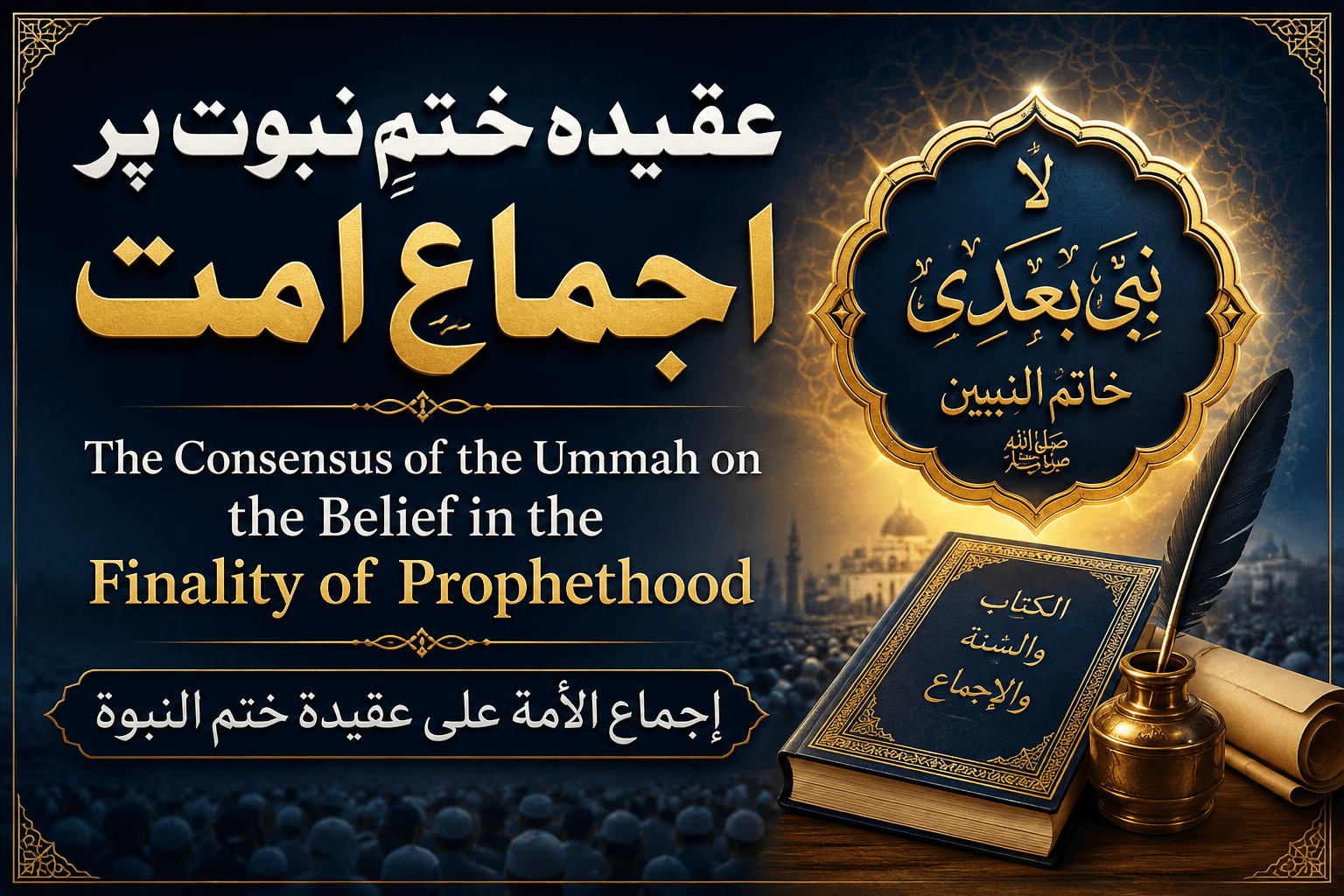
What is the Consensus of the Ummah on the Finality of Prophethood?
The Consensus (Ijma) of the Ummah on the Finality of Prophethood refers to the complete and unconditional agreement of the Companions (Radi Allahu Anhum) and all the scholars and jurists of the entire Muslim Ummah that Prophet Muhammad (ﷺ) is the last Prophet and Messenger of Allah, and that absolutely no new prophet or messenger will come after him. According to this belief, anyone who claims prophethood after him (ﷺ) is a disbeliever (Kafir) and a liar, and their followers are also excluded from the fold of Islam.
The Legal Status of Consensus (Ijma)
In Islamic jurisprudence, "Ijma" (Consensus) is ranked third among the foundational sources of rulings, immediately following the Holy Quran and the blessed Hadiths. This is based on the blessed Hadith of the Messenger of Allah (ﷺ):
"My Ummah will never unite upon misguidance; therefore, when you see a disagreement, hold fast to the great majority (Sawad-e-Azam)."
Any issue upon which the Companions (ؓ) or the Ummah reach a consensus becomes just as obligatory to follow as the Quran and Hadith. The consensus of the Companions (ؓ) is as absolute and certain as the verses of the Quran are regarding any given issue.
The First Consensus of the Ummah (The Decision of the Companions ؓ)
It is a matter of profound importance that the very first consensus of the Ummah in Islamic history was formed on the issue of the Finality of Prophethood.
After the passing of the Prophet (ﷺ), when Musaylimah the Liar claimed prophethood, his status was not like that of an ordinary disbeliever. Rather, he claimed to believe in the prophethood of Muhammad (ﷺ) and the Quran, acknowledged prayer and fasting, and the call to prayer (Adhan) he initiated even included the words "I bear witness that Muhammad is the Messenger of Allah." Despite all these acts of worship and reciting the Kalimah, purely due to his claim of being a new prophet, the Companions (ؓ) unanimously declared him a disbeliever.
In the Jihad (Battle of Yamama) led by Caliph Abu Bakr Siddiq (ؓ) against Musaylimah the Liar and his followers, not a single Companion argued that they should not be fought simply because they recite the Kalimah or face the Qiblah. In this battle, 1,200 Companions (ؓ) were martyred, including 700 memorizers (Huffaz) and reciters (Qurra) of the Quran. This serves as clear evidence of how paramount the issue of the Finality of Prophethood was to the Companions.
Why Does This Consensus Exist?
The fundamental reason for this consensus is that the Holy Quran and Mutawatir (mass-transmitted) Hadiths have made this issue absolutely clear.
It is established from approximately 99 verses of the Holy Quran (such as the verse of Khatam an-Nabiyyin) and over 210 Mutawatir Hadiths that the chain of prophethood has come to an end.
Allah Almighty stated in Surah Al-Ma'idah: "Today I have perfected your religion for you." This means there is no longer any need or room for addition, alteration, or a new prophet in the religion of Islam.
Since this issue is proven by Nusoos-e-Qat'iyyah (clear and definitive textual evidences), the scholars of the Ummah and the Companions reached a consensus that anyone who claims prophethood now is a liar and a disbeliever.
Declarations of the Imams and Great Scholars
Eminent scholars across various eras have described the intensity and absolute nature of this consensus as follows:
Imam al-Azam Abu Hanifa (RA): During his time, when a person claimed prophethood and asked for time and permission to present evidence for his truthfulness, the Imam said: "Whoever demands proof from him (the claimant of prophethood) also becomes a disbeliever, because the Prophet (ﷺ) has said that there is no prophet after me."
Hujjat-ul-Islam Imam Ghazali (RA): He states: "The Ummah has unanimously understood from this word (Khatam an-Nabiyyin) that there will be no prophet and no messenger after him (ﷺ). There is no room for reinterpretation (Ta'weel) or specification (Takhsees) in it, and whoever denies this denies the consensus."
Mulla Ali al-Qari (RA): "Claiming prophethood after our Prophet (ﷺ) is disbelief (Kufr) by consensus."
Allama Syed Mahmud al-Alusi (RA): "The Prophet (ﷺ) being the Seal of the Prophets is proven by the Quran, Sunnah, and the consensus of the Ummah; whoever claims contrary to this is a disbeliever, and if he does not repent, he should be killed."
Conclusion
In summary, the consensus of the Ummah on the Finality of Prophethood is an impregnable fortress and a unanimous decision of the Islamic faith, built upon the foundation of the Quran, Mutawatir Hadiths, and the sacrifices of the Companions (ؓ). Its status is so firmly established and definitive that anyone who attempts to introduce any reinterpretation, alternative explanation, or doubt regarding it is considered excluded from the fold of Islam.
Have a question about this post?
Ask a Question
About the Author
Muhammad Awais
By the boundless grace and guidance of Allah Almighty, Muhammad Awais is associated with the noble journey of teaching, research, and writing. In his quest to quench his thirst for knowledge, he has completed the Dars-e-Nizami (Traditional Islamic Education), an MA in English, an M.Phil in Islamic Studies, and a B.Ed. Currently, he is pursuing his Ph.D. in Islamic Studies at Hazara University. The core of his academic interests primarily revolves around Islamic Sciences, Western Philosophy, contemporary intellectual discourses, Ilm al-Kalam (Islamic Scholastic Theology), and both classical and modern logic—subjects he continuously strives to comprehend more deeply and reflect upon. His association as a 'Master Trainer' with the British Council and other local institutions, coupled with his experience in competitive examinations, has acquainted him with a diverse array of academic disciplines, for which he is profoundly grateful to the Lord of Majesty. With his very limited abilities, he is making a humble effort to contribute a small share towards serving knowledge, offering intellectual guidance, and fostering an environment of positive academic dialogue. It is his heartfelt prayer that the Lord of the Worlds graciously accepts these modest and fragmented efforts in His Divine Presence, and makes this knowledge beneficial for His creation. Ameen.