
Banū Qurayẓah: Myths and Facts
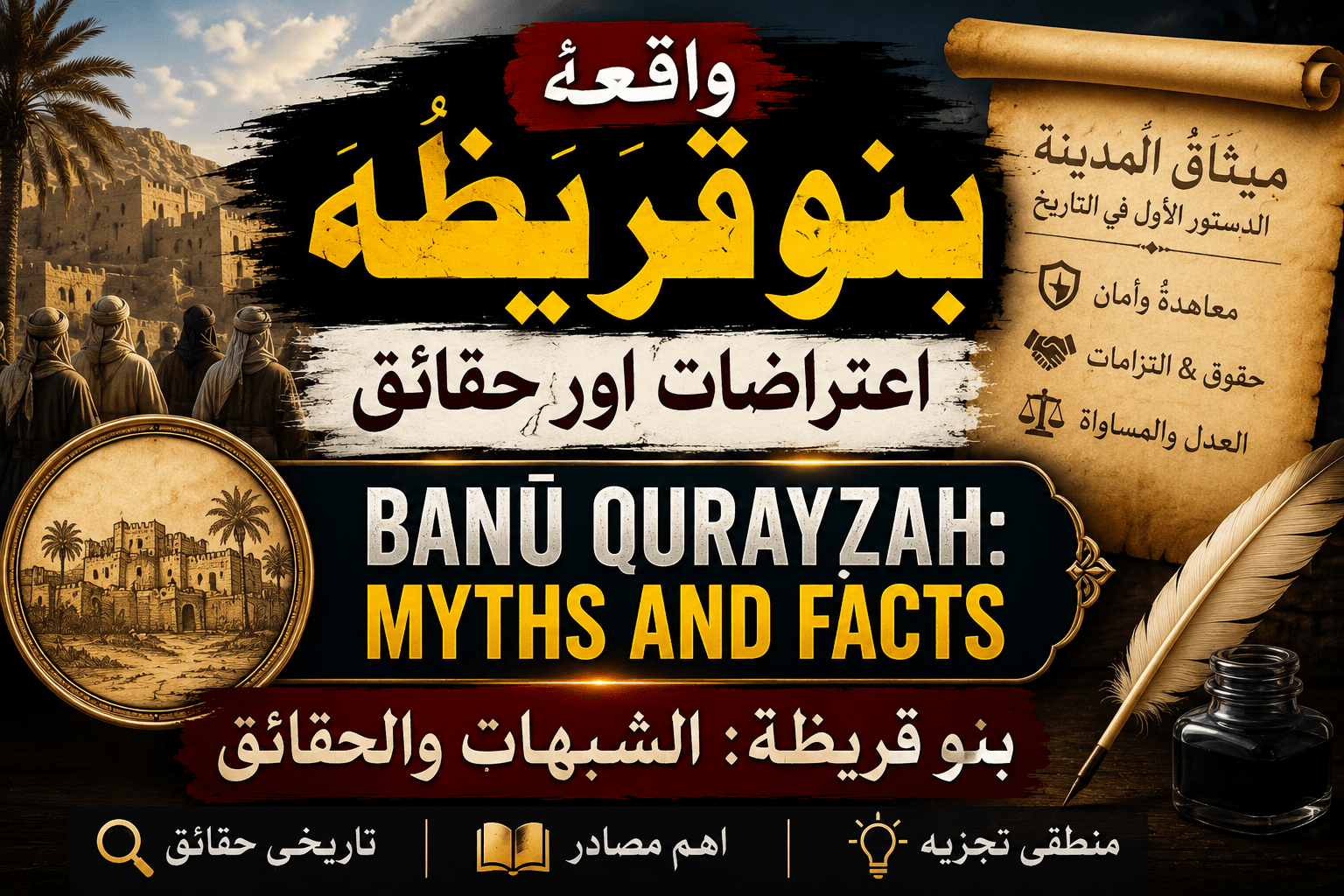
When the Prophet Muhammad ﷺ migrated to Madinah, he concluded a comprehensive political and defensive treaty with the city's various tribes, particularly the Jewish tribes. This agreement, commonly known as the Constitution of Madinah (Ṣaḥīfat al-Madīnah), is widely regarded as the first written constitutional charter in history. It established mutual rights and responsibilities, guaranteed religious freedom, protected life and property, and regulated relations among the diverse communities of the city.
The tribe of Banū Qurayẓah was one of the signatories to this covenant. As an expression of justice and equality, the Prophet ﷺ also abolished certain pre-Islamic social inequalities between Banū Qurayẓah and Banū Naḍīr. Before Islam, the blood money (diyah) for a member of Banū Qurayẓah was only half that of a member of Banū Naḍīr. The Prophet ﷺ eliminated this discriminatory practice and established legal equality between the two tribes.
Historical Background and the Treason of Banū Qurayẓah
During the Battle of the Confederates (al-Aḥzāb/Khandaq), Quraysh and several allied Arab tribes assembled an army of approximately ten thousand warriors and laid siege to Madinah. This represented an existential threat to the nascent Muslim community.
At this critical moment, Banū Qurayẓah violated the Constitution of Madinah after being persuaded by Ḥuyayy ibn Akhṭab, the leader of the exiled Banū Naḍīr. They entered into negotiations with the confederate forces and planned to attack the Muslims from within the city, targeting the vulnerable residential areas where women and children had taken refuge.
Had this plan succeeded, the Muslims would have faced military assault from both outside and inside the city, placing the entire community at risk of annihilation.
The Siege and the Appointment of an Arbitrator
Following the withdrawal of the confederate army, the Prophet ﷺ immediately marched toward the strongholds of Banū Qurayẓah. The siege lasted approximately twenty-five days before the tribe surrendered.
Rather than accepting the Prophet's direct judgment, Banū Qurayẓah themselves requested that Sa'd ibn Mu'ādh, the respected chief of the Aws tribe and their former ally before Islam, serve as the sole arbitrator. They expected that their long-standing alliance with him would result in a lenient verdict.
The Judgment of Sa'd ibn Mu'ādh and Its Consistency with the Torah
Before delivering his verdict, Sa'd ibn Mu'ādh obtained the explicit agreement of both parties that his judgment would be final and binding.He ruled that the adult male combatants should be executed, their military property distributed, and the women and children taken into custody.
Many scholars have noted that this judgment corresponded closely with the military legislation found in the Book of Deuteronomy (20:10–14), where cities that reject peaceful terms and continue armed resistance after a siege are subjected to similar legal consequences.
The Major Objections and Their Critical Evaluation:
Objection One:
The punishment was excessively harsh, inhumane, and disproportionate.
Response:
Throughout both ancient and modern legal history, high treason—particularly collaboration with an invading enemy during wartime—has consistently been regarded as one of the gravest criminal offenses, often punishable by death.
The offense committed by Banū Qurayẓah was not merely the violation of a political treaty. It involved active collaboration with an invading coalition at a time when the survival of the Muslim community depended upon maintaining internal security.
Had their plan succeeded, the entire population of Madinah would likely have faced destruction. Within the legal and military norms of seventh-century Arabia, the judgment served both as a punishment for wartime treason and as a deterrent against similar acts threatening the security of the state.
Objection Two:
The judgment was issued personally by Prophet Muhammad ﷺ, making him responsible for its severity.
Response:
First: The arbitrator was chosen by Banū Qurayẓah themselves.
Historical sources consistently report that the Prophet ﷺ did not impose Sa'd ibn Mu'ādh as judge. Rather, Banū Qurayẓah themselves requested him as the arbitrator because of his previous alliance with their tribe.
Second: The judgment reflected their own legal tradition.
Sa'd ibn Mu'ādh did not invent a new legal ruling nor simply apply Islamic law. His judgment has been understood by many scholars as corresponding to the legal principles contained within the Torah, the very scripture accepted by Banū Qurayẓah themselves.
Consequently, once they voluntarily selected the arbitrator and agreed beforehand to accept his verdict, objections portraying the judgment as arbitrary become historically and logically difficult to sustain.
Objection Three
Hundreds of people were executed, making the incident a massacre.
Response
First: Only those directly involved in the act of treason were punished.
Several contemporary historians have questioned the larger numerical estimates reported in some traditional narratives. Some researchers argue that those actually executed were the principal combatants who had actively participated in the betrayal and military conspiracy, estimating their number to have been approximately thirty to forty individuals.
Second: Even according to the traditional accounts
The punishment was not indiscriminate. Women, children, the elderly, and individuals who had not participated in the treason were not subjected to execution. Likewise, some individuals received clemency or embraced Islam and were therefore spared.
For this reason, describing the incident as an indiscriminate "massacre" or "genocide" oversimplifies the historical evidence and often reflects ideological assumptions rather than careful historical analysis.
Moreover, the Prophet Muhammad ﷺ consistently demonstrated mercy throughout his life, accepting intercession and granting pardon whenever justice and public welfare permitted. His overall conduct cannot reasonably be reduced to a single episode detached from its historical, legal, and military context.
Have a question about this post?
Ask a Question
About the Author
Muhammad Awais
By the boundless grace and guidance of Allah Almighty, Muhammad Awais is associated with the noble journey of teaching, research, and writing. In his quest to quench his thirst for knowledge, he has completed the Dars-e-Nizami (Traditional Islamic Education), an MA in English, an M.Phil in Islamic Studies, and a B.Ed. Currently, he is pursuing his Ph.D. in Islamic Studies at Hazara University. The core of his academic interests primarily revolves around Islamic Sciences, Western Philosophy, contemporary intellectual discourses, Ilm al-Kalam (Islamic Scholastic Theology), and both classical and modern logic—subjects he continuously strives to comprehend more deeply and reflect upon. His association as a 'Master Trainer' with the British Council and other local institutions, coupled with his experience in competitive examinations, has acquainted him with a diverse array of academic disciplines, for which he is profoundly grateful to the Lord of Majesty. With his very limited abilities, he is making a humble effort to contribute a small share towards serving knowledge, offering intellectual guidance, and fostering an environment of positive academic dialogue. It is his heartfelt prayer that the Lord of the Worlds graciously accepts these modest and fragmented efforts in His Divine Presence, and makes this knowledge beneficial for His creation. Ameen.