
The Concept of Knowledge: An Islamic and Western Perspective
1. The Concept of Knowledge
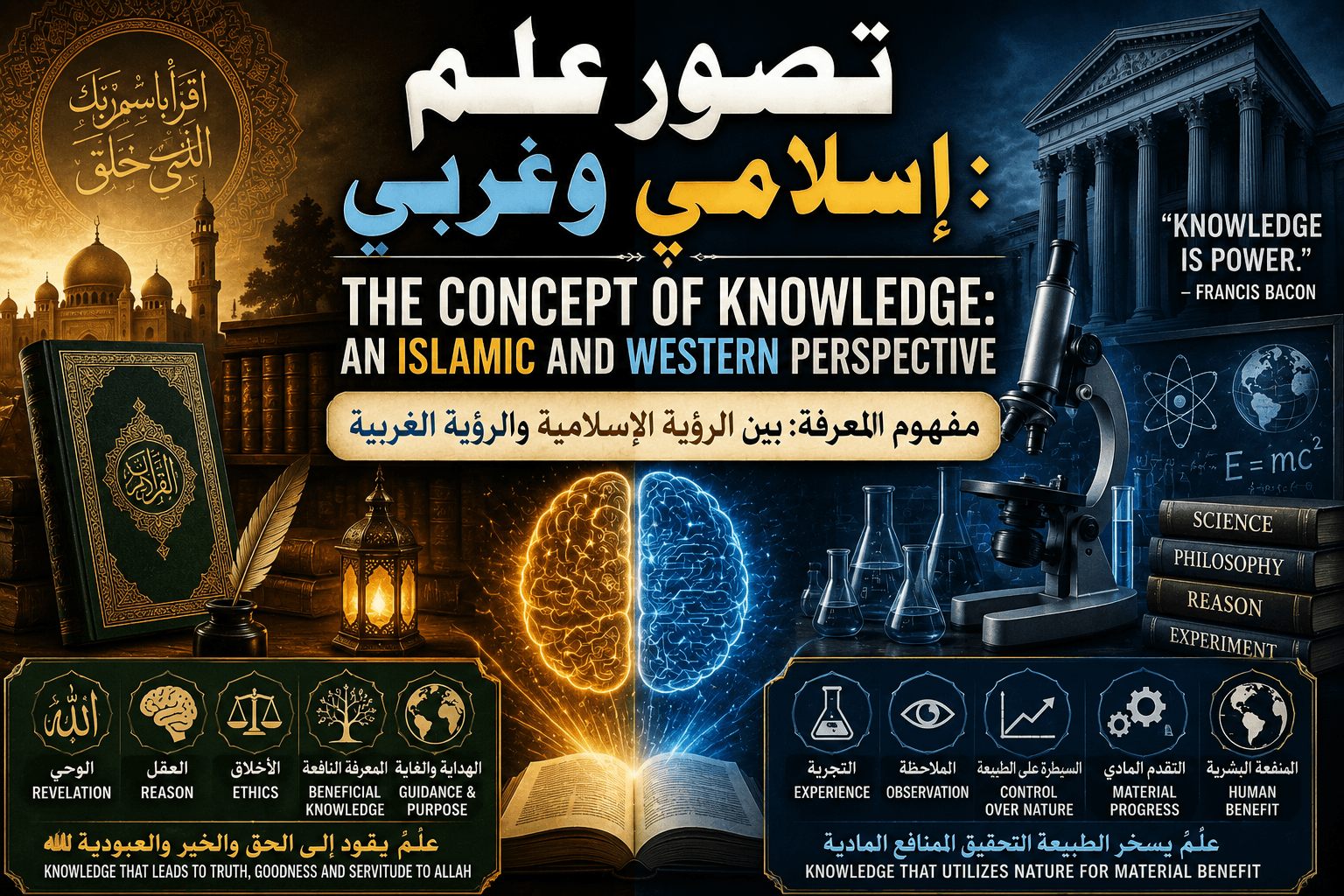
Knowledge constitutes the cornerstone of human civilization, and the intellectual foundations of every society are largely determined by how it understands the concept of knowledge itself. A comparative examination of the Islamic and Western conceptions of knowledge reveals two distinct epistemological paradigms, each founded upon different philosophical assumptions and directed toward different civilizational objectives.
2. Knowledge in the Islamic Epistemological Tradition
Islamic epistemology is fundamentally grounded in Divine Revelation (Waḥy). According to this worldview, God is the ultimate source of all knowledge, and the revealed guidance serves as the supreme criterion by which human reason, empirical observation, and intuition are evaluated.
From the Islamic perspective, the objective of knowledge is not merely to achieve material progress or exercise dominion over nature. Rather, its ultimate purpose is to attain the knowledge of God, comprehend the divine purpose behind creation, cultivate moral excellence, and secure success in both this life and the Hereafter.
Knowledge in Islam transforms the individual not only into an informed person but also into a morally responsible one. Consequently, Islam does not recognize a rigid separation between religious and worldly sciences. Every branch of knowledge that enables humanity to better understand God's creation, appreciate His wisdom, and serve His creation within the framework of divine guidance is regarded as beneficial knowledge (ʿIlm Nāfiʿ).
Within this intellectual framework, human reason occupies a highly esteemed position; however, it functions under the guidance of revelation. This relationship establishes harmony between rational inquiry and divine guidance, preserving both the intellectual integrity and the moral sanctity of knowledge.
3. The Western Concept of Knowledge
In contrast, the Western conception of knowledge has historically evolved under the influence of Rationalism and Empiricism. Following the Renaissance and the Enlightenment, Western intellectual thought increasingly sought to emancipate knowledge from religious authority, giving rise to what is commonly described as secular epistemology.
Within this framework, knowledge is derived primarily from human reason, sensory observation, and scientific experimentation. Reality is generally confined to that which can be observed, measured, tested, or mathematically verified. Consequently, the principal aim of knowledge becomes the understanding, control, and utilization of the material universe for technological advancement, economic development, and human convenience.
Although this intellectual tradition has produced extraordinary achievements in science and technology, many scholars argue that it has simultaneously contributed to a growing moral and spiritual crisis by separating reason from revelation and excluding transcendent values from the pursuit of knowledge.
4. The Intellectual Divergence
The fundamental difference between these two epistemological systems lies in their respective metaphysical foundations. Western thought generally regards human reason as an autonomous authority capable of independently determining truth, whereas Islam views reason as an indispensable yet limited faculty that requires the guidance of divine revelation in matters beyond its independent capacity.
Furthermore, the scope of knowledge in the Western paradigm is largely confined to the observable material world. In contrast, the Islamic worldview embraces both the seen (ʿĀlam al-Shahādah) and the unseen (ʿĀlam al-Ghayb), integrating worldly existence with the eternal reality of the Hereafter.
Thus, the distinction between these two conceptions is not merely epistemological but also philosophical and civilisational. One primarily views the human being as a material entity whose needs are to be fulfilled through scientific and technological progress, while the other regards humanity as God's honoured vicegerent (Khalīfah) on earth, entrusted with a higher moral and spiritual mission.
In today's rapidly evolving intellectual landscape, humanity faces a profound question: Should the pursuit of knowledge remain exclusively dedicated to material advancement, or should it be harmonised with divine revelation so that scientific excellence is accompanied by moral responsibility, spiritual refinement, and the realisation of humanity's higher purpose?
Have a question about this post?
Ask a Question
About the Author
Muhammad Awais
By the boundless grace and guidance of Allah Almighty, Muhammad Awais is associated with the noble journey of teaching, research, and writing. In his quest to quench his thirst for knowledge, he has completed the Dars-e-Nizami (Traditional Islamic Education), an MA in English, an M.Phil in Islamic Studies, and a B.Ed. Currently, he is pursuing his Ph.D. in Islamic Studies at Hazara University. The core of his academic interests primarily revolves around Islamic Sciences, Western Philosophy, contemporary intellectual discourses, Ilm al-Kalam (Islamic Scholastic Theology), and both classical and modern logic—subjects he continuously strives to comprehend more deeply and reflect upon. His association as a 'Master Trainer' with the British Council and other local institutions, coupled with his experience in competitive examinations, has acquainted him with a diverse array of academic disciplines, for which he is profoundly grateful to the Lord of Majesty. With his very limited abilities, he is making a humble effort to contribute a small share towards serving knowledge, offering intellectual guidance, and fostering an environment of positive academic dialogue. It is his heartfelt prayer that the Lord of the Worlds graciously accepts these modest and fragmented efforts in His Divine Presence, and makes this knowledge beneficial for His creation. Ameen.