
Explaining Nietzsche's Statement: "God Is Dead"
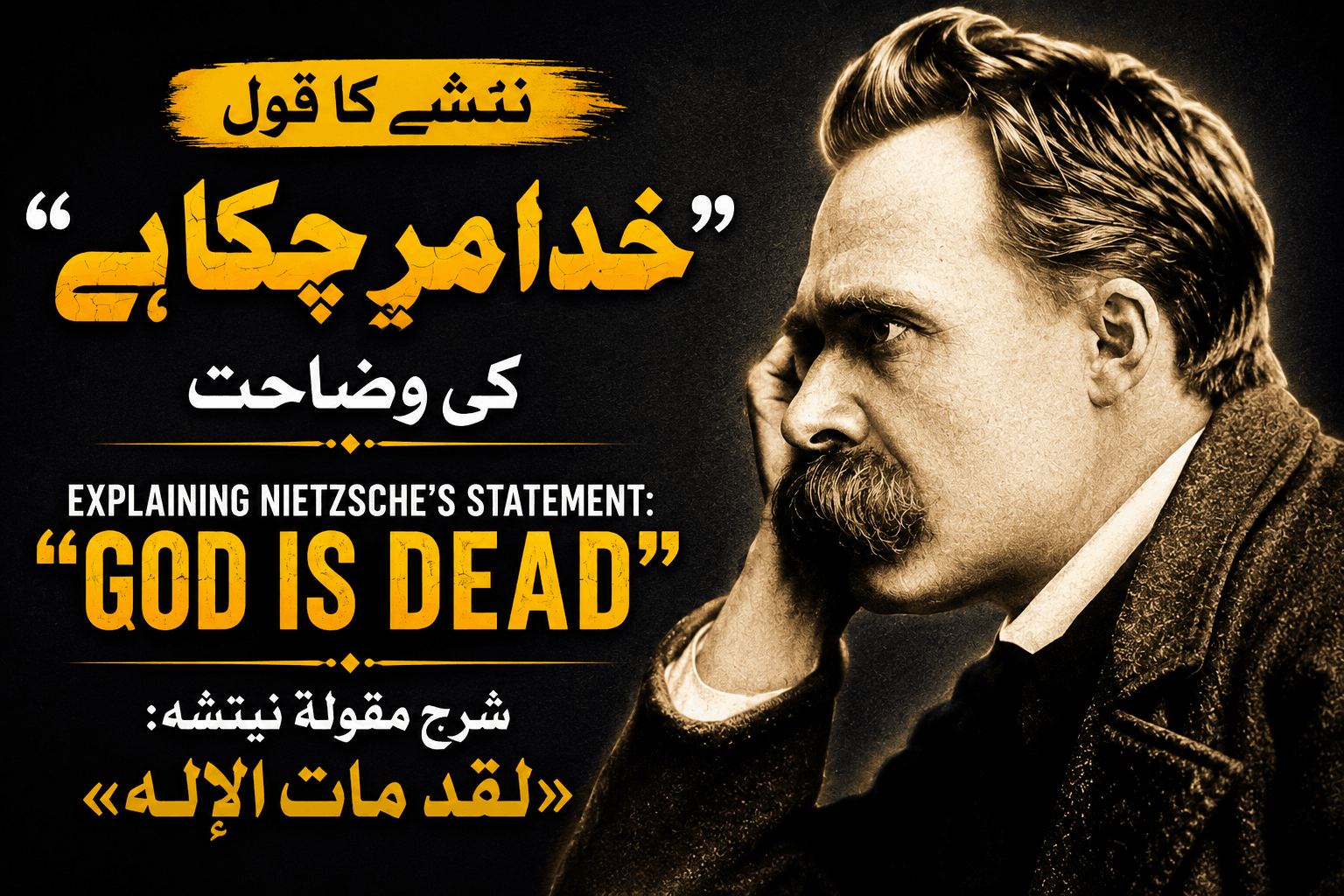
Few statements in the history of philosophy have become as famous—and as widely misunderstood—as the German philosopher Friedrich Nietzsche's declaration: "God is dead."
Contrary to popular belief, Nietzsche was not announcing the literal death of God. Rather, he was offering a profound diagnosis of the intellectual and moral condition of modern Western civilization and expressing deep concern about its future.
Nietzsche presents this statement through the character of the "Madman" in The Gay Science, particularly in Section 125. When the Madman proclaims, "God is dead," he is not making a metaphysical claim. Instead, he argues that with the rise of modern science, secularism, and rationalism, belief in God had ceased to function as the central foundation of morality, meaning, and human life in Western society.
Reference:
Nietzsche, F. (1882). The Gay Science (Die fröhliche Wissenschaft).
The Moral Vacuum and the Threat of Nihilism
Nietzsche's greatest concern was that once people abandoned religious faith and divine moral values, they would lose any objective purpose or meaning in life. He described this condition as nihilism. He warned that if traditional values were destroyed without replacing them with a new and life-affirming system of values, humanity would inevitably face a profound moral and spiritual crisis.
The Philosophy of the Übermensch
Nietzsche introduced the concept of the Übermensch (often translated as "Overman" or "Superman") as his response to nihilism. The Übermensch is not merely a physically superior individual; rather, he is someone who creates his own values, shapes his own destiny, and possesses the courage to give meaning to life despite the collapse of traditional religious certainties.
A Comparison Between Nietzsche and Allama Muhammad Iqbal
An interesting intellectual comparison can be drawn between Nietzsche and Allama Muhammad Iqbal, who studied Nietzsche's philosophy extensively. Although Iqbal rejected Nietzsche's notion of the "death of God" as a fundamentally flawed understanding of reality, he admired Nietzsche's emphasis on human strength, self-development, and overcoming weakness.
Iqbal's philosophy of Khudi (Selfhood), however, differs significantly from Nietzsche's vision. According to Iqbal, the perfection of the self is achieved not by creating values independently of God, but by strengthening one's selfhood in harmony with the Divine Will. A fully developed person becomes morally elevated and spiritually empowered through closeness to God rather than separation from Him.
Reference:
Muhammad Iqbal. The Reconstruction of Religious Thought in Islam.
Conclusion
Nietzsche's famous declaration, "God is dead," should not be understood as a call to atheism. Rather, it is a diagnosis of the cultural and spiritual condition of modern Europe after the decline of religious belief. His central concern was the moral vacuum created by the loss of transcendent values and the danger that this vacuum would lead to nihilism.
For Nietzsche, the proclamation of God's death symbolizes the collapse of traditional sources of meaning and the urgent responsibility of humanity to confront this crisis by creating values capable of sustaining a meaningful and dignified human existence.
References
1. Nietzsche, Friedrich. The Gay Science (Die fröhliche Wissenschaft). 1882.
2. Stanford Encyclopedia of Philosophy. "Friedrich Nietzsche."
3. Iqbal, Muhammad. The Reconstruction of Religious Thought in Islam.
Have a question about this post?
Ask a Question
About the Author
Muhammad Awais
By the boundless grace and guidance of Allah Almighty, Muhammad Awais is associated with the noble journey of teaching, research, and writing. In his quest to quench his thirst for knowledge, he has completed the Dars-e-Nizami (Traditional Islamic Education), an MA in English, an M.Phil in Islamic Studies, and a B.Ed. Currently, he is pursuing his Ph.D. in Islamic Studies at Hazara University. The core of his academic interests primarily revolves around Islamic Sciences, Western Philosophy, contemporary intellectual discourses, Ilm al-Kalam (Islamic Scholastic Theology), and both classical and modern logic—subjects he continuously strives to comprehend more deeply and reflect upon. His association as a 'Master Trainer' with the British Council and other local institutions, coupled with his experience in competitive examinations, has acquainted him with a diverse array of academic disciplines, for which he is profoundly grateful to the Lord of Majesty. With his very limited abilities, he is making a humble effort to contribute a small share towards serving knowledge, offering intellectual guidance, and fostering an environment of positive academic dialogue. It is his heartfelt prayer that the Lord of the Worlds graciously accepts these modest and fragmented efforts in His Divine Presence, and makes this knowledge beneficial for His creation. Ameen.