
Was Sultan Mahmud of Ghazni Really a Plunderer?
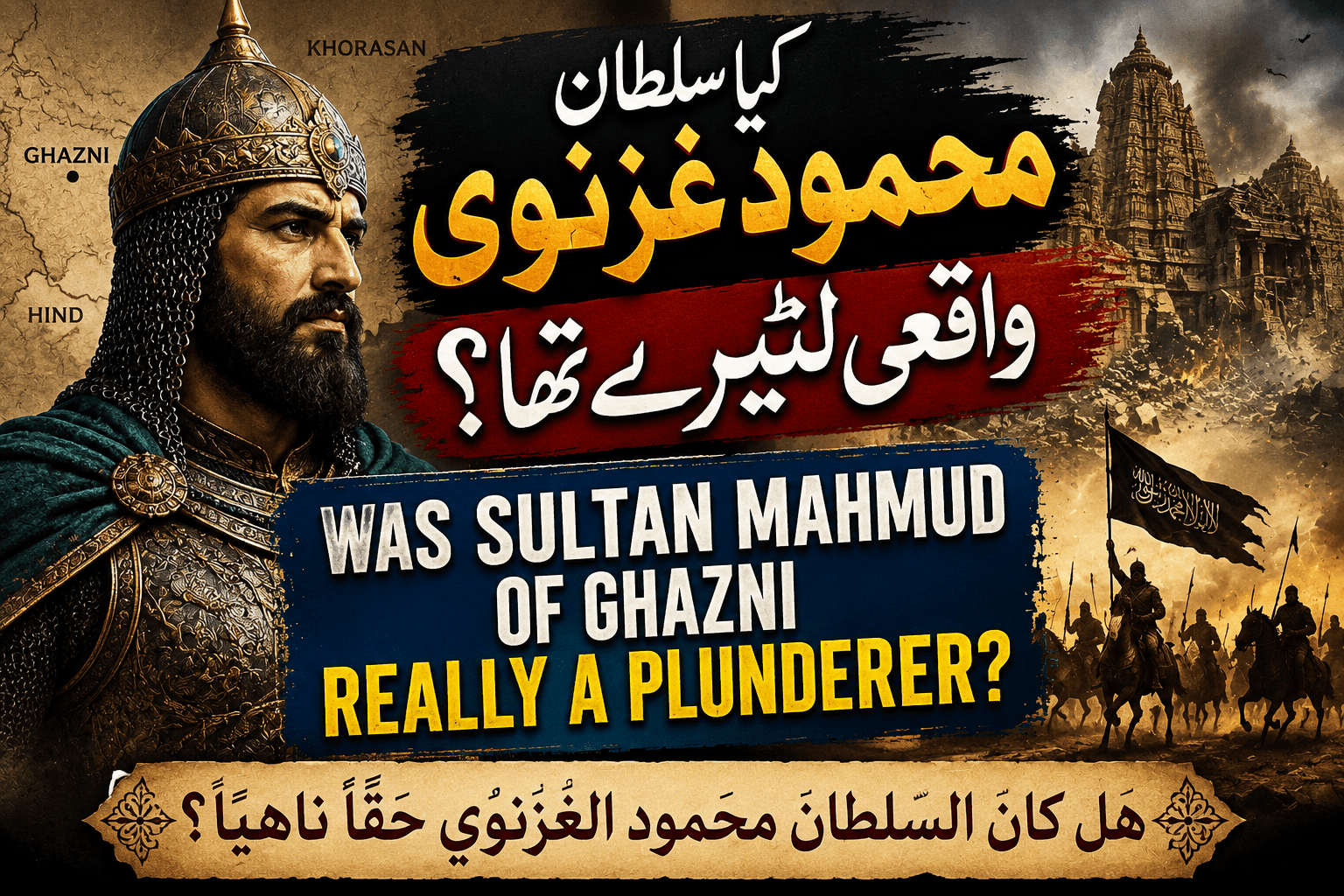
Contrary to the narrative that portrays Sultan Mahmud of Ghazni as merely a "plunderer" or "raider," historical evidence and a number of academic studies present him as a distinguished military commander and a capable ruler. The following are some of the principal arguments advanced in support of this perspective, together with their cited sources.
1. Colonial Political Propaganda
A number of historians argue that the portrayal of Sultan Mahmud as a "plunderer" gained prominence during the British colonial period in the nineteenth century. According to this view, Lord Ellenborough, the Governor-General of India, promoted this narrative as part of the British policy of creating divisions between the peoples of India and Afghanistan in order to consolidate colonial rule. It is also noted that on 9 March 1843, the British Parliament discussed issues related to the portrayal of Mahmud's historical image and its political implications.
Source: Daily Jang (Pakistan), "Why Is Mahmud of Ghazni Called a Plunderer?"
2. Political and Strategic Objectives
According to several historical studies, Sultan Mahmud's campaigns against temples were motivated primarily by political and military considerations rather than by religious intolerance. During the medieval period, temples were not merely places of worship; they also functioned as state treasuries and economic centers that financed local kingdoms. Consequently, targeting these institutions was intended to weaken the financial resources of rival rulers and diminish their military capabilities.
Source: Temple Desecration under Muslim Rule: Critical Analysis of Orientalist Perspective.
3. Clemency and Moral Character
One of the most frequently cited examples of Sultan Mahmud's magnanimity is his treatment of Raja Jayapala. After defeating him in 1001 CE, Mahmud took the Raja prisoner. However, he neither compelled him to embrace Islam nor ordered his execution. Instead, after keeping him in honorable custody for several months, he released him with dignity. Supporters of this interpretation argue that had Mahmud's primary objective been forced conversion or indiscriminate violence, such treatment would have been unlikely.
Source: Darul Uloom Deoband, "Was the Arrival of Muslims in India a Blessing or...?"
4. Patronage of Scholarship and Literature
A ruler remembered solely as a plunderer could hardly have transformed his capital into one of the leading intellectual centers of the Islamic world. Under Sultan Mahmud's patronage, Ghazni became a flourishing center of learning and culture. His court attracted some of the greatest scholars and literary figures of the age, including Al-Biruni, Ferdowsi, and Al-Utbi. It was under Mahmud's patronage that Al-Biruni composed his celebrated work, Kitab al-Hind (Taḥqīq Mā li'l-Hind), one of the most important classical studies of Indian civilization, religion, philosophy, and science.
Source: History of Medieval India, LPU Distance Education.
5. Misconceptions Regarding the Arrival of Islam in India
Historical evidence indicates that Islam had reached the Indian subcontinent centuries before Sultan Mahmud's military expeditions. Arab Muslim merchants had established commercial and cultural relations with the western coast of India from the earliest period of Islam, and some historical accounts also refer to the arrival of Companions of the Prophet ﷺ in the region. Furthermore, the Cheraman Juma Mosque in Kerala, traditionally dated to 629 CE, is frequently cited as evidence that Islam spread to parts of India through peaceful trade, preaching, and cultural interaction rather than solely through military conquest.
Sources: Daily Jang, "Why Is Mahmud of Ghazni Called a Plunderer?"; research by Muhammad Ishaq Bhatti.
Conclusion
Based on these historical references, proponents of this interpretation argue that describing Sultan Mahmud of Ghazni simply as a "plunderer" reflects a politically motivated narrative rather than a balanced historical assessment. They contend that this portrayal was reinforced during the colonial period to support the British strategy of "divide and rule." Accordingly, they maintain that a fair evaluation of Mahmud's legacy requires examining his life, policies, and achievements within their broader historical context rather than reducing his character to a single dimension.
Have a question about this post?
Ask a Question
About the Author
Muhammad Awais
By the boundless grace and guidance of Allah Almighty, Muhammad Awais is associated with the noble journey of teaching, research, and writing. In his quest to quench his thirst for knowledge, he has completed the Dars-e-Nizami (Traditional Islamic Education), an MA in English, an M.Phil in Islamic Studies, and a B.Ed. Currently, he is pursuing his Ph.D. in Islamic Studies at Hazara University. The core of his academic interests primarily revolves around Islamic Sciences, Western Philosophy, contemporary intellectual discourses, Ilm al-Kalam (Islamic Scholastic Theology), and both classical and modern logic—subjects he continuously strives to comprehend more deeply and reflect upon. His association as a 'Master Trainer' with the British Council and other local institutions, coupled with his experience in competitive examinations, has acquainted him with a diverse array of academic disciplines, for which he is profoundly grateful to the Lord of Majesty. With his very limited abilities, he is making a humble effort to contribute a small share towards serving knowledge, offering intellectual guidance, and fostering an environment of positive academic dialogue. It is his heartfelt prayer that the Lord of the Worlds graciously accepts these modest and fragmented efforts in His Divine Presence, and makes this knowledge beneficial for His creation. Ameen.