
Islamic and Western Philosophy: A Comparative and Critical Study
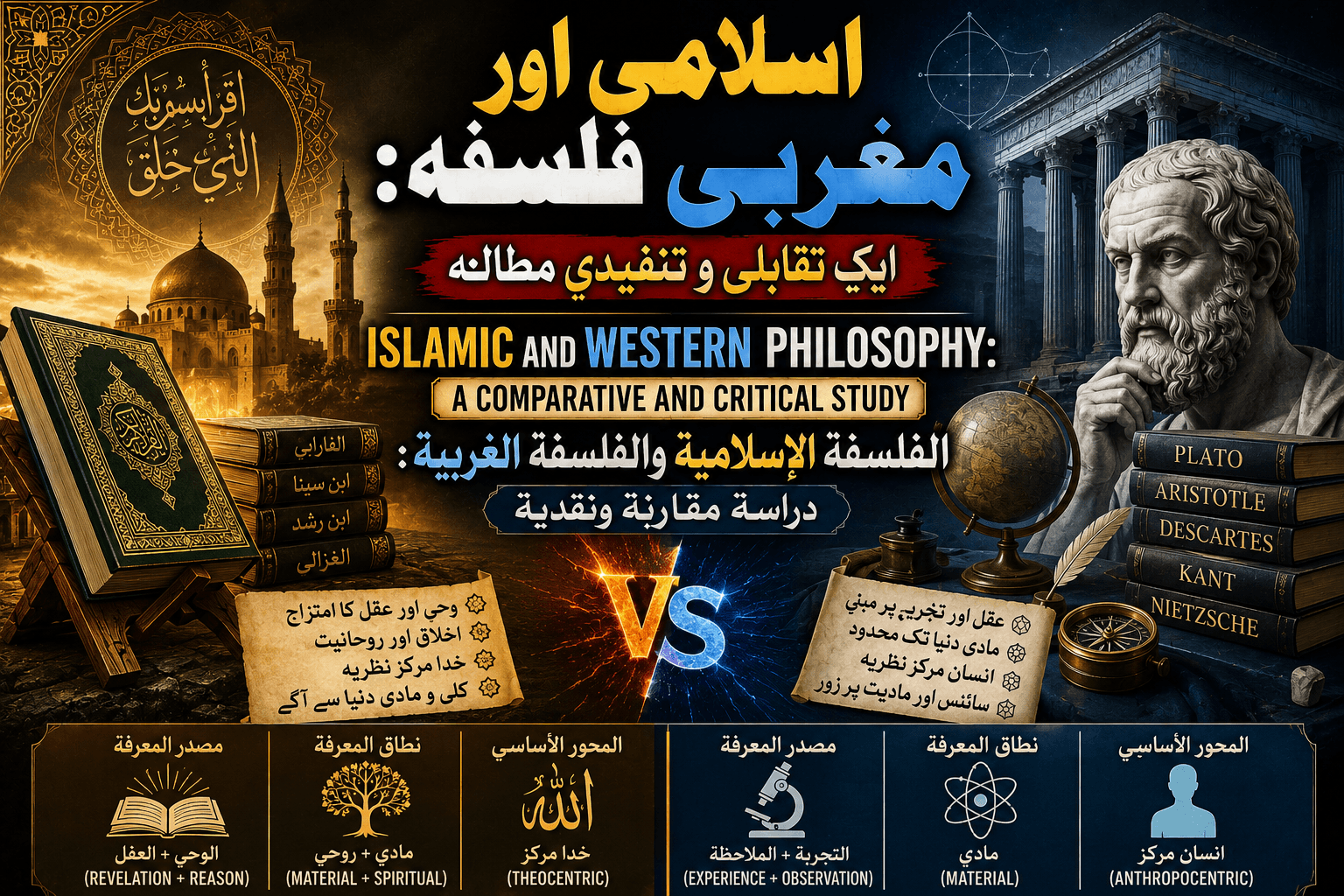
To understand the differences between Islamic philosophy and Western philosophy, it is essential to examine several fundamental issues identified by scholars through various academic studies and research.
1. What Is Islamic Philosophy?
Islamic philosophy is not merely an extension or imitation of Greek philosophy. Rather, it is an independent intellectual tradition that developed within Islamic civilization, grounded in Divine Revelation (the Qur'an) and the Prophetic Sunnah. At its core, it seeks to establish harmony between human reason and revelation, balancing rational inquiry with divine guidance.
Intellectual Foundation
Islamic philosophy is rooted in Islamic beliefs and values. Its scope extends beyond the material world to encompass ethics, political philosophy, epistemology, and metaphysics.
Reference: Islamic Philosophy – Legal Rights Activists.
The Role of Reason
Islamic philosophy recognizes reason as an essential means of acquiring knowledge. However, reason is understood to function under the guidance of revelation rather than independently of it. It complements revelation by helping to understand, interpret, and apply divine teachings without contradicting them.
Reference: What Is Meant by Islamic Philosophy? – Sukhan-e-Ishq.
2. Fundamental Differences Between Islamic and Western Philosophy
The primary distinction between Islamic and Western philosophy lies in their respective sources of knowledge and worldviews.
Empiricism versus Metaphysics
Modern Western philosophy, particularly Positivism, considers sensory experience and scientific observation to be the only reliable sources of knowledge. Consequently, any claim that cannot be empirically verified is often regarded as meaningless or scientifically insignificant.
Islamic philosophy, by contrast, maintains that knowledge is not confined to sensory perception. It also includes metaphysical realities that can be known through sound reason and Divine Revelation.
Reference: Philosophy in Islam and the West – Existenz.
Anthropocentrism versus Theocentrism
Much of modern Western philosophy adopts an anthropocentric perspective, placing human reason, autonomy, and desires at the center of moral and intellectual authority.
Islamic philosophy, on the other hand, is fundamentally theocentric. It recognizes God as the ultimate source of truth, values, and purpose, and views every aspect of human life as subject to divine guidance.
Reference: The Islamic Concept of Life and Western Civilization – Abul A‘la Mawdudi.
Harmony Between Reason and Revelation
One of the defining characteristics of Islamic philosophy is its commitment to maintaining harmony between reason and revelation. These are viewed as complementary sources of knowledge, each operating within its proper domain.
In contrast, the history of Western philosophy has often witnessed tension—and at times outright conflict—between philosophy and religion, leading many modern philosophical traditions to separate intellectual inquiry from religious authority.
Reference: International Journal of Multicultural and Multireligious Understanding.
Have a question about this post?
Ask a Question
About the Author
Muhammad Awais
By the boundless grace and guidance of Allah Almighty, Muhammad Awais is associated with the noble journey of teaching, research, and writing. In his quest to quench his thirst for knowledge, he has completed the Dars-e-Nizami (Traditional Islamic Education), an MA in English, an M.Phil in Islamic Studies, and a B.Ed. Currently, he is pursuing his Ph.D. in Islamic Studies at Hazara University. The core of his academic interests primarily revolves around Islamic Sciences, Western Philosophy, contemporary intellectual discourses, Ilm al-Kalam (Islamic Scholastic Theology), and both classical and modern logic—subjects he continuously strives to comprehend more deeply and reflect upon. His association as a 'Master Trainer' with the British Council and other local institutions, coupled with his experience in competitive examinations, has acquainted him with a diverse array of academic disciplines, for which he is profoundly grateful to the Lord of Majesty. With his very limited abilities, he is making a humble effort to contribute a small share towards serving knowledge, offering intellectual guidance, and fostering an environment of positive academic dialogue. It is his heartfelt prayer that the Lord of the Worlds graciously accepts these modest and fragmented efforts in His Divine Presence, and makes this knowledge beneficial for His creation. Ameen.