
The Concept of the Finality of Prophethood (Khatm-e-Nubuwwat)
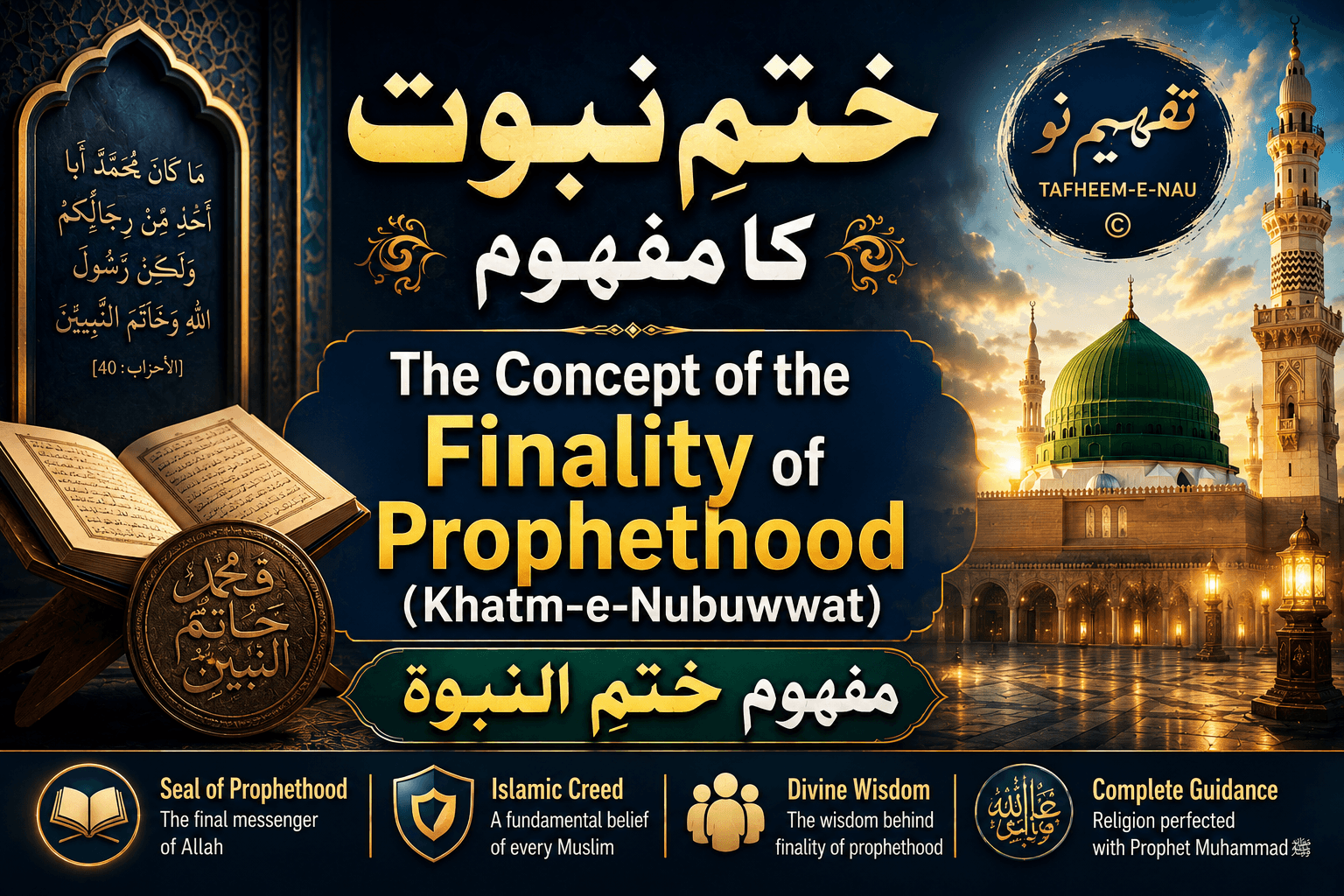
One of the most important and unanimously agreed-upon fundamental beliefs of Islam is the Finality of Prophethood (Khatm-e-Nubuwwat). This means that Prophet Muhammad (PBUH) is the last Prophet and Messenger of Allah, and no new prophet or messenger will come after him until the Day of Judgment. Allah Almighty completed the chain of prophethood with him (PBUH) and declared the religion of Islam as the final and perfect religion for humanity.
Allah Almighty states in the Holy Quran:
مَا كَانَ مُحَمَّدٌ أَبَا أَحَدٍ مِّن رِّجَالِكُمْ وَلَٰكِن رَّسُولَ اللَّهِ وَخَاتَمَ النَّبِيِّينَ (Al-Ahzab: 40)
Translation: (O Muslims!) Muhammad (PBUH) is not the father of any of your men, but he is the Messenger of Allah and the last of all the Prophets.
This blessed verse clearly shows that the chain of prophethood has ended with him (PBUH). This belief is also clarified in the blessed Hadiths.
The Holy Prophet (PBUH) said:
"La Nabiyya Ba'di" (Sahih Bukhari, Hadith No. 3455)
Translation: "There is no prophet after me."
The belief in the Finality of Prophethood is essentially a declaration of the preservation and completion of the religion of Islam. Had the chain of prophethood continued, doors to alteration and division in the religion could have opened, but Allah Almighty perfected the religion by making the Holy Quran the final divine book and the Holy Prophet (PBUH) the last prophet. Therefore, it is obligatory for every Muslim to have perfect faith in this belief. In short, the Finality of Prophethood is not merely a belief, but a strong foundation among the pillars of Islam, which protects the faith, unity, and religious identity of the Muslim Ummah.
The Finality of Prophethood in the Light of the Quran
The belief in the Finality of Prophethood is one of the fundamental and most important beliefs of Islam. This means that Allah Almighty completed the chain of prophethood by sending Prophet Muhammad (PBUH) as the last Prophet and Messenger. No prophet or messenger will come after him (PBUH) until the Day of Judgment. This belief is proven by the Holy Quran, the blessed Hadiths, and the consensus (Ijma) of the Muslim Ummah. The Holy Quran has stated this reality clearly in various places.
The clearest verse regarding the Finality of Prophethood is found in Surah Al-Ahzab:
مَا كَانَ مُحَمَّدٌ أَبَا أَحَدٍ مِّن رِّجَالِكُمْ وَلَكِن رَّسُولَ اللَّهِ وَخَاتَمَ النَّبِيِّينَ (Al-Ahzab: 40)
Translation: (O Muslims!) Muhammad (PBUH) is not the father of any of your men, but he is the Messenger of Allah and the last of all the Prophets.
In this blessed verse, the word "Khatam an-Nabiyyin" is a clear proof that the Holy Prophet (PBUH) is the final link in prophethood. All exegetes (Mufassirun) have explained its meaning as follows: no type of prophethood remains after him (PBUH). Allah Almighty has closed the door of prophethood with him (PBUH).
The Holy Quran did not limit the messengership of the Holy Prophet (PBUH) to a single nation or region but declared it universal for all of humanity. Allah Almighty states:
وَمَا أَرْسَلْنَاكَ إِلَّا كَافَّةً لِّلنَّاسِ بَشِيرًا وَنَذِيرًا (Saba: 28)
Translation: "And We have not sent you but to all mankind as a bearer of good tidings and as a warner."
Previous prophets (Peace Be Upon Them) were sent for specific nations and times, but the Holy Prophet (PBUH) was sent for all humanity. Once his messengership was declared universal and eternal, the need for a new prophet no longer remained.
Similarly, Allah Almighty says:
الْيَوْمَ أَكْمَلْتُ لَكُمْ دِينَكُمْ وَأَتْمَمْتُ عَلَيْكُمْ نِعْمَتِي وَرَضِيتُ لَكُمُ الْإِسْلَامَ دِينًا (Al-Ma'idah: 3)
Translation: "This day I have perfected for you your religion, completed My favor upon you, and have chosen for you Islam as your religion."
It is known from this verse that the religion of Islam has been perfected. When the religion was perfected, no need for a new Sharia or a new prophet remained. If a prophet were to come later, the declaration of the perfection of religion would become meaningless.
These teachings of the Holy Quran also indicate that the Finality of Prophethood is actually a means of protecting the religion. Had the chain of prophethood continued, various people would have made new claims, creating divisions within the Ummah. By granting the last Prophet, the last Book, and a perfect religion, Allah Almighty made arrangements for guidance until the Day of Judgment.
In short, in the light of the Holy Quran, the Finality of Prophethood is an absolute, clear, and unwavering belief. It is necessary for every Muslim to have perfect faith in this belief, because it is one of the important foundational pillars of faith and also the basis for the unity and stability of the Muslim Ummah.
Have a question about this post?
Ask a Question
About the Author
Dr. Muhammad Saeed Awan
Dr. Muhammad Saeed Awan is a distinguished religious scholar, researcher, and dynamic academic professional whose academic and practical life represents a splendid and dignified blend of traditional religious sciences, contemporary modern education, and the corporate world. He completed his Dars-e-Nizami from the country's renowned religious institution, Jamia Darul Uloom Karachi. Alongside his firm grounding in religious sciences, he pursued modern education, earning an M.A. in Islamic Studies from Hazara University, Mansehra. Advancing his journey of research, he completed his MS (M.Phil) with distinction from the International Islamic University Islamabad. Taking this quest for knowledge even further, he successfully completed his Ph.D. from Hazara University. Alongside his academic and research engagements, his role in the practical and economic sphere is highly active, remarkable, and extensive. For several years, he has been effectively rendering his professional services as an Investment Manager at Pak Qatar Family Takaful. This vital responsibility at a renowned financial institution is a clear testament to his exceptional administrative skills and his strong grasp of the modern economic system. Islamic economics, the principles of Takaful, and contemporary intellectual discourses are his primary areas of interest. Through his extensive religious background, profound in-depth study, and corporate sector insight, he is deeply committed to aligning modern economic demands with Islamic principles, actively striving to make a significant contribution to the intellectual and economic guidance of society.