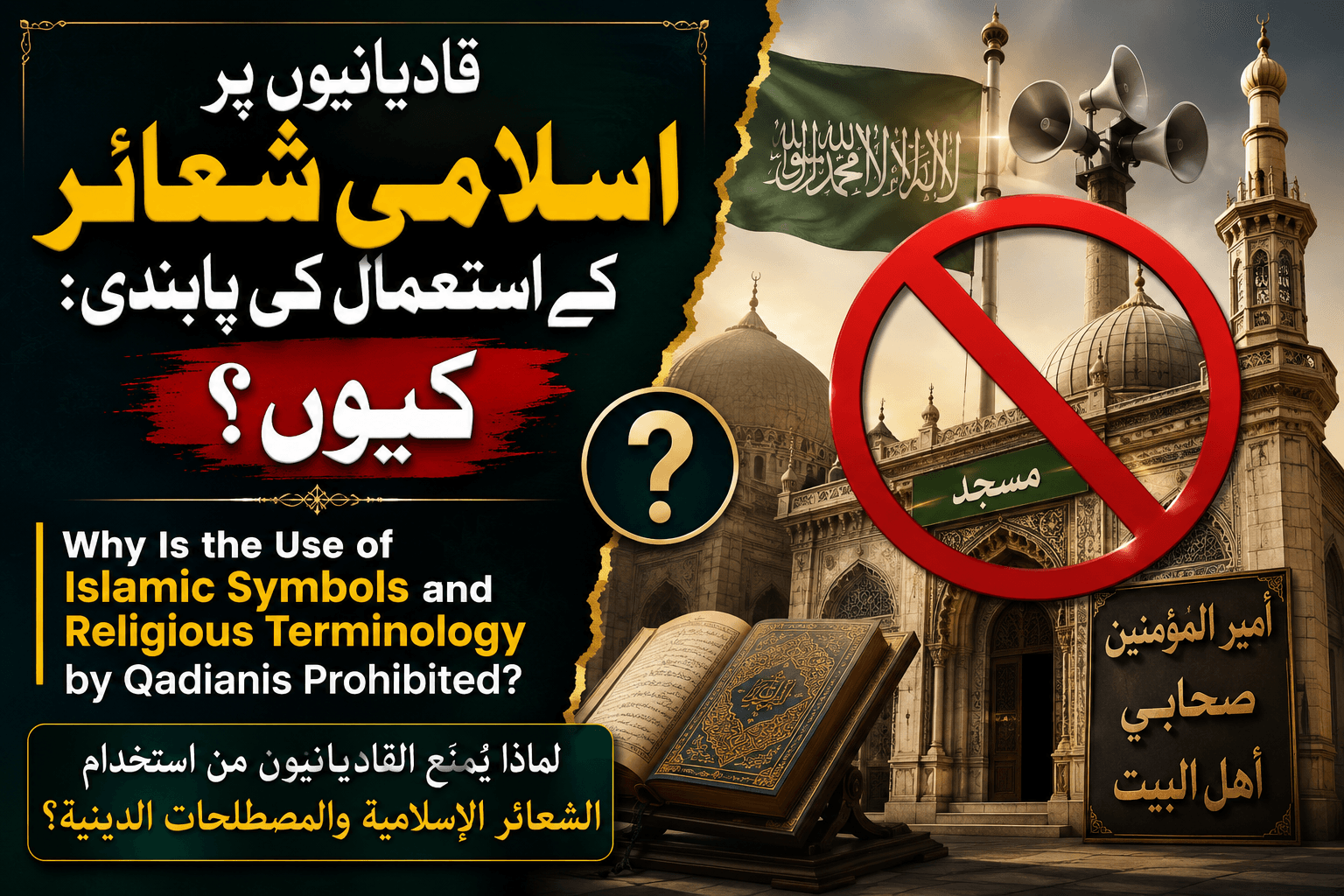
Why Is the Use of Islamic Symbols and Religious Terminology by Qadianis Prohibited?
Background of the Objection
In Pakistan, through the Second Constitutional Amendment of 1974, Article 260(3) of the Constitution was amended to officially declare Ahmadis, Qadianis, and the Lahori Group as non-Muslims. Subsequently, during the regime of General Zia-ul-Haq, Ordinance XX was issued on April 26, 1984, which added Sections 298-B and 298-C to the Pakistan Penal Code. Under these laws, it was made a punishable offense for Ahmadis to call themselves Muslims, represent their religion as Islam, call their places of worship 'Masjids' (Mosques), call the 'Azan', or use specific Islamic titles (such as Ameer-ul-Momineen, Sahabi, Ahl-e-Bait, etc.). The punishment for these offenses was set at up to three years of imprisonment and a fine.
The Objection:
An objection is often raised against this law, arguing that these provisions are a clear violation of Article 20 of the Constitution of Pakistan (which guarantees religious freedom to every citizen) and the Universal Declaration of Human Rights. The objectors argued that performing Islamic prayers, saying "Assalam-o-Alaikum," or calling their places of worship a mosque is a part of their faith; therefore, forcibly preventing them from using their daily religious practices and terminology through state laws, and penalizing them for it, is tantamount to usurping their fundamental human rights.
The Answer:
The superior courts of Pakistan, specifically the Federal Shariat Court (in the Mujeeb-ur-Rehman Case 1985) and the Supreme Court of Pakistan (in Zaheeruddin v. State 1993), provided detailed and logical responses to this objection based on the following solid arguments:
1. The Logic of Trademark Law and the Prevention of Deception:
The Supreme Court of Pakistan, in its majority judgment in Zaheeruddin v. State (1993), rejected this objection by presenting a highly logical example of a "commercial trademark." The court reasoned that:
Just as in the commercial world, a company like Coca-Cola does not allow any other person to sell their product in a Coca-Cola bottle or under its name, even if it costs only a few cents, because it is a violation of the company's property rights and amounts to deceiving the consumers.
Similarly, Islamic terms and symbols (Azan, Masjid, Kalima, etc.) are the exclusive identity and "Trademark" of the Muslim Ummah.
Since the Constitution of Pakistan has declared Ahmadis as non-Muslims, they cannot use specific Islamic titles and symbols to "pass off" as Muslims and deceive the public. The purpose of the law is to prevent deception and protect the property rights of others.
2. Establishment of a Separate Ummah and the Condition to Coin New Terms:
The Federal Shariat Court, in the Mujeeb-ur-Rehman v. Federal Government (1985) case, shed detailed light on this aspect, stating that the conduct of the Qadiani/Ahmadi community contradicts their own claims.
The court held that since Ahmadis recognize only their followers as true Muslims and have declared all other Muslims as infidels (Kafirs), thereby forming a separate Ummah, they are no longer a part of the Muslim Ummah.
The court clarified that Ordinance XX does not stop Qadianis from practicing their religion, but rather prevents them from using terminology that does not belong to them. Therefore, they have no right to use Islamic symbols, and they are free to coin new terms for their places of worship and religious practices.
3. Public Order and Defense of Ideological Frontiers:
Article 20 of the Constitution of Pakistan does not make religious freedom absolute and unconditional; rather, this freedom is "subject to law, public order, and morality."
The Supreme Court ruled that Ahmadis publicly posing as Muslims and adopting Islamic symbols severely injures the religious sentiments of the Muslim majority, creating a grave threat to law and order in the country.
Citing historical facts, the court stated that Muslims in the subcontinent view the emergence of the Ahmadiyya community as an "attack on ideological frontiers," because the political and social organization of the Muslim society is inherently based on its religion.
The court concluded that no individual can be allowed to insult the religion of another community under the guise of religious freedom. Therefore, to maintain public order and save the country from civil war, the state has the absolute right to legally restrict such provocative actions.
Have a question about this post?
Ask a Question
About the Author
Muhammad Awais
By the boundless grace and guidance of Allah Almighty, Muhammad Awais is associated with the noble journey of teaching, research, and writing. In his quest to quench his thirst for knowledge, he has completed the Dars-e-Nizami (Traditional Islamic Education), an MA in English, an M.Phil in Islamic Studies, and a B.Ed. Currently, he is pursuing his Ph.D. in Islamic Studies at Hazara University. The core of his academic interests primarily revolves around Islamic Sciences, Western Philosophy, contemporary intellectual discourses, Ilm al-Kalam (Islamic Scholastic Theology), and both classical and modern logic—subjects he continuously strives to comprehend more deeply and reflect upon. His association as a 'Master Trainer' with the British Council and other local institutions, coupled with his experience in competitive examinations, has acquainted him with a diverse array of academic disciplines, for which he is profoundly grateful to the Lord of Majesty. With his very limited abilities, he is making a humble effort to contribute a small share towards serving knowledge, offering intellectual guidance, and fostering an environment of positive academic dialogue. It is his heartfelt prayer that the Lord of the Worlds graciously accepts these modest and fragmented efforts in His Divine Presence, and makes this knowledge beneficial for His creation. Ameen.