
Are Islamic Penal Laws a Product of an Ancient Tribal Era? A Scholarly Evaluation
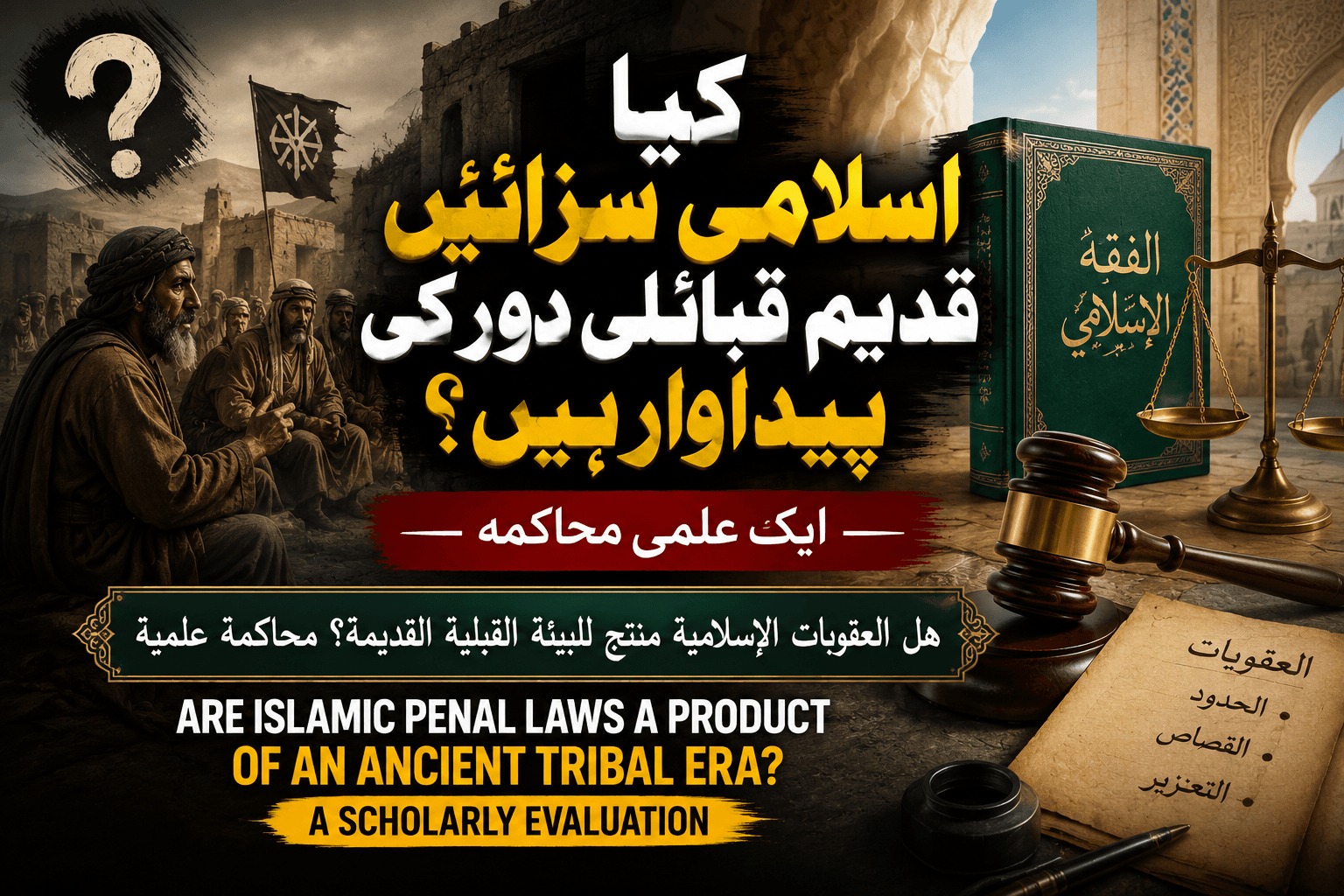
It has become a recurring argument today to claim that Islamic penal laws (the
Hudud) were merely a necessity of a bygone, desert-tribal society, and that their implementation in our "civilized and modern" era is an affront to humanity. To move beyond mere rhetoric, let us weigh this claim on the scales of logic and intellectual rigor.
1) What is the true yardstick of "Modernity"?
The first question is: does a law’s "modernity" or "antiquity" determine its validity or error? If we accept the current Western legal framework as the absolute measure of truth, we must then ask: has this modern system actually succeeded in curbing crime? Today, in the most "advanced" societies where penalties are limited to incarceration and fines, we see an alarming rise in crime rates. If a law fails to secure society or human safety, can we really hide its failure behind the facade of being "modern"?
2) The Constancy of Human Nature:
Human nature has not changed in the last 1,400 years; man today possesses the same greed, desires, anger, and urge for vengeance as his ancestors. Islamic penal laws do not address a "time period"; they address the human condition. Just as the principles of mathematics remain constant, the foundational principles of ethics, justice, and accountability transcend the limits of time. Sharia posits that these laws are in perfect harmony with this unchanging human nature, which is why they do not expire with time but remain a balanced path for humanity in every age.
3) The Philosophy of Punishment: Vengeance or Reform?
Critics often label these laws as "barbaric" to incite emotion, but this is a fundamental intellectual fallacy. The purpose of punishment in Islam is not merely to destroy the criminal, but to serve as a deterrent so powerful that the very thought of committing such crimes becomes horrifying to the public. Current "civilization" sheds tears for the rights of the criminal, while ignoring the rights of the society whose peace has been shattered by a single act of violence. Severity in Islam is, in fact, a form of profound mercy—protecting thousands of innocent lives from the harm of a single predator.
4) Are they truly "Tribal"?
Labeling these laws as "tribal" is a historical inaccuracy. Is Roman law, which forms the basis of the modern Western legal system, not also ancient? Do we reject the philosophy of democracy or human rights simply because they were founded by ancient Greeks? The value of a law is not determined by its origin, but by its "utility and effectiveness." Islam derives its laws from Divine Revelation—the knowledge of the Creator who understands the human psyche—not from the trial-and-error experiments of a tribal leader.
5) Rigorous Judicial Standards:
A vital scholarly point is that Islam has established extremely stringent judicial requirements (such as the necessity of four eyewitnesses or absolute, ironclad proof) for the implementation of these penalties. These laws are designed primarily to prevent crime from occurring in the first place, and where it does occur, the burden of proof is set so high that the innocent are protected from miscarriage of justice. Our modern crisis is not that the laws are "old," but that we have lost the judicial integrity required to apply them with their intended Islamic spirit of equity.
6) Conclusion
The claim that Islamic penal laws are "outdated" is merely an echo of Orientalist narratives that seek to impose secular molds upon every aspect of life. In reality, the skyrocketing crime rates in the modern world prove that humanity is in dire need of the principles that teach us to respect our boundaries and honor our nature.
Rejecting a law simply because it is "not a product of the current moment" is not intellectual integrity; it is merely following the passing fads
of contemporary thought.
Have a question about this post?
Ask a Question
About the Author
Muhammad Awais
By the boundless grace and guidance of Allah Almighty, Muhammad Awais is associated with the noble journey of teaching, research, and writing. In his quest to quench his thirst for knowledge, he has completed the Dars-e-Nizami (Traditional Islamic Education), an MA in English, an M.Phil in Islamic Studies, and a B.Ed. Currently, he is pursuing his Ph.D. in Islamic Studies at Hazara University. The core of his academic interests primarily revolves around Islamic Sciences, Western Philosophy, contemporary intellectual discourses, Ilm al-Kalam (Islamic Scholastic Theology), and both classical and modern logic—subjects he continuously strives to comprehend more deeply and reflect upon. His association as a 'Master Trainer' with the British Council and other local institutions, coupled with his experience in competitive examinations, has acquainted him with a diverse array of academic disciplines, for which he is profoundly grateful to the Lord of Majesty. With his very limited abilities, he is making a humble effort to contribute a small share towards serving knowledge, offering intellectual guidance, and fostering an environment of positive academic dialogue. It is his heartfelt prayer that the Lord of the Worlds graciously accepts these modest and fragmented efforts in His Divine Presence, and makes this knowledge beneficial for His creation. Ameen.