
Sex or Gender? The Islamic Perspective
:The Objection:
Secular and liberal thinkers consider "gender" to be a social construct and an internal feeling. Based on this, they raise the objection: Why does Islam consider only the biological sex assigned at birth as the absolute and final reality?
The Response:
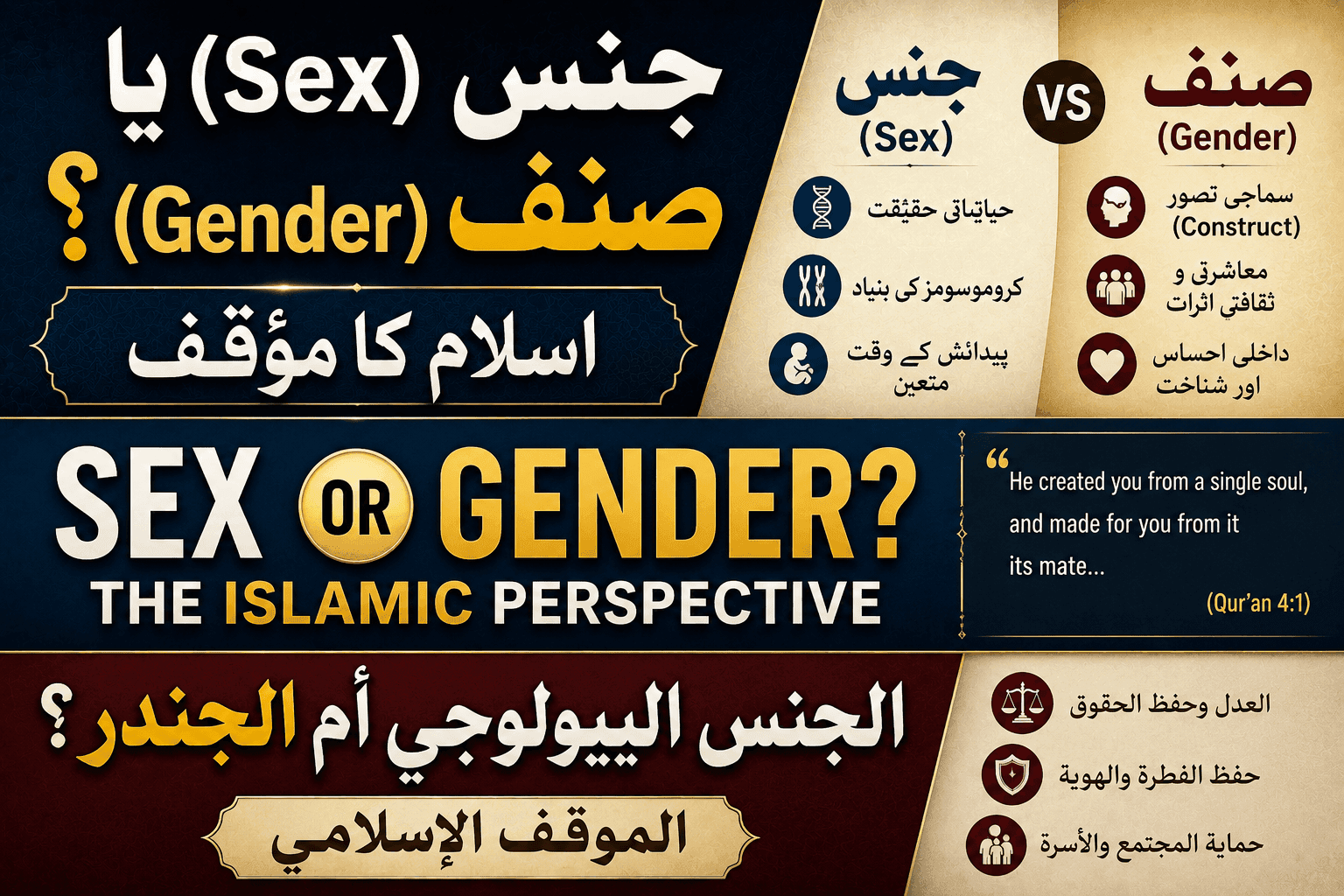
To understand the basis of this objection, it is essential to comprehend the difference between two fundamental terms in modern Western sociology: "Sex" and "Gender." According to liberal and secular thinkers, "sex" refers to the biological and physical characteristics based on which a child is declared male or female at birth. In contrast, "gender" is considered a social construct and an internal feeling.
According to Western dictionaries, such as Merriam-Webster and Oxford, a transgender person is someone whose internal identity and perception of their gender do not align with their biological sex assigned at birth:
"of, relating to, or being a person whose gender identity differs from the sex the person was identified as having at birth."
The core of the secular thinkers' objection is their claim that a person's true identity is their self-perceived gender identity (their internal and psychological feeling), rather than their physical body. According to them, society and the law should recognize this internal feeling of the individual, even if it completely contradicts their physical anatomy. Consequently, they criticize Islam, questioning why Islamic laws (such as inheritance, hijab, and the family system) are strictly limited to birth anatomy and biology, and why they do not grant an individual's internal psychological inclinations the status of their definitive identity.
The Distinction Regarding Khuntha (Intersex):
Liberal circles often propagate the impression that Islam entirely ignores gender diversity or medical complexities. This is a massive academic misconception. Classical Islamic jurisprudence (Fiqh) contains highly detailed and compassionate laws regarding sexual ambiguity. Islam fully recognizes the rights of individuals born with ambiguous primary sex organs, who are termed "Khuntha" (Intersex) in jurisprudential terminology.
Jurists have formulated clear rules for determining their sex in light of medical and physical signs (such as the urinary tract or signs of puberty). If it is medically impossible to determine the sex (a condition known as Khuntha Mushkil), there are still middle-ground solutions and specific rulings for them.
However, what Islam strictly rejects is the practice of the "Mukhannath" (Effeminate man/Transgender by choice), where a person is physically and biologically a complete male but deliberately, driven merely by psychological inclination, adopts the resemblance of women. The blessed Ahadith (prophetic traditions) have cursed men who imitate women. The fundamental reason for this is that rebelling against the biological system established by nature leads to societal corruption and disorder.
Protection of Women's Rights:
Another highly crucial aspect in refuting this objection is social protection, particularly the defense of women's rights. This point was strongly emphasized in the ruling of the Federal Shariat Court and in human rights debates: accepting internal gender identity as an absolute reality jeopardizes the "safe spaces" of women.
If the law accepts mere internal claims of an individual instead of biology, any biological male could declare his identity as a woman and enter female washrooms, hospital wards, and educational institutions. This is a blatant violation of women's privacy and their social safety.
Unnatural Imposition of Western Terminology on Local Culture:
From an academic and research perspective, the contemporary term "transgender," which considers psychological feeling as the sole criterion for gender, is actually a product of Western and colonial thought that does not align with the indigenous family and societal realities of South Asia.
Historically, the "Khawaja Sira" community found in the subcontinent has had its own distinct cultural and traditional identity based on the Guru-Chela (master-disciple) system. This is being forcefully conflated with liberal Western concepts of being 'transgender.' Liberal thinkers are ignoring these local historical facts and attempting to impose a framework that advocates for the unlimited and undefined internal freedom of the individual.
Conclusion:
In summary, Islam's foundation of human identity on biological sex is, in fact, a realistic, objective, and socially balanced decision. Internal feelings and psychological states can change with time, circumstances, and environment; therefore, they cannot be made the definitive foundation for any concrete family, legal, or economic system (such as inheritance and marriage).
While Islam provides a compassionate and detailed legal capacity for genuine medical compulsions (Intersex/Khuntha), it simultaneously rejects rebellion against innate biological identity based merely on psychological and internal desires, ensuring that the moral and legal balance of society remains intact.
Have a question about this post?
Ask a Question
About the Author
Muhammad Awais
By the boundless grace and guidance of Allah Almighty, Muhammad Awais is associated with the noble journey of teaching, research, and writing. In his quest to quench his thirst for knowledge, he has completed the Dars-e-Nizami (Traditional Islamic Education), an MA in English, an M.Phil in Islamic Studies, and a B.Ed. Currently, he is pursuing his Ph.D. in Islamic Studies at Hazara University. The core of his academic interests primarily revolves around Islamic Sciences, Western Philosophy, contemporary intellectual discourses, Ilm al-Kalam (Islamic Scholastic Theology), and both classical and modern logic—subjects he continuously strives to comprehend more deeply and reflect upon. His association as a 'Master Trainer' with the British Council and other local institutions, coupled with his experience in competitive examinations, has acquainted him with a diverse array of academic disciplines, for which he is profoundly grateful to the Lord of Majesty. With his very limited abilities, he is making a humble effort to contribute a small share towards serving knowledge, offering intellectual guidance, and fostering an environment of positive academic dialogue. It is his heartfelt prayer that the Lord of the Worlds graciously accepts these modest and fragmented efforts in His Divine Presence, and makes this knowledge beneficial for His creation. Ameen.