
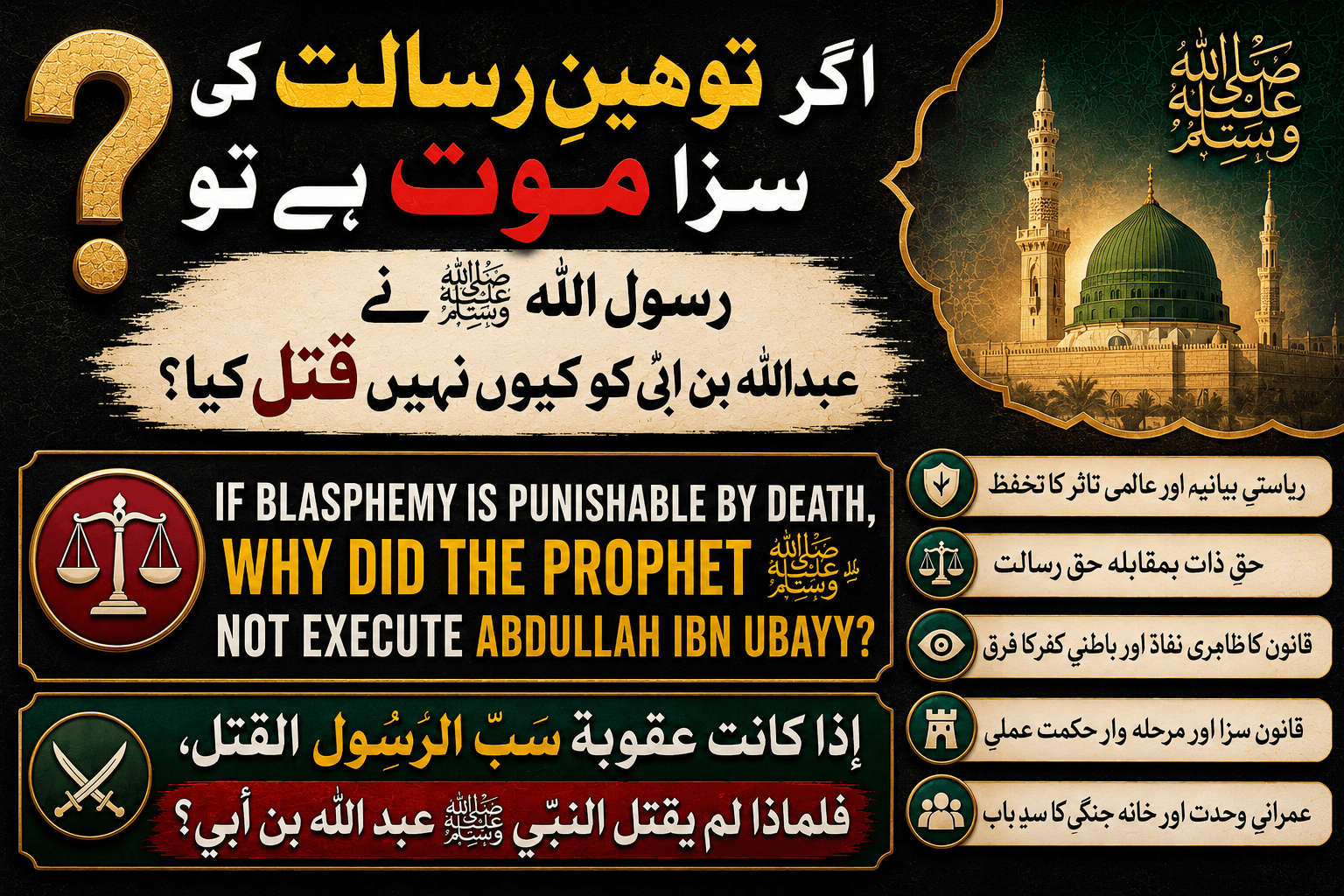
If Blasphemy Is Punishable by Death, Why Did the Prophet ﷺ Not Execute Abdullah ibn Ubayy?
The Objection:
"If the punishment for blasphemy against the Prophet (ﷺ) and treason in Islam is death, why did the Prophet (ﷺ) not allow the execution of Abdullah ibn Ubayy, the leader of the hypocrites?"
Critics often point to the incident during the Ghazwah of Banu al-Mustaliq, where Abdullah ibn Ubayy famously remarked, "When we return to Medina, the more honorable will surely drive out the meaner," (na'udhu billah). When Umar ibn al-Khattab (RA) and even Abdullah ibn Ubayy’s own son (Abdullah ibn Abdullah, RA) requested permission to execute him, the Prophet (ﷺ) forbade them. Critics argue that this demonstrates that there is no fixed corporal punishment for blasphemy, or that the state has the absolute authority to grant pardons for such crimes.
Response:
Instead of viewing this incident through an emotional or singular lens, a comprehensive analysis—situated in the context of the nascent Islamic State, political sociology, and strategic statecraft—reveals profound wisdom:
1. Preservation of State Narrative and Global Perception (Information Warfare):
The state of Medina was in its most sensitive phase of formation, surrounded by hostile tribes, the Jewish community, and the Quraysh of Mecca. Abdullah ibn Ubayy was, in the eyes of the law, a "Muslim" who recited the Shahadah and prayed with the community. Had the Prophet (ﷺ) ordered his execution, the external perception would not have been that of a "hypocrite" being punished, but rather a propaganda victory for enemies who would claim: "Muhammad (ﷺ) kills his own companions." The Prophet’s (ﷺ) historic statement, "Let not the people say that Muhammad kills his companions," (Sahih Bukhari) was a masterclass in diplomacy and 'soft power,' preventing the alienation of new converts and the fragmentation of the state.
2. Rights of the Individual vs. Rights of the Message:
Islamic jurisprudence establishes a nuanced distinction: The Prophet (ﷺ) possessed the authority to forgive personal insults directed at his own person, a reflection of his unparalleled mercy. However, after his passing, the honor of the Prophet (ﷺ) and the sanctity of the Message became a matter of state law and collective societal duty, not a personal right that can be waived by individuals. As Sheikh al-Islam Ibn Taymiyyah (RA) clarifies in Al-Sarim al-Maslul, the Prophet’s (ﷺ) pardoning was an act of prophetic mercy and discretion, which cannot be adopted as a legal precedent (exception) for the Ummah to ignore the crime of blasphemy.
3. Distinguishing Between External Law and Internal Belief:
A golden principle of Islamic law is: "We judge by what is apparent, while Allah deals with the secrets of the heart."
Abdullah ibn Ubayy’s primary crime was 'Nifaq' (hypocrisy), an internal condition known only through divine revelation (Wahi), not through material evidence. Had he been executed based solely on revelation without a public, judicial process, it would have set a dangerous legal precedent, allowing future rulers to eliminate political dissidents by simply labeling them "hypocrites." The Prophet (ﷺ) safeguarded the integrity of the judicial process by prioritizing observable, legal proofs.
4. Gradualism in Legal Implementation (Gradualism in Law):
The history of Islamic law shows that the implementation of penal codes was contingent upon state authority and stability. In the Meccan period, the focus was on patience and resilience, whereas in the Medinan period, as the state solidified, penal laws were fully implemented. The case of Abdullah ibn Ubayy occurred during a transitional phase where internal unity was the primary existential priority.
5. Maintaining Social Cohesion and Preventing Civil War:
Abdullah ibn Ubayy was a tribal chieftain of the Khazraj. Executing him would have likely triggered deep-seated tribal animosity, potentially reigniting the wars between the Aws and Khazraj tribes that Islam had only recently resolved. The Prophet’s (ﷺ) strategy led to the natural outcome where the hypocrite became socially isolated, ultimately losing his credibility among his own family and tribe, dying in complete political and social obscurity.
Conclusion:
The decision not to execute Abdullah ibn Ubayy is not proof of the absence of punishment for blasphemy; rather, it is a testament to the sophistication of Islamic governance. It highlights the importance of "Fiqh al-Waqi" (Contextual Jurisprudence—the science of understanding current realities and socio-political context) and "Ma'alat al-Af'al" (Consequences of Actions—the foresight to assess the long-term impact of a decision). The Prophet (ﷺ) demonstrated that a state leader must balance justice with stability and diplomatic wisdom, providing a milestone for modern statecraft and intellectual discourse.
Have a question about this post?
Ask a Question
About the Author
Muhammad Awais
By the boundless grace and guidance of Allah Almighty, Muhammad Awais is associated with the noble journey of teaching, research, and writing. In his quest to quench his thirst for knowledge, he has completed the Dars-e-Nizami (Traditional Islamic Education), an MA in English, an M.Phil in Islamic Studies, and a B.Ed. Currently, he is pursuing his Ph.D. in Islamic Studies at Hazara University. The core of his academic interests primarily revolves around Islamic Sciences, Western Philosophy, contemporary intellectual discourses, Ilm al-Kalam (Islamic Scholastic Theology), and both classical and modern logic—subjects he continuously strives to comprehend more deeply and reflect upon. His association as a 'Master Trainer' with the British Council and other local institutions, coupled with his experience in competitive examinations, has acquainted him with a diverse array of academic disciplines, for which he is profoundly grateful to the Lord of Majesty. With his very limited abilities, he is making a humble effort to contribute a small share towards serving knowledge, offering intellectual guidance, and fostering an environment of positive academic dialogue. It is his heartfelt prayer that the Lord of the Worlds graciously accepts these modest and fragmented efforts in His Divine Presence, and makes this knowledge beneficial for His creation. Ameen.