
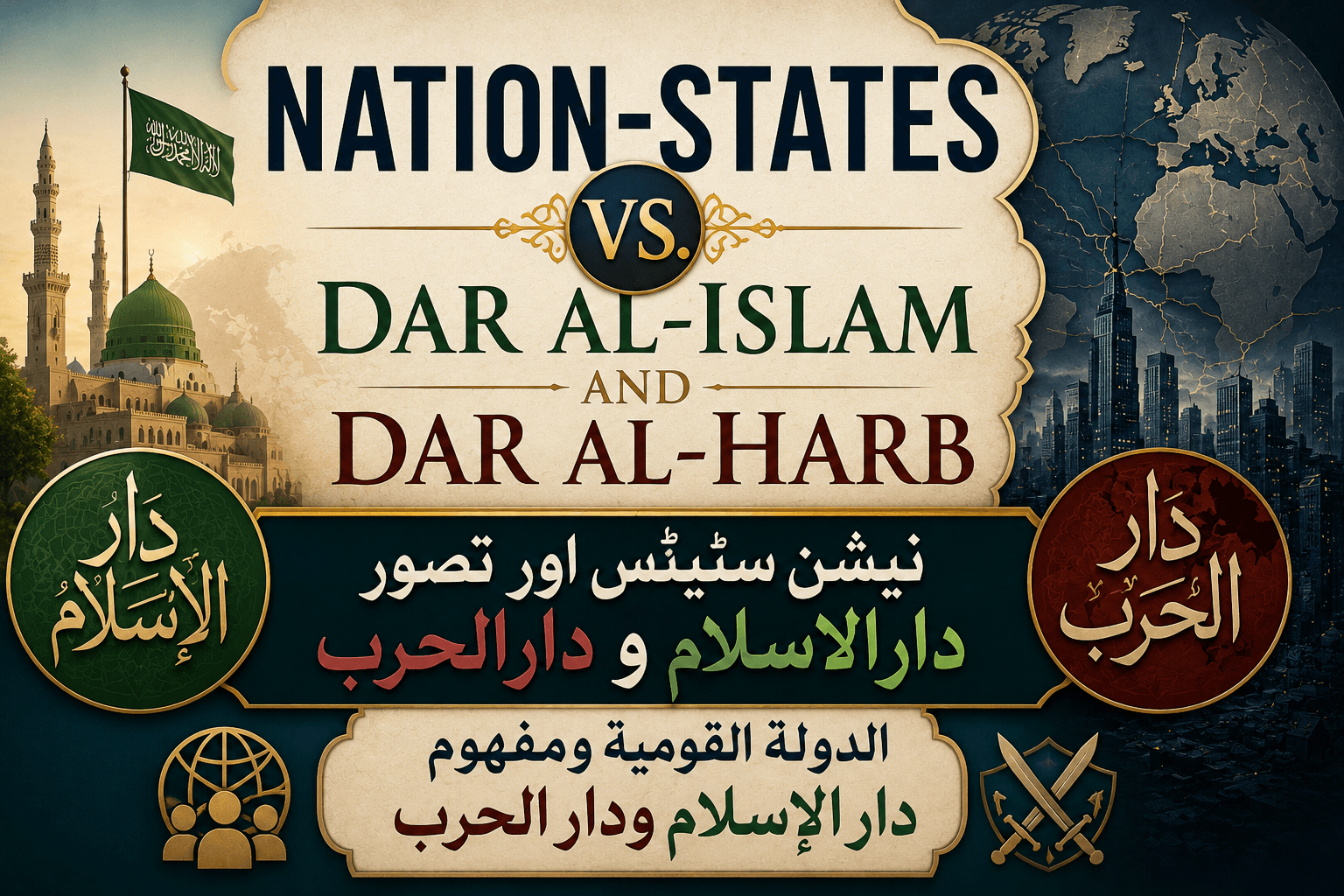
Nation-States vs. Dar al-Islam and Dar al-Harb
Objection:
Critics claim that dividing the world into the categories of Dar al-Islam (Abode of Islam) and Dar al-Harb (Abode of War) is neither an eternal nor a textually mandated (mansus) ruling in the Quran and Sunnah. In their view, this division was a jurisprudential deduction (ijtihad) by medieval jurists that emerged within the context of the geographical conditions, tribal factions, and mutual conflicts of global empires of that era. According to them, in the contemporary era—where sovereign states, defined borders, and international laws prevail under the Westphalian System—such a division based on religious grounds has not only become irrelevant but is also incompatible with the concepts of global peace and state sovereignty.
Response:
The response to this objection can be understood in light of the following scholarly points:
1. The Distinction Between Legal Frameworks and Textually Mandated Terms
It is a fact that the terms Dar al-Islam and Dar al-Harb do not appear literally in the Holy Quran; however, their foundational concept is derived from the Quran and Sunnah. Islamic jurists formulated these terms to give an organized legal structure to various Shariah rulings, such as migration (hijrah), jihad, asylum (aman), and the collective affairs of Muslims. Just as terms like "state," "border," and "jurisdiction" are adopted in modern international law for legal convenience, the purpose of these terms in Islamic jurisprudence was to provide practical and legal guidance, rather than to invent a new Shariah command.
2. The Pre-Modern International System and Historical Reality
At the time of the advent of Islam, the modern concept of "Nation States" did not exist. Instead, the world was divided into large empires with unstable borders subject to shifting political conditions. Relations between states were mostly based on war, dominance, or temporary treaties. In such an environment, Islamic jurists established a legal division to safeguard the lives, property, and religious freedom of Muslims, making it clear where Islamic law was enforced, where Muslims enjoyed religious freedom, and where their rights faced threats.
3. The Evolutionary Nature of Jurisprudential Terms
The division between Dar al-Islam and Dar al-Harb was never static in Islamic jurisprudence; rather, its interpretation changed over different eras according to circumstances:
In the early period, Dar al-Islam referred to the territory ruled by a Muslim sovereign.
Later, particularly after the Mongol invasions, some jurists modified this criterion, making the enforcement of Islamic laws the basis of Dar al-Islam, even if the ruler was not Muslim.
In the modern era, numerous scholars have further broadened this concept, stating that any country where Muslims can practice their religious duties with complete freedom can also fall under the meaning of Dar al-Islam.
This evolution is clear proof that this division was a jurisprudential tool, not an unalterable article of faith.
4. Dar al-Ahd and Modern International Relations
Islamic jurisprudence did not restrict the world solely to Dar al-Islam and Dar al-Harb; it also recognized a distinct category known as Dar al-Ahd (Abode of Treaty) or Dar al-Sulh (Abode of Peace). This referred to states with which Muslims shared peace or mutual cooperation treaties. Today, when most countries are bound by the UN Charter and international treaties, these relations can be understood jurisprudentially under the principle of Dar al-Ahd. Consequently, the classical jurisprudential concept of Dar al-Harb, which was based on a state of perpetual warfare, no longer retains its practical status in the current international system.
5. The Concept of the Ummah and Transnational Identity
Collective identity in Islam is not confined to geographical boundaries but is rooted in the concept of the Ummah, which represents a transnational religious community. A major objective of the jurisprudential division of Dar al-Islam was to provide a shared legal and religious identity for Muslims worldwide. While this concept certainly differs from modern state citizenship, its core purpose was to protect the religious, legal, and collective rights of Muslims. Therefore, it is incorrect to view this division solely through the lens of political geography; it must be understood within the framework of the higher objectives (maqasid) of Islamic law.
Conclusion:
It is incorrect to assert that the concept of Dar al-Islam and Dar al-Harb is entirely detached from the Shariah or that it was merely an baseless invention of the jurists. The reality is that while these terms are indeed the result of jurisprudential ijtihad, they are grounded in principles from the Quran and Sunnah aimed at protecting the life, property, faith, and collective rights of Muslims.
While the practical applications and legal interpretations of these terms may change with time—as Islamic jurists have indeed demonstrated throughout history—the underlying core principles, namely the protection of human rights, religious freedom, legal responsibility, and social order, remain vital today. Therefore, separating these terms from their historical, jurisprudential, and legal context and dismissing them as a mere temporary medieval invention is not a scholarly sound analysis.
Have a question about this post?
Ask a Question
About the Author
Muhammad Awais
By the boundless grace and guidance of Allah Almighty, Muhammad Awais is associated with the noble journey of teaching, research, and writing. In his quest to quench his thirst for knowledge, he has completed the Dars-e-Nizami (Traditional Islamic Education), an MA in English, an M.Phil in Islamic Studies, and a B.Ed. Currently, he is pursuing his Ph.D. in Islamic Studies at Hazara University. The core of his academic interests primarily revolves around Islamic Sciences, Western Philosophy, contemporary intellectual discourses, Ilm al-Kalam (Islamic Scholastic Theology), and both classical and modern logic—subjects he continuously strives to comprehend more deeply and reflect upon. His association as a 'Master Trainer' with the British Council and other local institutions, coupled with his experience in competitive examinations, has acquainted him with a diverse array of academic disciplines, for which he is profoundly grateful to the Lord of Majesty. With his very limited abilities, he is making a humble effort to contribute a small share towards serving knowledge, offering intellectual guidance, and fostering an environment of positive academic dialogue. It is his heartfelt prayer that the Lord of the Worlds graciously accepts these modest and fragmented efforts in His Divine Presence, and makes this knowledge beneficial for His creation. Ameen.