
Penalty for Apostasy and Freedom of Conscience
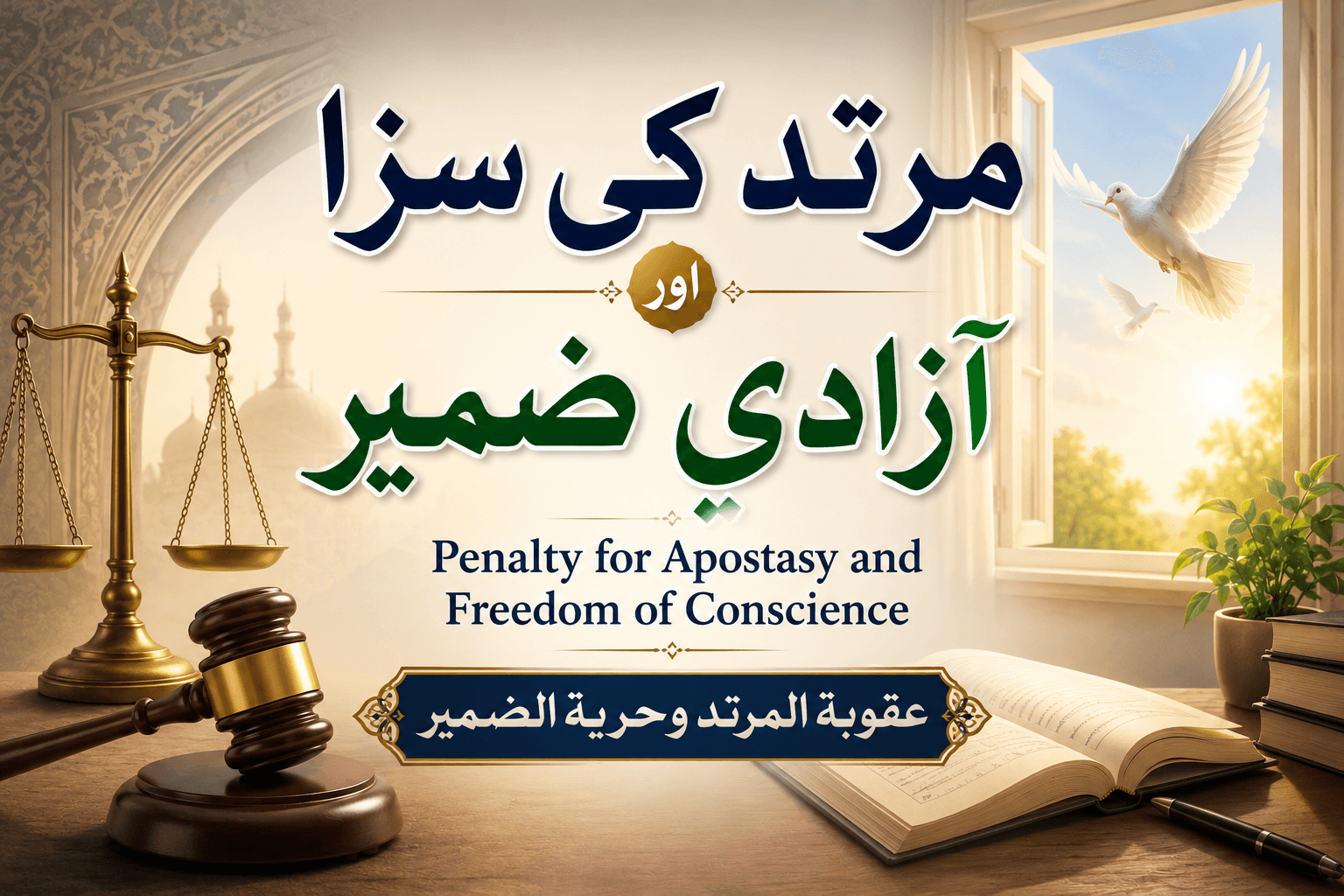
Objection: "The Penalty for Apostasy is Contrary to Freedom of Conscience and Belief"
Critics argue that faith is a private and internal matter. They claim that if a person leaves Islam to adopt another religion or becomes an atheist, they have not physically harmed anyone. Therefore, imposing the death penalty for merely changing one’s opinion or belief is a clear violation of the universal human right of "Freedom of Conscience" and contradicts the concept of personal liberty.
Response: "Apostasy is Not Merely a Matter of Belief, but a Political and Social Rebellion"
To provide a scholarly response to this objection, one must understand the circumstances under which the penalty for apostasy is applied in Islam and the objectives behind it:
1) Apostasy: Not just a belief, but "High Treason"
A deep study of Islamic history and jurisprudential texts reveals that in Islam, "apostasy" was not treated in the sense of changing one's religion in private life, but rather as synonymous with "rebellion against the state" or "High Treason." During the Prophetic era and the period of the Companions, Islam constituted the social and political system of the state as a single entity. Therefore, leaving Islam was effectively a breach of the political allegiance upon which the state was founded.
In modern laws as well, all countries punish "High Treason" with death or life imprisonment. If a person spies for a foreign power or leads an armed rebellion against the state, are they pardoned under the guise of "freedom of conscience"? Certainly not, because they have threatened the existence of the state. By the same logic, apostasy was viewed as an open rebellion against the political and social system of Islam.
2) Social Stability and Public Order
In the Islamic state, apostasy was not treated as a mere individual act, but as an action capable of destabilizing the security and public order of the community. When a person publicly announces their exit from Islam, they breach the "Social Contract" upon which the society is built. The primary purpose of this penalty is to prevent chaos; as the mass apostasy of groups in that era often served as a precursor to armed conflict and internal strife.
3) "Freedom of Belief" vs. "Freedom of Promotion and Rebellion"
The Quranic principle states: *"There is no compulsion in religion."* Islam does not force anyone to convert. However, when an individual enters the fold of Islam and then exits while explicitly declaring their rejection of the state's laws and the covenant of allegiance, they are committing an "Active Action":
Belief: What an individual harbors in their heart is a matter between them and God, and there is no worldly penalty for it.
Apostasy:When an individual transforms their belief into a public political and social challenge, they enter the jurisdiction of Hudud (statutory penalties).
4) The Legal Perspective in the Modern Era
It is a scholarly fact that the concept of the "Nation State" in the current era differs from the concept of the state in the early centuries. Consequently, many contemporary Muslim scholars have discussed this issue from new angles, with some researchers arguing that the penalty for apostasy was linked to the integration of religion and state, whereas, in the framework of modern legal structures, the method of application may differ. Nevertheless, from a jurisprudential standpoint, this penalty remains a strong barrier to protect the "survival of the state" and "societal ethics."
5) Conclusion
Viewing the penalty for apostasy as contrary to "freedom of belief" is a one-sided analysis. If viewed solely as a "belief," it is a matter of freedom of conscience; however, if viewed as "armed rebellion against the state" or "open war against the social order," it becomes as logical as the penalty for "High Treason" in any modern state. Islam considered apostasy a breach of collective loyalty, not merely a personal belief, and this is the scholarly point that
critics often overlook.
Have a question about this post?
Ask a Question
About the Author
Muhammad Awais
By the boundless grace and guidance of Allah Almighty, Muhammad Awais is associated with the noble journey of teaching, research, and writing. In his quest to quench his thirst for knowledge, he has completed the Dars-e-Nizami (Traditional Islamic Education), an MA in English, an M.Phil in Islamic Studies, and a B.Ed. Currently, he is pursuing his Ph.D. in Islamic Studies at Hazara University. The core of his academic interests primarily revolves around Islamic Sciences, Western Philosophy, contemporary intellectual discourses, Ilm al-Kalam (Islamic Scholastic Theology), and both classical and modern logic—subjects he continuously strives to comprehend more deeply and reflect upon. His association as a 'Master Trainer' with the British Council and other local institutions, coupled with his experience in competitive examinations, has acquainted him with a diverse array of academic disciplines, for which he is profoundly grateful to the Lord of Majesty. With his very limited abilities, he is making a humble effort to contribute a small share towards serving knowledge, offering intellectual guidance, and fostering an environment of positive academic dialogue. It is his heartfelt prayer that the Lord of the Worlds graciously accepts these modest and fragmented efforts in His Divine Presence, and makes this knowledge beneficial for His creation. Ameen.