
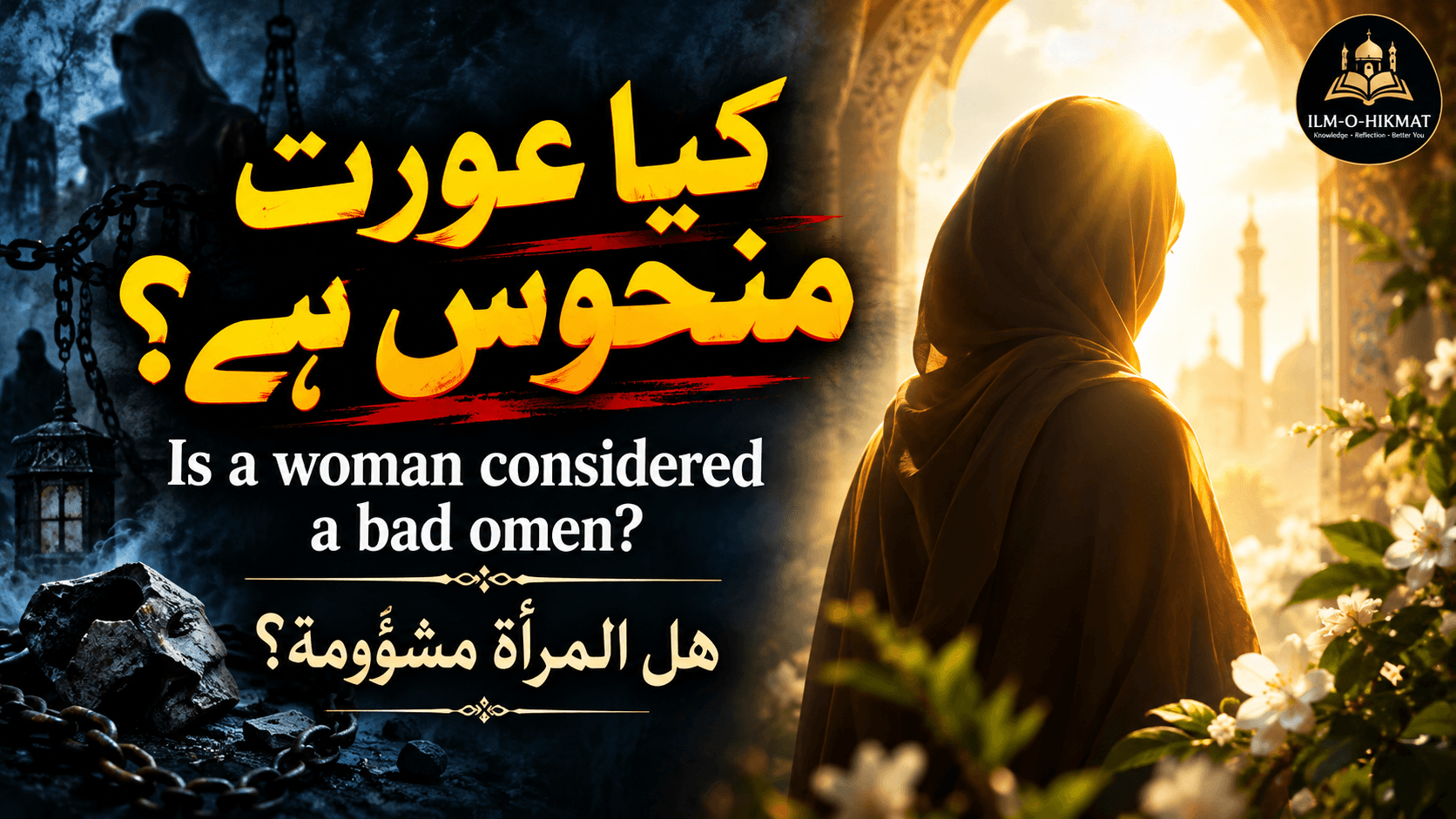
Is a woman considered a bad omen?
Objection:
On the one hand, it is claimed that Islam eradicated the superstitions of the era of ignorance (Jahiliyyah) and elevated women from the depths of degradation to the highest pinnacle of honor and respect. On the other hand, the most authentic books of Hadith (Sahih al-Bukhari and Sahih Muslim) contain narrations that ostensibly contradict this fundamental narrative of equality and reverence.
Hadith: "If there is a bad omen in anything, it is in the woman, the house, and the horse."
If Islam opposes ignorant concepts like bad omens (superstitions), why do authentic Ahadith express the possibility of bad omens in these things?
Is it not an insult to women to place them alongside an inanimate building (a house) and an animal (a horse)? Why was the woman considered a symbol of misfortune?
How can a conscious mind accept this blatant contradiction where, on the one hand, "paradise lies beneath the feet of the mother" and a "daughter is a blessing," while on the other hand, the same gender is portrayed as the source of bad omens and misfortune?
Answer:
Superstition and belief in bad omens are ancient diseases of human history that have subjected mankind to psychological fear for centuries. Islam arrived to liberate human intellect from these illusory chains, clarifying that the entire system of the universe rests in the hands of Allah, and no creature or object possesses inherent misfortune. However, due to a lack of academic integrity or ignorance of context, objections are sometimes raised against Islam based on certain Ahadith. One of the most famous objections relates to the narration about "the bad omen in women, houses, and horses," which is used in an attempt to create the impression that Islam considers women or worldly blessings as ominous.
Basis of the Objection:
Critics typically present the narration from Bukhari and Muslim in which the Messenger of Allah (ﷺ) said: "If there is a bad omen in anything, it is in the woman, the house, and the horse." In addition to these, this is also found in Ibn Majah and Muwatta Imam Malik. Superficially, this Hadith creates the impression that bad omens exist in these things.
A realistic and factual analysis of this objection is as follows:
1. Context and the Correction by Aisha (R.A)
To correctly understand any statement, it is essential to know its background. This Hadith is narrated by a few Companions, including Abu Huraira (R.A). The reality is that these esteemed Companions arrived late to the gathering and only heard the latter part of the Prophet's (ﷺ) statement, missing the first part.
When this was mentioned to the Mother of the Believers, Aisha (R.A), she completely uprooted this misunderstanding. According to Musnad Tayalisi (Hadith: 1537), it is recorded as follows:
حدثنا أبو داود قال حدثنا محمد بن راشد عن مكحول قيل لعائشة ان أبا هريرة يقول قال قال رسول الله صلى الله عليه و سلم : الشؤم في ثلاث في الدار والمرأة والفرس فقالت عائشة لم يحفظ أبو هريرة لأنه دخل رسول الله صلى الله عليه و سلم يقول قاتل الله اليهود يقولون ان الشوم في ثلاث في الدار والمرأة والفرس فسمع أخر الحديث ولم يسمع أوله
(Book: Musnad Abi Dawud al-Tayalisi, Author: Sulaiman bin Dawud Abu Dawud al-Farsi al-Basri al-Tayalisi, Publisher: Dar al-Ma'rifah – Beirut)
It was mentioned to Aisha (R.A) that Abu Huraira (R.A) says the Messenger of Allah (ﷺ) said: "Bad omens are in three things: the house, the woman, and the horse."
Upon this, Aisha (R.A) said: "Abu Huraira (R.A) did not memorize the complete statement. In reality, he entered (the gathering) while the Messenger of Allah (ﷺ) was saying: 'May Allah destroy the Jews; they say that bad omens are in three things: the house, the woman, and the horse.' Thus, he heard the end of the Hadith and did not hear its beginning."
This clarification proves that this is not an Islamic belief, but rather a superstitious Jewish belief that the Prophet (ﷺ) was actively refuting.
2. Conditional Expression (Logical Negation)
It is a principle of linguistics and logic that when a statement is made using "if" (a condition) regarding an impossibility, it actually signifies the negation of that thing, not its affirmation.
It is mentioned in Sahih al-Bukhari:
إِنْ كَانَ فِي شَيْءٍ فَفِي الْمَرْأَةِ، وَالْفَرَسِ، وَالْمَسْكَنِ
"If there were to be any bad omen, it would be in the horse, the woman, and the house."
(Sahih al-Bukhari, Book of Jihad and Expeditions, Hadith: 2859)
(Similarly, it is in Muwatta Imam Malik, Hadith 437, and Sunan Ibn Majah, Book of Marriage, Hadith: 1994)
Meaning, since there is absolutely no concept of bad omens in Islam, there is no bad omen in these three things either.
3. Principles of Understanding Hadith and Narrator Abbreviations
Just as verses of the Holy Quran explain one another, Ahadith also provide commentary for each other. If one Hadith is brief or concise, its correct understanding can only be achieved by combining it with other detailed narrations. Cherry-picking a few incomplete or brief Ahadith while concealing the detailed narrations that clarify the truth is not an academic service, but rather a clear intellectual dishonesty.
4. Uprooting the Beliefs of the Era of Ignorance
These three specific things (the woman, the house, and the horse) were mentioned in the Ahadith because, during the era of ignorance, the Arabs and Jews considered these exact three things to be ominous. If they suffered a loss during a journey, they would blame the horse; if an illness struck, they would change their house; and if there was a family issue, they would declare the woman as a symbol of bad luck. The Messenger of Allah (ﷺ) directly targeted this ignorant belief and severed the roots of this superstition.
5. Woman as a Source of Blessing, Not Misfortune
Islam has not only negated the concept of bad omens but has also presented an incredibly beautiful and positive counter-narrative, declaring women as a source of blessing.
Makmar bin Muawiyah (R.A) says: I heard the Messenger of Allah (ﷺ) saying:
" لَا شُؤْمَ وَقَدْ يَكُونُ الْيُمْنُ فِي ثَلَاثَةٍ فِي الْمَرْأَةِ، وَالْفَرَسِ وَالدَّارِ"
"There is no bad omen, and blessings are in three things: the woman, the horse, and the house."
(Sunan Ibn Majah, Book of Marriage, Hadith: 1993)
6. Rational Deduction from the Prophetic Conduct (ﷺ)
A contradiction between words and actions might be found in an ordinary human, but never in a Prophet. If we study the blessed biography of the Prophet (ﷺ), all doubts are automatically resolved:
The Prophet (ﷺ) married multiple times and stated that women and perfume were made beloved to him in this world. If women were ominous, he would have stayed away from them.
The Prophet (ﷺ) had living quarters (houses) built for the Mothers of the Believers and resided in them himself.
He always possessed some form of a mount (a horse, a mule, or a she-camel).
Is it logically possible for the Prophet (ﷺ) to declare something as ominous and then spend his entire life with it? Undoubtedly, his actions serve as the greatest proof that there is no misfortune in these things.
Islam does not consider women, mounts, or residences as symbols of misfortune; rather, it declares them as sources of mercy and blessing. The incomplete narrations that are often presented were actually stated to refute the false beliefs of the Jews and the people of Jahiliyyah, which critics present entirely out of context.
Have a question about this post?
Ask a Question
About the Author
Muhammad Awais
By the boundless grace and guidance of Allah Almighty, Muhammad Awais is associated with the noble journey of teaching, research, and writing. In his quest to quench his thirst for knowledge, he has completed the Dars-e-Nizami (Traditional Islamic Education), an MA in English, an M.Phil in Islamic Studies, and a B.Ed. Currently, he is pursuing his Ph.D. in Islamic Studies at Hazara University. The core of his academic interests primarily revolves around Islamic Sciences, Western Philosophy, contemporary intellectual discourses, Ilm al-Kalam (Islamic Scholastic Theology), and both classical and modern logic—subjects he continuously strives to comprehend more deeply and reflect upon. His association as a 'Master Trainer' with the British Council and other local institutions, coupled with his experience in competitive examinations, has acquainted him with a diverse array of academic disciplines, for which he is profoundly grateful to the Lord of Majesty. With his very limited abilities, he is making a humble effort to contribute a small share towards serving knowledge, offering intellectual guidance, and fostering an environment of positive academic dialogue. It is his heartfelt prayer that the Lord of the Worlds graciously accepts these modest and fragmented efforts in His Divine Presence, and makes this knowledge beneficial for His creation. Ameen.