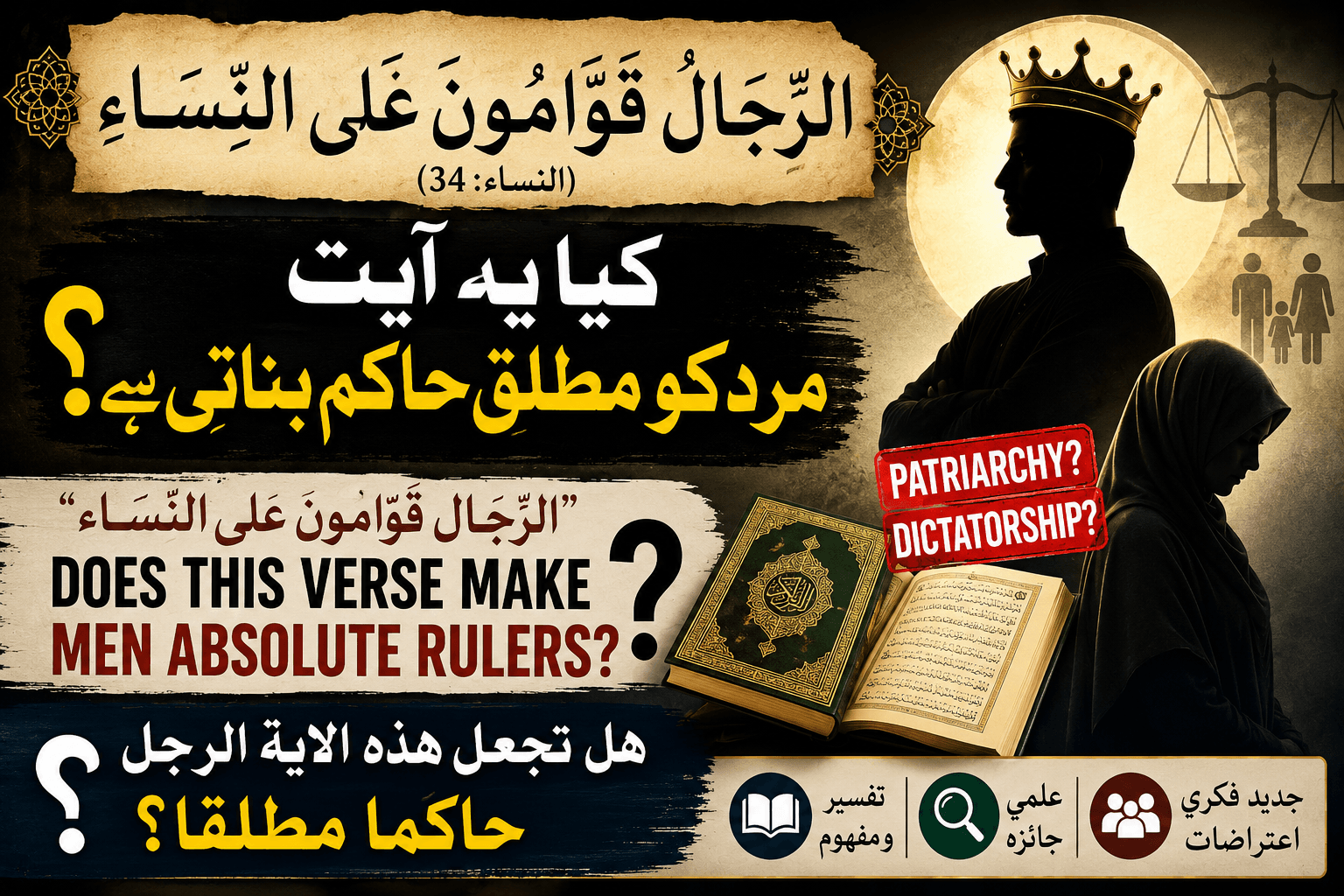
الرِّجَالُ قَوَّامُونَ عَلَى النِّسَاءِ Does This Verse Make Men Absolute Rulers?
Objection:
In contemporary academic and intellectual debates, particularly within modern liberal and feminist discourse, the Quranic verse ("Ar-Rijalu qawwamuna 'ala an-nisa" - Men are the protectors and maintainers of women) is often cited to claim that Islam advocates an oppressive, dictatorial, and patriarchal family system.
Response:
When we deconstruct this objection purely through a logical, structural, and academic lens, a completely new and enlightening perspective emerges. This issue can be deconstructed through the following points:
1) Qawwamiyat: Linguistic and Ontological Understanding
The primary misconception lies in the translation and interpretation of the word itself. The term "Qawwam" is an intensive morphological form derived from the Arabic root 'Q-W-M' (Qiyam). Lexically, it absolutely does not connote being a ruler, an oppressor, or a dictator. Arabic vocabulary contains specific words for absolute authority—such as 'Hakim' (Ruler), 'Musaitir' (Controller), or 'Jabbar' (Tyrant)—words the Quran deliberately avoided using for men.
"Qawwam" signifies a guardian, a provider, and a manager who diligently maintains the affairs of an institution. Ontologically, Islam considers men and women strictly equal as human beings. Qawwamiyat is not a title of innate or biological superiority; it is merely a practical and administrative classification.
2) Structural and Institutional Necessity
According to the principles of modern sociology, the family is the most sensitive and fundamental institution of society. It is an established principle of logic and organisational theory that no institution—even one comprising just two individuals—can function without a management authority. If the centres of power within a home run are parallel, the institution will inevitably fall victim to anarchy.
Qawwamiyat is, in fact, a structural necessity designed to save the family institution from this very anarchy. It is not "bossism," but rather a highly dignified and balanced form of the "division of labor."
3) Privilege vs. Obligation
The core of this objection stems from viewing Qawwamiyat through the lens of Western Patriarchy. Western patriarchy grants men unilateral power and privilege, whereas the Quran imposes a heavy obligation upon them.
The subsequent clause of the verse explicitly clarifies the rationale behind this Qawwamiyat : "…and because they spend out of their wealth." This indicates that this degree of Qawwamiyat is not a gratuitous honor; in exchange, a 100% legal and moral liability for the economic maintenance and protection of the family is placed squarely on the man's shoulders. In modern legal terminology, this is a perfect illustration of "Authority coupled with Absolute Liability." According to Islamic jurisprudence, if a man fails to provide financial maintenance ( Nafaqah ), the woman has the right to seek the annulment of the marriage, unequivocally proving that Qawwamiyat is not an absolute dictatorship but a status strictly conditional upon performance.
4) Refuting the Premise of Patriarchal Oppression
Historically, Western 'Patriarchy' (e.g., under Coverture laws) dictated that a woman possessed no independent legal or economic status; she was considered the property first of her father, and subsequently of her husband.
In stark contrast, under the Islamic model of Qawwamiyat , a woman is a completely free and Independent Legal Entity. She owns her wealth, can engage in commerce, and the "Qawwam" (man) exercises zero legal jurisdiction over her personal wealth, inheritance, or Mahr (dower). Logically speaking: How can an individual be classified as a dictator when he holds absolutely no legal authority over the personal wealth and property of his supposed "subjects"?
Conclusion:
The assertion that Qawwamiyat is an oppressive patriarchal system is the direct result of evaluating Islamic epistemology through a faulty Western conceptual framework. The family system ordained by Islam is not built on blind power dynamics, but is established upon mutual respect, an equitable division of labor, and service. Qawwamiyat does not elevate a man to the status of a master; rather, it designates him as a responsible servant and manager of the fa
mily institution.
Have a question about this post?
Ask a Question
About the Author
Muhammad Awais
By the boundless grace and guidance of Allah Almighty, Muhammad Awais is associated with the noble journey of teaching, research, and writing. In his quest to quench his thirst for knowledge, he has completed the Dars-e-Nizami (Traditional Islamic Education), an MA in English, an M.Phil in Islamic Studies, and a B.Ed. Currently, he is pursuing his Ph.D. in Islamic Studies at Hazara University. The core of his academic interests primarily revolves around Islamic Sciences, Western Philosophy, contemporary intellectual discourses, Ilm al-Kalam (Islamic Scholastic Theology), and both classical and modern logic—subjects he continuously strives to comprehend more deeply and reflect upon. His association as a 'Master Trainer' with the British Council and other local institutions, coupled with his experience in competitive examinations, has acquainted him with a diverse array of academic disciplines, for which he is profoundly grateful to the Lord of Majesty. With his very limited abilities, he is making a humble effort to contribute a small share towards serving knowledge, offering intellectual guidance, and fostering an environment of positive academic dialogue. It is his heartfelt prayer that the Lord of the Worlds graciously accepts these modest and fragmented efforts in His Divine Presence, and makes this knowledge beneficial for His creation. Ameen.