
From Mind to Reality: The Ontological Argument and the Rational Journey of God's Existence
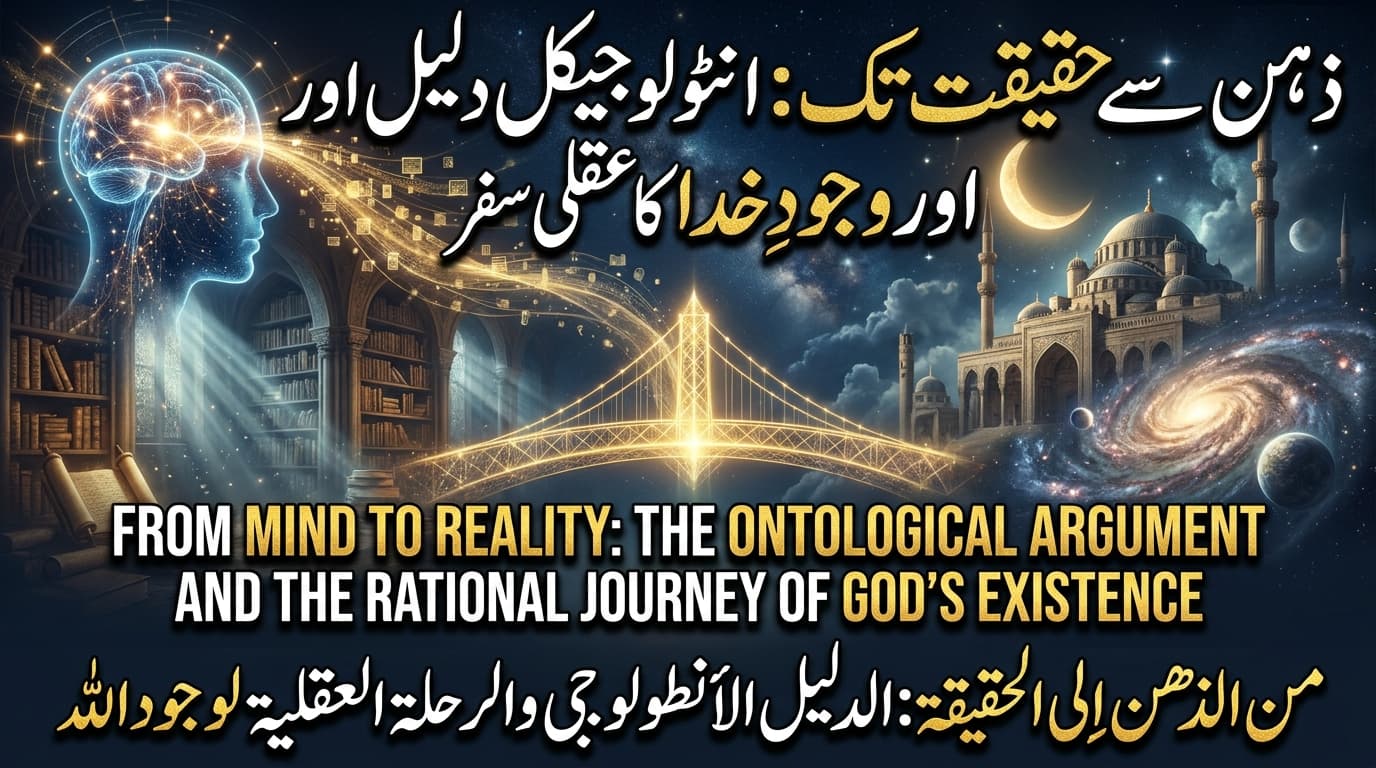
Pondering the existence of the universe and the transcendent power operating behind it has been the oldest and most constant pursuit in human history. Whenever the existence of the Almighty is discussed, our attention generally turns to the vastness of the heavens and the earth, the laws of physics, or cosmic events like the Big Bang, which is termed the 'Cosmological Argument' in the language of philosophy. But have you ever wondered whether observing the external universe is the only way to prove God? Or is there a concept of God within our very minds that bears witness to His existence outside of it?
This second perspective is known in philosophy as the Ontological Argument. It is a purely rational and philosophical argument that, instead of relying on evidence from the external material world, proves His real existence from the foundational concept of God itself. To understand this deep intellectual subject, we must move away from our material senses and step into the realm of pure reason.
The Concept of the Most Perfect Being: When Thought Touches Perfection
The Ontological Argument does not begin with a complex scientific formula, but with a simple yet profoundly deep concept that arises in the human mind. We can all conceive in our minds a Being that is "most perfect", that is, at the ultimate limits of perfection.
When we think of such a most perfect Being, sound intellect immediately acknowledges that this Being cannot have any form of deficiency, defect, decline, or dependence on another. It is perfect in every aspect. The question here is not whether that Being exists in the external world or not, but rather whether the human mind possesses the capacity to hold a blueprint of "Absolute Perfection" within itself. The answer is: absolutely, it does. And this blueprint is the very first brick of this entire argument.
Mental Existence vs. External Existence:
Now we come to the most fascinating and central point of this argument: what is the relationship between a concept existing inside the mind and its existence in the real external world?
Pause and think for a moment; if a Being who possesses all perfections were restricted only to the confines of our mind and had no existence in the external world, would It truly deserve to be called "the most perfect"? Certainly not. From an intellectual and logical standpoint, for a goodness or perfection to exist merely in the mind is an incomplete attribute, whereas its actual existence in reality (externally) is a far greater perfection.
A simple example: You have a concept in your mind of a magnificent, beautiful, and charitable hospital where every disease is treated free of charge. This concept is certainly wonderful, but if this hospital actually exists in the real external world, it would be a millions-of-times greater and more real attribute than the mere mental concept.
Since existing in reality is a greater attribute than existing merely in the mind, it becomes logically necessary for this "most perfect being" to exist in reality. If It were not present externally, Its perfection would remain incomplete, which directly contradicts Its own definition (of being the most perfect). Therefore, Its very concept demands Its real existence.
Possibility and Necessity: The Logical Burden on the Atheist
In philosophical discourse, atheists sometimes raise the objection that the existence of God is a mere illusion. The Ontological Argument answers this by shifting the burden of proof to the objector. If someone claims that God's existence is impossible, they must logically prove that the concept of God contains an inherent rational contradiction.
If the existence of God is not impossible, then by the laws of logic, only two paths remain:
Either that existence is "possible" (contingent—meaning it can either exist or not exist).
Or that existence is "necessary" (meaning its existence is required under all circumstances).
Since we established above that for a "most perfect being," existence cannot be a mere alternative or an option, but rather its actual existence in reality is an intrinsic attribute to fulfill its perfection, that entity does not remain a contingent being. It is determined to be a "Necessary Being" in its essence—that is, a Being whose non-existence is impossible for the intellect to conceive.
Objective Perception: The Universal Design of Human Nature
Some might say that all of this is merely baseless philosophical hairsplitting, detached from reality. However, the study of the universe and human history leads us to an astonishing reality: no matter which corner of the world a human being inhabits, whether they follow a religion, are agnostic, or a staunch atheist, there naturally exists within them a concept of a "Supreme Being"—the highest and most sublime power. This proves that this perception is not a personal or individual illusion, but rather an objective reality.
If this were merely an ordinary thought or a fiction of the human brain (like the idea of a flying horse), it would not be identical and universal across all human beings worldwide.
The fact that every human being across distinct regions of the world, without any mutual communication, senses a supreme and most perfect Being within themselves proves that this is not an accidental thought. This is that universal truth and seal that God has endowed within the innate nature (Fitrah) of every human, serving as the greatest internal sign of His existence.
Refutation of Circular Reasoning and Scholarly Maturity
Some critics attempt to dismiss this argument by calling it "circular reasoning"—a debate where the beginning and the end rely on the same premise. However, in the academic world, this objection holds no weight. This argument is not based on a fictional story; rather, its foundation is our own direct observation and conscious experience. It is an established fact that every rational human being in the universe—whether a believer affirming God or an atheist denying Him—is compelled to think about God and grapple with this concept. This thought itself is an existential reality, not a fictional tale.
Interestingly, this purely conscious and innate argument has been embraced in the discourses of history's great Islamic thinkers, particularly Shaykh al-Islam Ibn Taymiyyah. In academic circles, it is considered an even more incisive and robust argument than traditional theological (Kalami) or cosmological arguments, because while the cosmological argument begins its journey from the fluctuations of the material world, this argument directly discusses human consciousness, the voice of conscience, and the reality of perfect existence.
Conclusion
The Ontological Argument teaches us that to find God, it is not solely necessary to scan the heavens with telescopes or scrutinize particles with microscopes. Rather, if we open the closed windows of our hearts and minds and deeply contemplate the very concept of "perfection and nature" within us, the existence of God is felt dawning from His very concept itself. This writing reminds us that the existence of God is not dependent on the boundaries of the material world; He is calling out from within man's own existence and consciousness.
Have a question about this post?
Ask a QuestionAbout the Author
Dr. Mufti Muhammad Ibrahim
Dr. Mufti Muhammad Ibrahim is a distinguished Islamic scholar, jurist, and researcher known for integrating traditional Islamic scholarship with modern academic standards. He completed his Dars-e-Nizami (Shahadat-ul-Alamia) from Jamia Darul Uloom Karachi and specialized in Islamic Jurisprudence (Fiqh) at Darul Iftaa Makki Masjid, Mansehra, where he has been serving as an Assistant Mufti for over a decade. He holds a Ph.D. in Islamic Studies from the University of Haripur, secured top position in M.Phil, and earned a Gold Medal in M.A. Islamiat. He also holds degrees in M.Sc. Pakistan Studies and B.A. English Literature. Dr. Ibrahim is an HEC-approved Ph.D. supervisor, with numerous postgraduate researchers completing their work under his supervision. He has authored over 30 research papers and several academic books. His research focuses on Quran and Hadith studies, as well as addressing modern intellectual challenges, particularly atheism. Through the platform "Tafheem-e-Nau," he actively engages in presenting reasoned responses to contemporary ideological questions.