
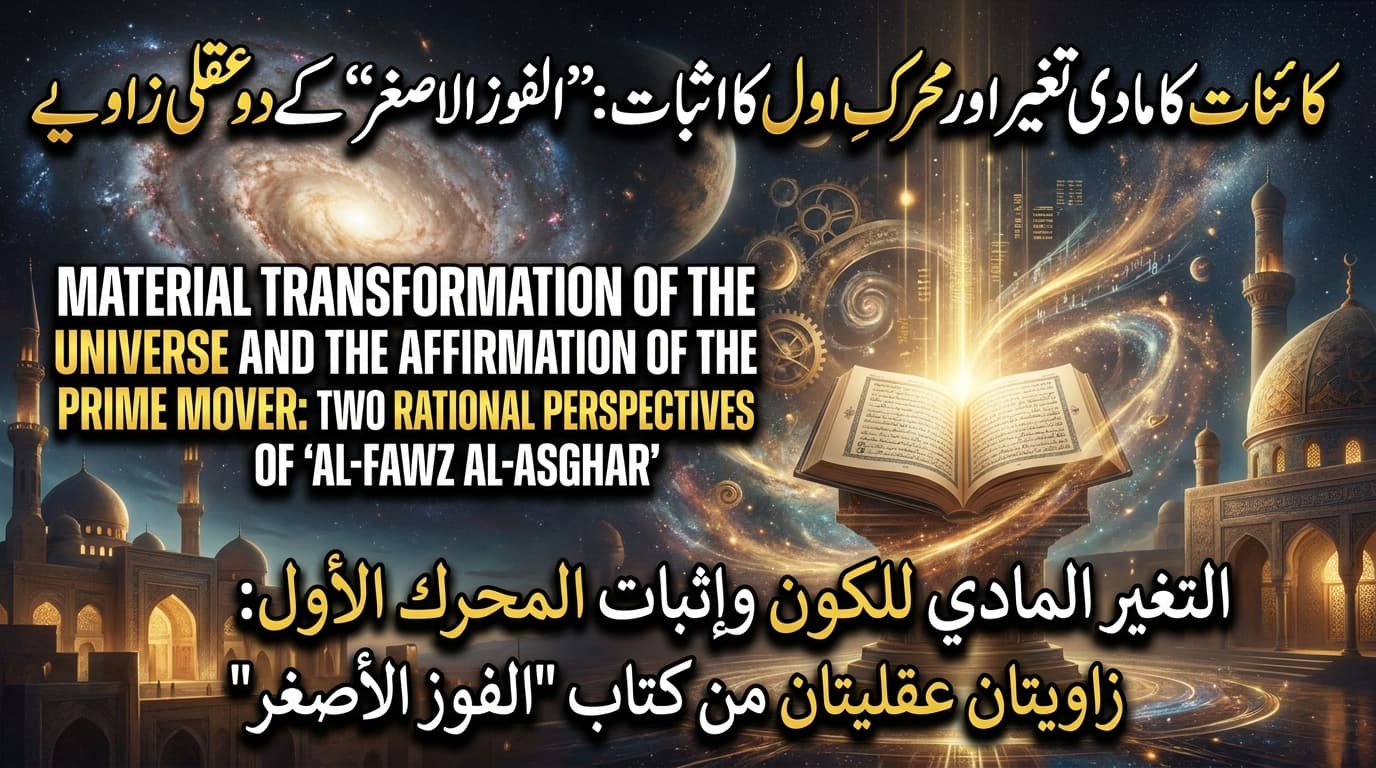
Material Transformation of the Universe and the Affirmation of the Prime Mover: Two Rational Perspectives of "Al-Fawz al-Asghar"
When we observe this magnificent universe spread around us, one thing appears absolutely clear: nothing here is static. Rivers are flowing, winds are blowing, the Earth is revolving in its orbit, and within our own bodies, cells are being replaced from old to new alternatives every second. But have you ever deeply pondered what force operates behind this constant commotion, this movement, and this perpetual change?
In classical metaphysical discourses, this question has always been a favorite subject among thinkers. Particularly, Allama Ahmad ibn Miskawayh, in his magnum opus "Al-Fawz al-Asghar," used these material transformations of the universe as a foundation to present two such robust rational arguments that shake the philosophy of materialism to its roots. Let us understand both of these arguments deeply and in a straightforward, contemporary style.
1. The Argument from Motion: The Dynamic Existence of the Universe and the Rational Demand for a Prime Mover
Every single particle of the universe bears witness that every physical body here is in motion in one form or another. It is a fundamental and accepted principle of both physics and logic that whatever is in motion (the moved) requires a 'mover' to impart motion to it. No material object can transition from a state of rest to a state of motion spontaneously.
Now, reason raises a question here: if object 'A' is moved by object 'B', then what moved object 'B'? If it is also in motion, it will certainly require a third force 'C'. If we continue to trace this chain backward indefinitely, it is termed 'infinite regress' in the language of logic—meaning an endless chain that has no root or beginning.
Practical Example: The Journey of a Railway Engine To understand this complex point, let us take the example of a train. Suppose you see an engine and hundreds of carriages attached behind it running on a railway track. Each carriage is in motion due to the pull of the carriage ahead of it. But is it possible for this chain to be infinite, with no engine at its front? Absolutely not. If there is no such engine (mover) at the front—which itself is not dependent on any carriage but possesses the capacity to pull the entire train—the whole train cannot move forward even an inch.
It is the definitive verdict of sound intellect that this endless chain is simply impossible. This entire system of motion must terminate somewhere at a 'Prime Mover' who is himself free from material limitations, transformation, and dependence on any other motion. Since every material body in the universe necessarily changes and is finite, its ultimate mover must transcend material laws.
2. The Law of Change and Transformation: The Journey from Contingent Existence (By Accident) to the Independent Essence (By Essence)
The second great truth of the universe is its constant, moment-by-moment change. If we go deeper, we discover that the existence of every entity in the universe is 'by accident' (bil-'aradh), meaning temporary, originated (hadith), and dependent on another. Water turns into steam, living beings grow old and decompose into dust, and even stars and galaxies lose their energy over time.
There is an established rule of logic and scholastic theology (Kalam): "That which exists by accident (temporarily) must ultimately trace its chain back to a reality that exists by essence (original and self-subsisting)."
Scientific and Rational Perspective
The Second Law of Thermodynamics in modern physics also teaches us that the useful energy of the universe is constantly diminishing and heading toward degradation. If this universe had been self-sustaining from eternity and if these temporary attributes were intrinsic to it, it would have succumbed to 'Heat Death' long ago.
When a single entity is not independent for its own survival, how can it be the cause of the entire universe's existence? All these transient signs, changing seasons, shifting material states, and the cosmic cycle of day and night point toward a 'True Agent' (Mu'aththir-e-Haqiqi) whose existence is essential (by essence), who is immortal, and who requires no external cause or support for His existence. In the language of theology, this very Being is called the 'Necessary Being' (Wajib al-Wujud).
Summary of the Discourse
If we weave these two arguments into a single intellectual thread, the premise of atheists regarding the universe—that everything is operating automatically under material expediency—is proven completely absurd. Since matter itself is devoid of intellect, consciousness, and eternal existence, it can neither set itself in motion nor formulate laws to sustain its temporary existence.
Consequently, the human intellect is left with no choice but to accept the truth that behind this magnificent material transformation of the universe lies a Wise, All-Knowing, All-Powerful, and Self-Subsisting Being, whose will and command bestowed the raiment of existence upon this entire workshop from non-existence. This intellectual journey is not a matter of blind faith, but an immutable logical conclusion emerging from the observation of every single particle of the universe.
Have a question about this post?
Ask a QuestionAbout the Author
Dr. Mufti Muhammad Ibrahim
Dr. Mufti Muhammad Ibrahim is a distinguished Islamic scholar, jurist, and researcher known for integrating traditional Islamic scholarship with modern academic standards. He completed his Dars-e-Nizami (Shahadat-ul-Alamia) from Jamia Darul Uloom Karachi and specialized in Islamic Jurisprudence (Fiqh) at Darul Iftaa Makki Masjid, Mansehra, where he has been serving as an Assistant Mufti for over a decade. He holds a Ph.D. in Islamic Studies from the University of Haripur, secured top position in M.Phil, and earned a Gold Medal in M.A. Islamiat. He also holds degrees in M.Sc. Pakistan Studies and B.A. English Literature. Dr. Ibrahim is an HEC-approved Ph.D. supervisor, with numerous postgraduate researchers completing their work under his supervision. He has authored over 30 research papers and several academic books. His research focuses on Quran and Hadith studies, as well as addressing modern intellectual challenges, particularly atheism. Through the platform "Tafheem-e-Nau," he actively engages in presenting reasoned responses to contemporary ideological questions.