
Illusion of Chance or Master Design? An Intellectual and Logical Inquiry into the Existence of God
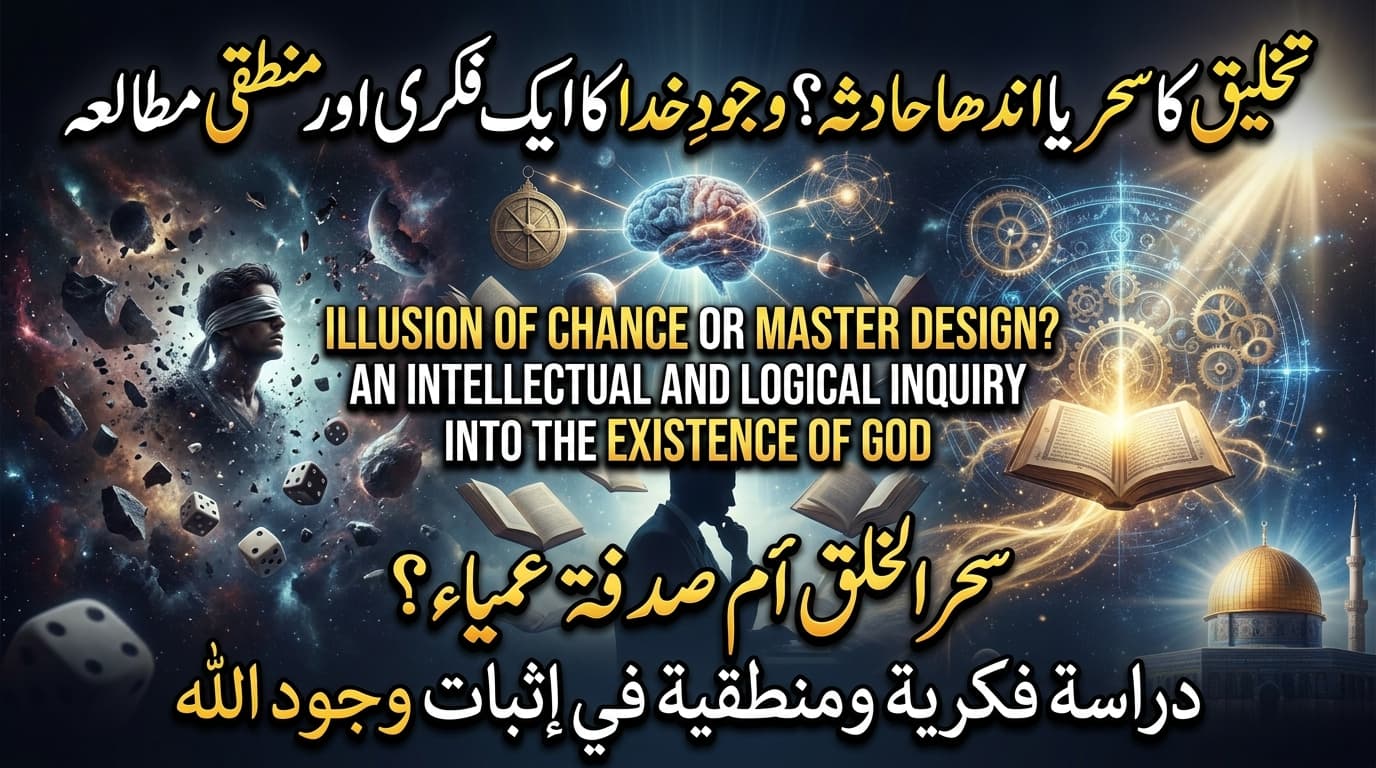
In the quiet of the night, when we look up at the sky, the silent rotation of the stars triggers a profound resonance within the soul. Is all this merely the result of an accidental material explosion, completely devoid of any intentional plan? Or does there exist behind this magnificent cosmic machinery a transcendent intellect that, while hidden from the material eye, reveals its presence through its handiwork?
Modern atheism has often donned a scientific garb to render the concept of God a mere illusion, yet the definitive laws of science themselves frequently negate this claim. Let us step away from conventional debates and weigh this profound subject on the scales of pure reason and intellectual depth.
1. Cosmic Order and Mathematical Precision (Fine-Tuning)
A major intellectual weapon of materialist philosophers has been the claim that the universe is purely the byproduct of material accidents and evolutionary processes. However, a deep study of the fundamental physical laws governing the universe reveals a mathematical precision that confounds human reason.
Scientists have coined the term Anthropic Principle to describe this breathtaking balance. The size of the Earth, the angle of its axial tilt, its precise distance from the Sun, and the exact ratio of gravitational pull—all have been calibrated with such immaculate precision that a mere 0.5% variance in this entire setup would completely erase the possibility of life on this planet. Observing this unparalleled harmony among celestial bodies, Sir Isaac Newton admitted that the collision-free orbit of billions of stars for millions of years is absolutely impossible without a Supreme Regulator.
Here, plain reason poses a simple question: if throwing sand, gravel, and cement into the air can never automatically assemble a beautiful house, how can an infinitely more complex and orderly universe emerge from the blind collision of material elements?
2. A Logical Fallacy: "Who Created God?"
Atheists frequently play what they consider their ultimate trump card by asking, "If everything has a creator, then who created God?" While this question may appear logical at first glance, from an academic and philosophical standpoint, it represents a fundamental category mistake.
· The Law of Causality: This law applies strictly to the material universe and everything bound within its limits. Observing a watch makes us think of a watchmaker because the watch is material and confined within the dimensions of time and space.
· A Transcendent Being: God is the Creator of the material world and the Author of these physical laws; hence, He cannot be bound by the very laws He instituted. Applying cosmic constraints to God strips Him of the very definition of divinity.
· The Principle of Necessary Existence: Philosophically, the chain of cosmic existence must terminate at a Being who is Self-Existent (Self-Sustaining)—One whose existence stems from His own essence and who relies on no external cause.
3. The Contradiction of Matter and Intellect: How Can the Void Create?
The entire edifice of modern atheism rests upon the assumption that the ultimate reality of the universe is matter alone. Yet, it is precisely here that materialist philosophy becomes ensnared in its own net. A direct comparison between human nature and inanimate matter reveals a stark truth:
· Humans possess intellect and consciousness, whereas matter is entirely devoid of any conscious awareness.
· Humans possess will, knowledge, insight, and emotions, while matter is utterly lacking in these attributes.
It completely defies sound logic to assert that an entity entirely destitute of intellect and consciousness could give birth to a highly conscious, thinking being like man. Where did a lifeless particle of dust acquire the power to forge a thinking brain? The truth remains that the more order, connection, and complexity a creation exhibits, the more intelligent and far-sighted its creator must be.
4. The Verdict of Intuition and Internal Consciousness
Moving beyond purely academic spheres, if we look inward, the existence of God feels as though it is pre-written into our internal consciousness. No matter where a human being resides, when trapped in a state of severe crisis or absolute helplessness, all material philosophies recede, and the heart instinctively turns toward an unseen, supreme transcendent power.
Even renowned atheist philosophers like Bertrand Russell acknowledged in their writings that the argument from design holds considerable logical weight, even though he later sought refuge from its implications by invoking信 Darwinism. However, Darwin's theory of evolution itself provides no scientific or academic justification for the non-existence of God; rather, it is merely a flawed attempt to explain a material mechanism of creation.
Conclusion:
Denying the existence of God reduces the universe, human life, and our moral strivings into something entirely meaningless and absurd. Atheism casts the human intellect into a dark abyss devoid of purpose or ultimate resolution. Conversely, belief in God anchors human existence, satisfies human reason, and provides the soul with the profound peace it has sought for centuries. Every single particle of the universe—from the intricate patterns on a butterfly's wing to the stars floating across the vast expanse of space—stands as a living testament to this one true Creator.
Have a question about this post?
Ask a QuestionAbout the Author
Dr. Mufti Muhammad Ibrahim
Dr. Mufti Muhammad Ibrahim is a distinguished Islamic scholar, jurist, and researcher known for integrating traditional Islamic scholarship with modern academic standards. He completed his Dars-e-Nizami (Shahadat-ul-Alamia) from Jamia Darul Uloom Karachi and specialized in Islamic Jurisprudence (Fiqh) at Darul Iftaa Makki Masjid, Mansehra, where he has been serving as an Assistant Mufti for over a decade. He holds a Ph.D. in Islamic Studies from the University of Haripur, secured top position in M.Phil, and earned a Gold Medal in M.A. Islamiat. He also holds degrees in M.Sc. Pakistan Studies and B.A. English Literature. Dr. Ibrahim is an HEC-approved Ph.D. supervisor, with numerous postgraduate researchers completing their work under his supervision. He has authored over 30 research papers and several academic books. His research focuses on Quran and Hadith studies, as well as addressing modern intellectual challenges, particularly atheism. Through the platform "Tafheem-e-Nau," he actively engages in presenting reasoned responses to contemporary ideological questions.