
The Allegation that Islamic Law Was Influenced by Roman Law: A Historical and Critical Analysis
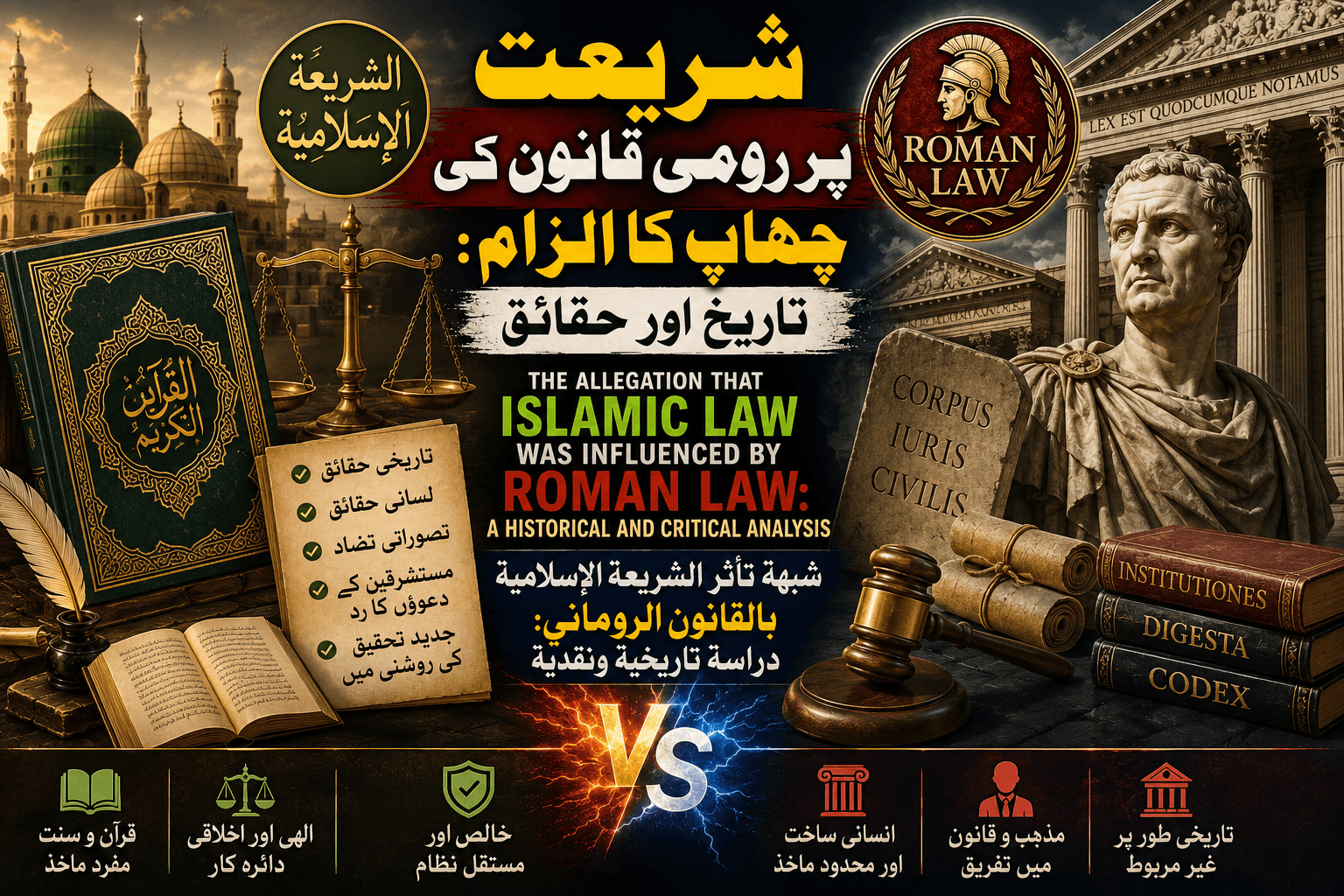
Western scholars and Orientalists have frequently argued that Islamic jurisprudence (Fiqh) and the Islamic legal system are not original or divinely inspired, but were instead borrowed from Roman, Byzantine, and Greek legal traditions during the formative period of Islam. This raises an important question: Did Muslim jurists actually derive the Islamic legal system from foreign laws, or is this claim unsupported by historical evidence? A careful examination of historical, linguistic, and conceptual evidence demonstrates that this allegation lacks a solid academic foundation.
It is commonly asserted that the early Muslim jurists must have relied upon Roman law while formulating Islamic jurisprudence. Although such a claim may appear convincing to those unfamiliar with the historical development of Islamic law, a critical analysis of the available evidence reveals that this theory is fundamentally flawed.
1. Geographical and Linguistic Disconnection
One of the strongest arguments against this claim is geographical reality. Historical sources confirm that after receiving prophethood, Prophet Muhammad ﷺ never traveled to territories governed by Roman law. Moreover, he had no knowledge of the Latin language in which Roman legal texts were composed.
The Qur'anic revelation descended in the Arabian Peninsula, particularly in the Hijaz, where Islamic law first emerged and developed. Consequently, it is only natural that Islamic legal principles evolved within the social and cultural context of Arabia rather than through interaction with Roman legal traditions.
Likewise, the major schools of Islamic jurisprudence developed in regions such as the Hijaz, Iraq, and Persia—areas that were not centers of Roman legal scholarship. The great Muslim jurists were educated within Islamic intellectual circles rather than Roman legal institutions.
2. Absence of Foreign Legal Terminology and Translations
Linguistic evidence provides another compelling argument.
Unlike medicine, philosophy, mathematics, and astronomy—fields in which Muslims translated numerous Greek, Persian, and Syriac works into Arabic—Islamic jurisprudence contains virtually no borrowed legal terminology from Roman or Byzantine law. Its technical vocabulary is derived almost entirely from the Qur'an and the Sunnah.
Furthermore, there is no historical evidence that Roman legal codes were translated into Arabic during the formative period of Islamic jurisprudence or that Muslim jurists consulted such texts while developing legal rulings.
Moreover, there is little evidence that the early jurists possessed sufficient proficiency in Latin, Greek, or Syriac to study Roman legal literature directly, making the theory of extensive borrowing historically implausible.
3. Fundamental Conceptual and Structural Differences
The philosophical foundations of Roman law and Islamic law differ fundamentally.
Roman law distinguished between religious law and civil law, treating them as separate legal spheres. Islamic law, by contrast, derives all legal rulings—whether religious, civil, criminal, or social—from a single divine source: revelation.
Accordingly, the legal systems developed by classical Muslim jurists, including Imam Abu Hanifah, represent an integrated legal framework rooted in the Qur'an and the Sunnah.
Because their foundational principles, objectives, and sources differ so profoundly, the claim that Islamic law is merely an adaptation of Roman law is historically and conceptually difficult to sustain.
4. Orientalist Claims and Contemporary Scholarly Responses
Among the most influential proponents of this theory was the Orientalist Joseph Schacht, who argued that Islamic law evolved primarily from administrative practices of the Umayyad state and earlier Near Eastern legal traditions rather than directly from Islamic revelation.
However, contemporary legal historian Dr. Wael B. Hallaq has subjected these claims to rigorous scholarly criticism. He argues that such theories emerged within a colonial intellectual framework that sought to portray Islamic civilization as derivative rather than original.
According to Hallaq, Islamic law is an independent and highly sophisticated legal tradition that developed its own methodologies, principles, and institutions from its primary sources—the Qur'an and the Sunnah—without relying on Roman legal models.
Indeed, Muslim jurists had no practical need to import foreign legal systems, as they continually derived legal rulings from Islamic revelation through the principles of ijtihād and legal reasoning.
5. The Reverse Historical Influence
Interestingly, modern scholarship increasingly suggests that the historical influence flowed in the opposite direction.
Rather than Islamic law borrowing from Roman law, several researchers argue that Islamic legal institutions significantly influenced aspects of medieval European legal development.
For example, certain scholars have identified similarities between Islamic judicial institutions and elements of the English Common Law tradition. Likewise, comparative legal studies acknowledge that the Islamic institution of Hawala (informal value transfer) influenced aspects of French and Italian commercial law.
Conclusion
In conclusion, the claim that Islamic law is merely a reproduction of Roman law lacks convincing historical, linguistic, and conceptual evidence.
The available evidence instead indicates that Islamic law constitutes an original, coherent, and divinely grounded legal system whose principles are derived primarily from the Qur'an and the Sunnah. Its intellectual independence, methodological sophistication, and internal consistency distinguish it from the legal traditions of the ancient world and establish it as one of history's most influential legal civilizations.
Have a question about this post?
Ask a Question
About the Author
Muhammad Awais
By the boundless grace and guidance of Allah Almighty, Muhammad Awais is associated with the noble journey of teaching, research, and writing. In his quest to quench his thirst for knowledge, he has completed the Dars-e-Nizami (Traditional Islamic Education), an MA in English, an M.Phil in Islamic Studies, and a B.Ed. Currently, he is pursuing his Ph.D. in Islamic Studies at Hazara University. The core of his academic interests primarily revolves around Islamic Sciences, Western Philosophy, contemporary intellectual discourses, Ilm al-Kalam (Islamic Scholastic Theology), and both classical and modern logic—subjects he continuously strives to comprehend more deeply and reflect upon. His association as a 'Master Trainer' with the British Council and other local institutions, coupled with his experience in competitive examinations, has acquainted him with a diverse array of academic disciplines, for which he is profoundly grateful to the Lord of Majesty. With his very limited abilities, he is making a humble effort to contribute a small share towards serving knowledge, offering intellectual guidance, and fostering an environment of positive academic dialogue. It is his heartfelt prayer that the Lord of the Worlds graciously accepts these modest and fragmented efforts in His Divine Presence, and makes this knowledge beneficial for His creation. Ameen.