
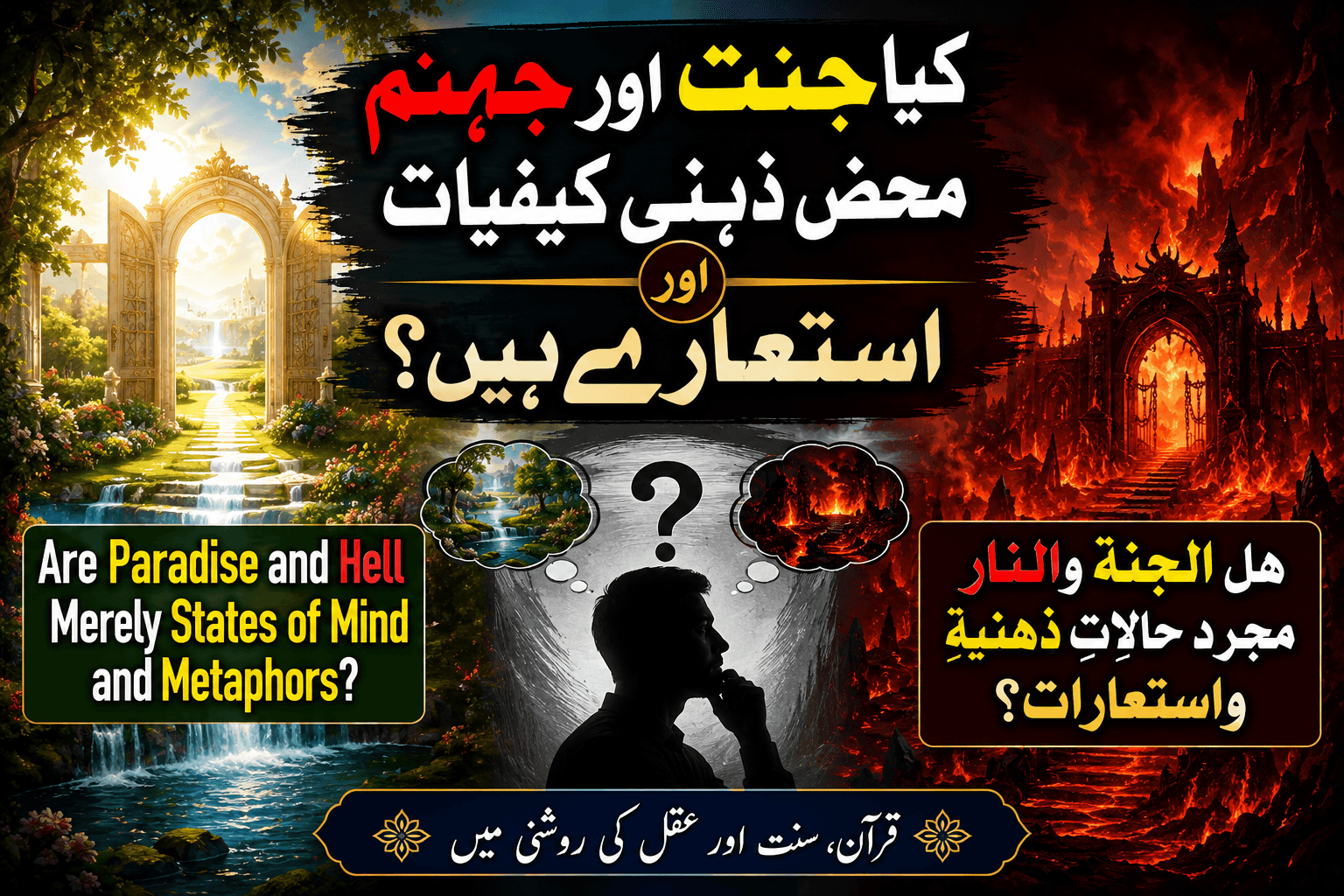
Are Paradise and Hell Merely States of Mind and Metaphors?
The Objection:
"Paradise and Hell are not physical places but merely states of mind and allegories."
Detailed Refutation:
Some modern thinkers have attempted to promote the theory that Paradise and Hell are not physical places but merely "states of the human self," and that the Quranic descriptions are mere allegories.
In Islamic theology, the Day of Judgment is not merely a spiritual resurrection, but is fundamentally based on a complete "Bodily Resurrection". This is not symbolic but a real, factual event. When a human is resurrected with their physical and material body, they logically require a physical, real, and concrete place to experience reward and punishment. If Paradise and Hell were merely a state of mind or a spiritual condition, there would be no need to raise the dead from their graves in physical forms.
1. Use of the Past Tense in the Noble Quran:
A principle of Arabic linguistics and the science of Tafsir (exegesis) is that something which has not yet come into existence is not described using the past tense. Allah Almighty has described the creation and existence of Paradise and Hell using explicit past tenses:
· Regarding Hell, He said: "U'iddat lil-Kafireen" (It has been prepared for the disbelievers).
· Regarding Paradise, He said: "U'iddat lil-Muttaqeen" (It has been prepared for the righteous).
If these were merely future mental states or psychological conditions, they would never have been described as independently 'prepared' places.
2. Eyewitness Facts of the Event of Mi'raj (Ascension):
The Holy Prophet (PBUH) physically and realistically observed Paradise during the Night of Ascension, which the Quran describes in these words: "Indaha Jannatul-Ma'wa" (Near it is the Paradise of Abode). If these were merely states of human consciousness, the Prophet (PBUH) would not have visually inspected them with his own eyes at a specific physical location in the heavens.
3. Concrete Evidence of Physical and Material Existence from Ahadith:
Authentic Ahadith (Prophetic traditions) provide concrete, physical, and sensory details about Paradise and Hell that completely negate their being mere 'allegories'. Among these tangible pieces of evidence are:
· Attempting to grab physical fruit: Once, during a prayer at the time of a solar eclipse, the Prophet (PBUH) stepped forward and tried to grab something. When asked by the Companions, he said: "I saw Paradise and wanted to take a bunch of grapes from it. If I had taken it, you would have eaten from it as long as the world remains." Grabbing a physical fruit in this material manner is concrete proof of it being a real place.
· The physical depth of Hell: The Companions once heard the loud sound of something crashing. The Prophet (PBUH) explained, "This is a stone that was thrown into the Fire seventy years ago, and it has been falling into the Fire until now when it reached its bottom." This establishes the existence of real dimensions, distances, and depth.
· Material components and structures: The Prophet (PBUH) mentioned finding the soil of Paradise to be pure "musk." He also saw a towering palace belonging to Hazrat Umar (RA) in Paradise and a woman performing ablution beside it, proving the existence of buildings, water, and tangible realities.
4. The Logical Reality of Metaphors and Allegories:
Some critics claim that the fire of Hell or the bounties of Paradise are merely figurative words. Philosophically and linguistically, figurative language is actually used to help understand a much greater and more intense reality. A symbol is always less than the reality it represents, not greater. Therefore, even if the fire is considered a metaphor, it does not mean there is no physical punishment at all. Rather, it logically means that the real, physical punishment there is infinitely more severe and formidable than worldly fire. The example of worldly fire is given simply because human minds cannot comprehend its true nature in this life.
Paradise and Hell are not imaginary products or psychological states originating in the human subconscious. Rather, they are real, physical places created by Allah Almighty in a separate and independent dimension. The bounties and punishments within them are as concrete, material, and sensory as the human body itself, which will be resurrected on the Day of Judgment to face accountability. The unanimous belief of the pious predecessors (Salaf al-Salih) and Ahl al-Sunnah is that Paradise and Hell have already been created, currently exist, and are absolute realities established by divine revelation, not mere allegories.
Have a question about this post?
Ask a Question
About the Author
Muhammad Awais
By the boundless grace and guidance of Allah Almighty, Muhammad Awais is associated with the noble journey of teaching, research, and writing. In his quest to quench his thirst for knowledge, he has completed the Dars-e-Nizami (Traditional Islamic Education), an MA in English, an M.Phil in Islamic Studies, and a B.Ed. Currently, he is pursuing his Ph.D. in Islamic Studies at Hazara University. The core of his academic interests primarily revolves around Islamic Sciences, Western Philosophy, contemporary intellectual discourses, Ilm al-Kalam (Islamic Scholastic Theology), and both classical and modern logic—subjects he continuously strives to comprehend more deeply and reflect upon. His association as a 'Master Trainer' with the British Council and other local institutions, coupled with his experience in competitive examinations, has acquainted him with a diverse array of academic disciplines, for which he is profoundly grateful to the Lord of Majesty. With his very limited abilities, he is making a humble effort to contribute a small share towards serving knowledge, offering intellectual guidance, and fostering an environment of positive academic dialogue. It is his heartfelt prayer that the Lord of the Worlds graciously accepts these modest and fragmented efforts in His Divine Presence, and makes this knowledge beneficial for His creation. Ameen.