
Is the Qur'an Forced to Fit Modern Science?
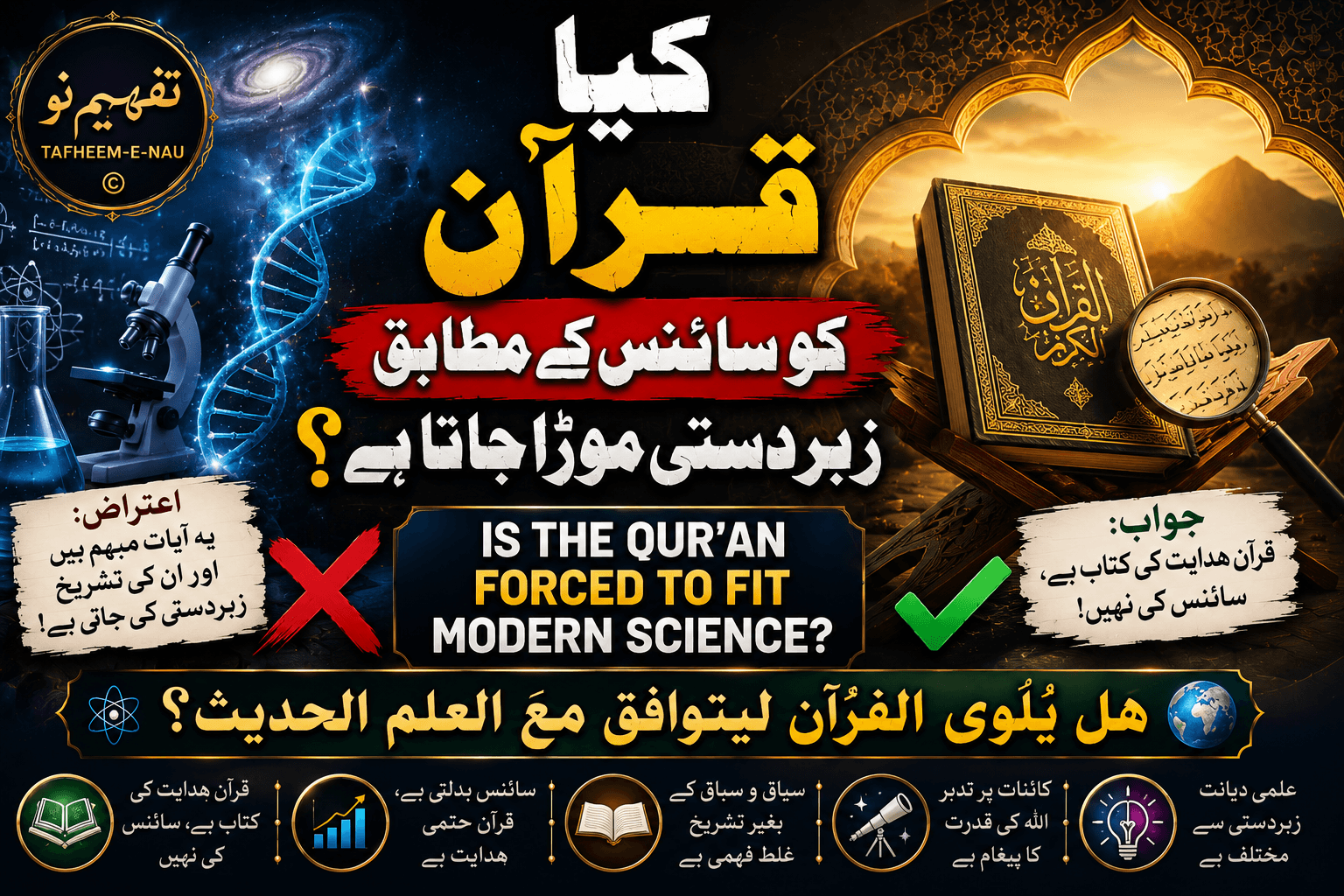
Objection:
Critics reject the scientific miracles of the Quran, arguing that its verses are ambiguous and are forcibly twisted to align with modern science.
Answer:
Treating the Holy Quran as a book of science and forcing its verses to fit modern scientific theories is considered an undesirable and incorrect approach, even among Islamic scholars. This objection from critics is actually valid against certain modern thinkers and writers who present Quranic words out of context under the guise of "scientific miracles." However, declaring the Quran false on this basis is entirely illogical. A comprehensive, academic, and principled evaluation of this objection is based on the following points:
1. The Quran is a Book of Guidance, Not Science:
The primary purpose of the Quran is to show humanity the path to attain Allah's pleasure. Therefore, it is not a textbook of physics, chemistry, or astronomy detailing scientific equations or the universe's intricacies. The mention of the universe, heavens, earth, and other natural phenomena in the Quran is not intended to lay the foundation for scientific theories; rather, its purpose is to invite humanity to reflect (Tadabbur) upon the creation of the universe and to realize the power of the Creator.
2. The Mutability of Science vs. The Certainty of the Quran:
Scientific knowledge is inherently evolutionary and probabilistic. No fact in science is absolute, and a theory universally accepted today may be refuted by a new observation tomorrow. In contrast, the statements of the Quran are based on absolute and definitive certainty. Prominent Islamic scholars have strictly forbidden subjecting Quranic verses to changing scientific theories. According to them, if we validate a current scientific theory through the Quran today, and that theory is proven wrong tomorrow, it would give the enemies of Islam an opportunity to claim—God forbid—that the Quran has been proven false.
3. Academic Rejection of Forced Scientific Interpretations:
The approach of commentators who detach Quranic verses from their clear literal meanings and context to align them with modern science has been strongly condemned. For instance, when humanity reached the moon, some interpreted the word 'Sultan' (authority/power) in Surah Ar-Rahman, Verse 33 ("you will never pass through them except by an authority") to mean 'science,' claiming it as a prophecy of space travel. Scholars have declared this a clear distortion of the Divine Word because, when viewed in its complete context, the verse pertains to the events of the Day of Judgment and the impossibility of escaping Allah's grasp, not worldly space exploration.
4. Polysemy (Multiple Meanings) is Not Ambiguity, but Literary Perfection:
What critics label as 'ambiguity' is actually the vastness of the Quranic language. From a linguistic perspective, for a text to have layers of meaning that remain comprehensible to humans of every era is a proof of its miraculous nature. Quranic verses were highly meaningful to a 7th-century human based on their observation, and they hold profound semantic depth for a modern-day scientist as well; these two meanings do not negate one another.
5. Use of Phenomenological Language (Visual Observations):
The Quran frequently describes events based on human visual observation. For example, critics object that the setting of the sun in a "murky spring" in the story of Dhul-Qarnayn (Surah Al-Kahf: 86) is a scientific error. However, this was not an astronomical claim that the sun actually falls into a swamp; rather, it was a description of Dhul-Qarnayn's personal visual observation (just as the sun appears to be sinking into the water to someone standing on a beach).
6. Real and Definitive Facts About the Universe:
Despite all these precautions, it is a historical fact that the Quran contains several clear and definitive statements regarding the universe and the physical world that require no mental gymnastics and could not possibly have been known to anyone in the 7th century. These include the continuous expansion of the universe ("Wa inna lamoosi'oon"), the creation of all living things from water, and the sky acting as a protected roof (the Atmosphere/Ozone layer) for the earth.
Conclusion:
In summary, the critics' objection that Quranic verses are forcibly twisted to fit modern science is, to an extent, a valid criticism of those Muslim researchers who adopt an apologetic attitude and attempt to prove every scientific theory from the Quran. However, this cannot be considered a flaw in the Quran itself, because the core premise and linguistic rules of the Quran do not support these conjectural scientific interpretations, nor does the Holy Quran depend on science to prove its ultimate truth.
Have a question about this post?
Ask a Question
About the Author
Muhammad Awais
By the boundless grace and guidance of Allah Almighty, Muhammad Awais is associated with the noble journey of teaching, research, and writing. In his quest to quench his thirst for knowledge, he has completed the Dars-e-Nizami (Traditional Islamic Education), an MA in English, an M.Phil in Islamic Studies, and a B.Ed. Currently, he is pursuing his Ph.D. in Islamic Studies at Hazara University. The core of his academic interests primarily revolves around Islamic Sciences, Western Philosophy, contemporary intellectual discourses, Ilm al-Kalam (Islamic Scholastic Theology), and both classical and modern logic—subjects he continuously strives to comprehend more deeply and reflect upon. His association as a 'Master Trainer' with the British Council and other local institutions, coupled with his experience in competitive examinations, has acquainted him with a diverse array of academic disciplines, for which he is profoundly grateful to the Lord of Majesty. With his very limited abilities, he is making a humble effort to contribute a small share towards serving knowledge, offering intellectual guidance, and fostering an environment of positive academic dialogue. It is his heartfelt prayer that the Lord of the Worlds graciously accepts these modest and fragmented efforts in His Divine Presence, and makes this knowledge beneficial for His creation. Ameen.