
Does Rejecting Hadith Lead to Atheism?
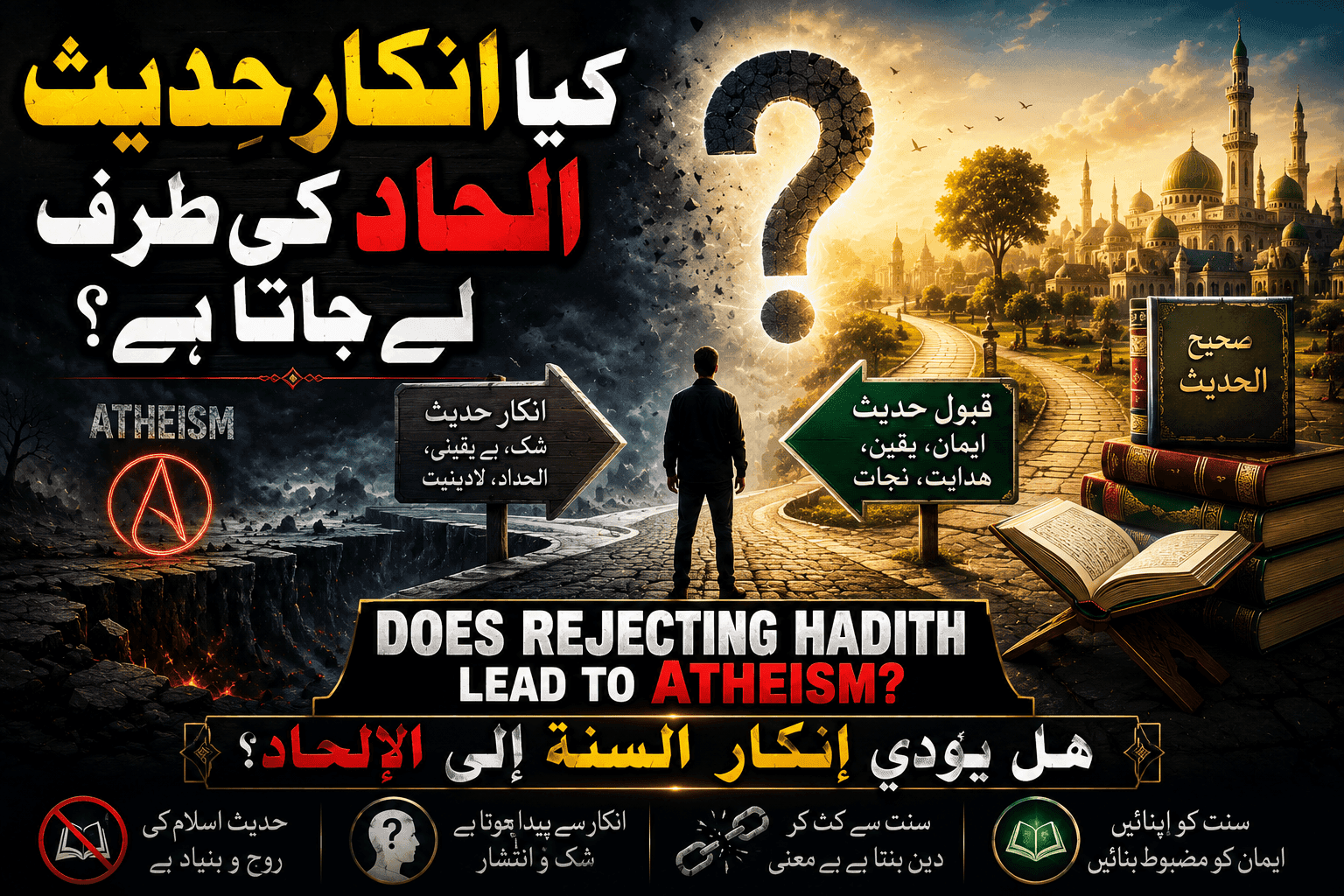
The rejection of Hadith increases the risk of atheism and irreligion because the Hadith constitutes the practical and explanatory framework of Islam. Once this framework is dismantled, the very foundations of the religion are undermined, gradually leading individuals toward complete alienation from faith. The primary reasons for this phenomenon are as follows:
1. The Collapse of Islam's Practical Framework
The Qur'an presents many religious obligations—such as prayer, fasting, zakāh, and pilgrimage—in a general form. Their detailed explanations and practical implementation are provided through the Sunnah and the authentic Hadith of the Prophet Muhammad ﷺ.
If the authority of Hadith is rejected, even the most fundamental aspects of Islamic practice cannot be established with certainty. As a result, the very foundations of Islam are weakened, leaving behind a version of the religion that is fragmented, impractical, and incapable of guiding daily life. When a religion is perceived as no longer practical or coherent, people may eventually abandon it altogether, thereby becoming more susceptible to atheism or irreligion.
2. Arbitrary Interpretation and Distortion of the Qur'an
One of the major consequences of rejecting Hadith is that Qur'anic verses become open to subjective and arbitrary interpretation. Without the explanatory authority of the Sunnah, individuals interpret the Qur'an according to their own intellectual preferences.
As a result, many fundamental Islamic beliefs—including angels, miracles, Paradise, Hell, and jinn—are either denied outright or reduced to poetic symbolism and metaphor. When the essential doctrines of the faith are reinterpreted in this manner, skepticism eventually extends to the divine origin and authority of the Qur'an itself.
History provides examples of individuals who began by rejecting Hadith and ultimately went on to deny the revealed nature of the Qur'an altogether.
3. The Supremacy of Human Reason Over Divine Revelation
Hadith rejecters often elevate human reason, modern science, and empirical observation above divine revelation. Whatever appears incompatible with their understanding is dismissed or reinterpreted.
Although reason is an invaluable human faculty, it is inherently limited and can be influenced by materialistic assumptions and prevailing intellectual trends. When human reason becomes the ultimate criterion of truth, people begin to reject all unseen realities that lie beyond empirical observation—including angels, revelation, the Hereafter, and ultimately even the existence of God.
Such excessive rationalism can become a pathway to atheism because both God and the unseen world transcend the limits of purely materialistic inquiry.
4. The Influence of Western Thought and the Path Toward Secularism
The movement rejecting Hadith in the Indian subcontinent emerged, to a significant extent, under the influence of Western intellectual thought. Its proponents sought to reinterpret Islam in a manner compatible with modern Western philosophical and social ideals.
This tendency often culminates in secularism, whereby religion is reduced to a purely private matter and excluded from public, legal, and political life. In attempting to redefine Islam according to liberal and secular values, the religion gradually loses its original identity and comprehensive worldview, leaving individuals increasingly detached from its teachings.
5. Following Personal Desires
The Prophetic Sunnah places moral and legal restraints upon human desires and passions. Those who reject Hadith frequently seek a version of Islam that imposes fewer obligations and fewer restrictions upon personal freedom.
When individuals begin to follow their desires without reference to divine guidance, they gradually rebel against every moral and spiritual limitation imposed by religion. This unchecked pursuit of the self ultimately leads to the rejection of God's authority and, in many cases, to atheism itself.
Conclusion
History demonstrates that many who rejected Hadith in an effort to reshape Islam according to their own reason or prevailing Western ideas ultimately presented a version of the religion that was internally inconsistent and practically unworkable. Consequently, many of their followers drifted toward skepticism, irreligion, or atheism.
Removing the authority of the Prophet Muhammad ﷺ and his teachings from Islam effectively dismantles the religion's interpretive and practical structure. Once that structure collapses, the resulting vacuum is often filled by secularism, irreligion, and, ultimately, atheism.
Have a question about this post?
Ask a Question
About the Author
Muhammad Awais
By the boundless grace and guidance of Allah Almighty, Muhammad Awais is associated with the noble journey of teaching, research, and writing. In his quest to quench his thirst for knowledge, he has completed the Dars-e-Nizami (Traditional Islamic Education), an MA in English, an M.Phil in Islamic Studies, and a B.Ed. Currently, he is pursuing his Ph.D. in Islamic Studies at Hazara University. The core of his academic interests primarily revolves around Islamic Sciences, Western Philosophy, contemporary intellectual discourses, Ilm al-Kalam (Islamic Scholastic Theology), and both classical and modern logic—subjects he continuously strives to comprehend more deeply and reflect upon. His association as a 'Master Trainer' with the British Council and other local institutions, coupled with his experience in competitive examinations, has acquainted him with a diverse array of academic disciplines, for which he is profoundly grateful to the Lord of Majesty. With his very limited abilities, he is making a humble effort to contribute a small share towards serving knowledge, offering intellectual guidance, and fostering an environment of positive academic dialogue. It is his heartfelt prayer that the Lord of the Worlds graciously accepts these modest and fragmented efforts in His Divine Presence, and makes this knowledge beneficial for His creation. Ameen.