
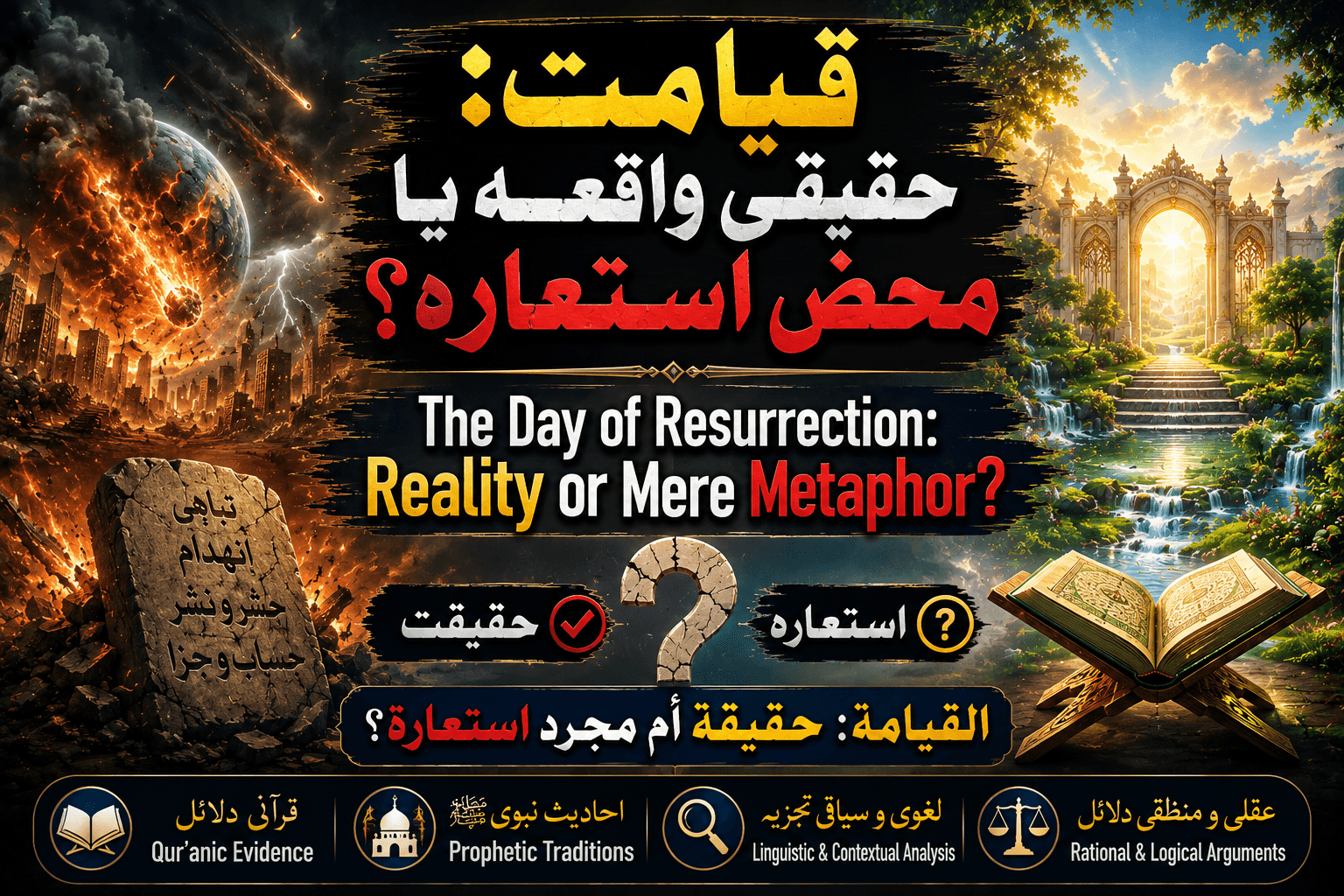
The Day of Resurrection: Reality or Mere Metaphor?
Objection
Some contemporary deniers of bodily resurrection argue that the Day of Resurrection (Yawm al-Qiyāmah) as a literal cosmic event—namely, the destruction of the universe and the gathering of humanity for judgment—does not actually exist. According to them, the Qur'ānic terms "Yawm al-Qiyāmah" (the Day of Resurrection) and "al-Sā'ah" (the Hour) do not refer to a physical or cosmic event but merely symbolize a worldly revolutionary era representing the final struggle between truth and falsehood.
Response
Interpreting the Hour (al-Sā'ah) and the Day of Resurrection (Yawm al-Qiyāmah) as nothing more than a worldly revolution or a political struggle between truth and falsehood—and reducing Paradise and Hell to mere psychological states—is, in reality, a form of semantic distortion (taḥrīf ma'nawī) of the Qur'ānic text. Such an interpretation departs from the plain meaning established by both the language and the context of the Qur'ān.
1. The Qur'ānic Context and Linguistic Evidence
Had the Day of Resurrection merely referred to a worldly revolution or political transformation, the pagan Arabs of Makkah would never have objected to it by questioning the physical resurrection of their bodies after death. Rather, the Qur'ān records their objection:
"They say: 'When we have become bones and scattered dust, shall we indeed be raised again as a new creation?'"
(Qur'ān 17:49)
Their argument was based on the decomposition of the human body into bones and dust. This clearly demonstrates that they understood the Prophet's ﷺ message to be about a literal bodily resurrection after death—not about a social revolution or political upheaval in this world.
2. The Qur'ānic Contrast Between This World and the Hereafter
The Qur'ān consistently contrasts the life of this world (al-Dunyā) with the Hereafter (al-Ākhirah), describing the former as temporary and insignificant compared to the eternal abode of the latter.
If the Hereafter or the Day of Resurrection merely referred to another historical phase within this worldly life, then this fundamental Qur'ānic distinction would become meaningless. The repeated contrast between this world and the Hereafter throughout the Qur'ān would lose its significance.
3. Explicit Evidence for Cosmic Upheaval on the Day of Resurrection
Both the Qur'ān and the Sunnah describe profound cosmic transformations that will occur when the Hour is established. These include the folding of the heavens, the replacement of the present earth and heavens, and the complete collapse of the existing cosmic order.
Allah says:
"On the Day when We shall fold up the heaven like the folding of a written scroll."
(Qur'ān 21:104)
He also says:
"The Day when the earth will be changed into another earth, and the heavens as well."
(Qur'ān 14:48)
Furthermore, authentic Prophetic traditions affirm that Allah will fold up the heavens and the earth on the Day of Resurrection before creating a new order of existence.
These texts clearly describe real cosmic events affecting the very structure of the universe. They cannot reasonably be reduced to metaphors, psychological experiences, or symbolic descriptions of ideological conflict.
Conclusion
Interpreting the Day of Resurrection and the Hour as nothing more than a worldly revolutionary movement or an ongoing struggle between truth and falsehood contradicts the apparent meaning of the Qur'ān, its linguistic context, the understanding of its earliest audience, and the explicit teachings of both the Qur'ān and the Sunnah.
According to Islamic doctrine, the Day of Resurrection is a literal, future cosmic event involving the destruction of the present universe, the bodily resurrection of all humanity, the universal gathering for judgment, and the final recompense of every individual. Belief in the Hereafter, therefore, is belief in an actual, objective reality—not merely a symbolic or metaphorical concept.
Have a question about this post?
Ask a Question
About the Author
Muhammad Awais
By the boundless grace and guidance of Allah Almighty, Muhammad Awais is associated with the noble journey of teaching, research, and writing. In his quest to quench his thirst for knowledge, he has completed the Dars-e-Nizami (Traditional Islamic Education), an MA in English, an M.Phil in Islamic Studies, and a B.Ed. Currently, he is pursuing his Ph.D. in Islamic Studies at Hazara University. The core of his academic interests primarily revolves around Islamic Sciences, Western Philosophy, contemporary intellectual discourses, Ilm al-Kalam (Islamic Scholastic Theology), and both classical and modern logic—subjects he continuously strives to comprehend more deeply and reflect upon. His association as a 'Master Trainer' with the British Council and other local institutions, coupled with his experience in competitive examinations, has acquainted him with a diverse array of academic disciplines, for which he is profoundly grateful to the Lord of Majesty. With his very limited abilities, he is making a humble effort to contribute a small share towards serving knowledge, offering intellectual guidance, and fostering an environment of positive academic dialogue. It is his heartfelt prayer that the Lord of the Worlds graciously accepts these modest and fragmented efforts in His Divine Presence, and makes this knowledge beneficial for His creation. Ameen.