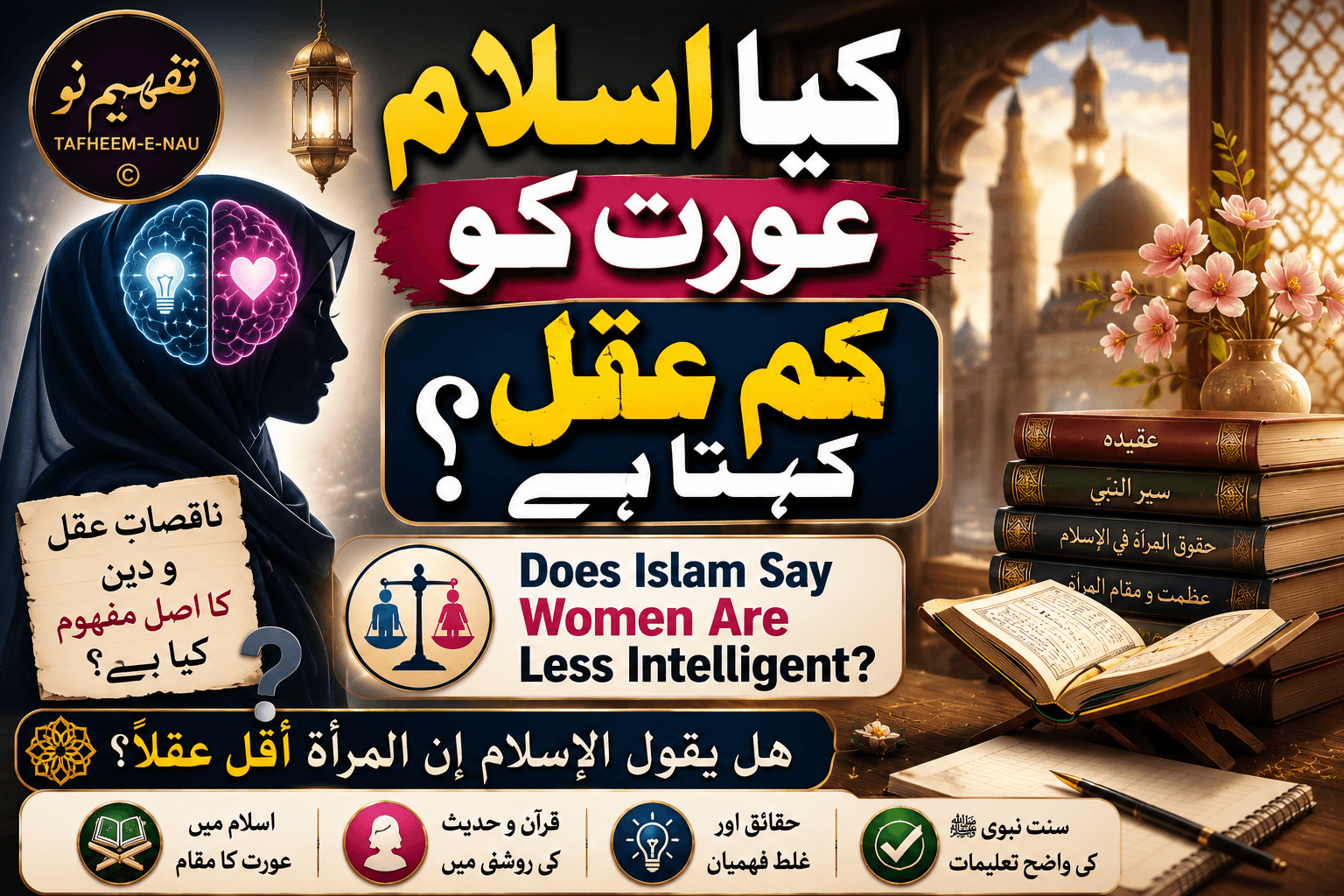
Does Islam Say Women Are Less Intelligent?
Objection:
In Ahadith (Prophetic traditions), women have been insulted by being labeled as "deficient in intellect and religion" (Naqisat-e-Aql-o-Deen).
Answer:
The purpose of the words "deficient in intellect and religion" used for women in Ahadith is by no means to insult them or to prove them inferior to men. Rather, the Prophet ﷺ himself provided the explanation for these words in the very same Hadith. If this Hadith is understood in its complete context and from a Shariah perspective, it becomes completely clear that it does not negate a woman's overall capability or spiritual status in any way.
The blessed Hadith is as follows:
"Narrated Abu Sa'id Al-Khudri: Once Allah's Messenger ﷺ went out to the Musalla (to offer the prayer) on 'Id-al-Adha or Al-Fitr prayer. Then he passed by the women and said, 'O women! Give alms, as I have seen that the majority of the dwellers of Hell-fire were you (women).' They asked, 'Why is it so, O Allah's Messenger?' He replied, 'You curse frequently and are ungrateful to your husbands. I have not seen anyone more deficient in intelligence and religion than you. A cautious sensible man could be led astray by some of you.' The women asked, 'O Allah's Messenger! What is deficient in our intelligence and religion?' He said, 'Is not the evidence of two women equal to the witness of one man?' They replied in the affirmative. He said, 'This is the deficiency in her intelligence. Isn't it true that a woman can neither pray nor fast during her menses?' The women replied in the affirmative. He said, 'This is the deficiency in her religion.'"
(Sahih al-Bukhari, Book of Menses, Chapter: A menstruating woman should not fast, Vol. 1, p. 68, Hadith 304, Dar Touq al-Najat)
In this, the Prophet ﷺ mentioned two types of deficiencies:
1. Deficiency in religion
2. Deficiency in intellect
Let us examine both:
1. The True Meaning of "Deficiency in Religion" (Nuqsan-e-Deen):
The Prophet ﷺ himself clarified this term, stating that it refers to women leaving prayers and fasting during their specific days of menstruation and postpartum bleeding (Nifas). This is not a moral flaw, a sin, or a punishment; rather, it is a special concession, ease, and mercy from Allah Almighty. Not praying during these specific days is actually strict obedience to Allah's command, and if a woman were to pray during these days, she would be sinful instead of earning a reward. Since the quantity of a woman's outward acts of worship (prayer, fasting) is numerically reduced during these days, it is termed a "deficiency in religion" merely in a numerical sense, not in a spiritual, moral, or faithful sense.
2. The True Meaning of "Deficiency in Intellect" (Nuqsan-e-Aql):
This does not relate to a woman's general intelligence, wisdom, or prudence. Instead, it only points to the rules of testimony in specific legal and judicial matters (such as financial contracts). According to the Holy Quran (Surah Al-Baqarah: 282), the testimony of two women is made equal to that of one man in financial matters so that if one forgets, the other may remind her. The reason for this is that, historically and generally, women had less direct experience in economic, commercial, and judicial matters compared to men. Therefore, this rule is based on experience, expertise, and social context, not on a woman's innate or biological lack of intelligence. This precaution was established merely to ensure complete accuracy in testimony.
3. Types of Intellect:
There are two types of intellect:
1. Aql-e-Shar'i (Legal/Consequential Intellect)
2. Aql-e-Urfi (Practical/Customary Intellect)
Women possess a very high level of Aql-e-Urfi. How, then, has the Shariah called women deficient in intellect? The simple answer is that "deficient in intellect" refers to Aql-e-Shar'i, whereas Aql-e-Urfi is abundant in women. The Hadith itself mentions this, stating that they can "lead a cautious sensible man astray". A woman successfully runs the household and her influence extends outside as well. However, there is a deficiency in Aql-e-Shar'i, which means failing to foresee the ultimate consequences of actions. When a person does not consider the outcome, they may suffer a loss. For example, a woman might say that a certain occasion is approaching and we must spend a specific amount on it, such as on a circumcision, a wedding, or an engagement, and certain customs must be strictly observed. Thus, they might spend the wealth of their husbands and fathers excessively on these customs. It is in this sense that they are called deficient in intellect, as they may overlook the financial consequences.
(The Role of Women in the Propagation of Religion, by Mufti Raza-ul-Haq, Monthly Bayyinat, Shawwal 1428 AH, 2007 CE, p. 39, Jamia Uloom-e-Islamia Allama Banuri Town, Karachi)
4. No Negation of Women's General Capability and Virtue:
This Hadith does not declare women's overall intellect, understanding, memory, or spiritual status to be inferior to men's. In Islam, the true standard of superiority is not gender, but Taqwa (piety). A woman, based on her righteous deeds, piety, knowledge, and capability, can far surpass men and attain a higher rank than them in the Hereafter. Islamic history is a living witness that many women were ahead of great men in knowledge and virtue. For instance, Hazrat Aisha (RA) was herself a profound scholar and jurist who guided prominent male Companions.
Conclusion:
Therefore, misinterpreting these specific words to insult women or considering them despicable and foolish in every aspect of life is a clear violation of the Prophet's ﷺ own teachings and Islamic principles. This Hadith is actually a realistic statement of the special concessions and legal rules granted by Allah in view of a woman's physical and biological conditions. To strip this out of context and use it as a basis for gender discrimination by atheists and orientalists is outright academic dishonesty.
Have a question about this post?
Ask a Question
About the Author
Muhammad Awais
By the boundless grace and guidance of Allah Almighty, Muhammad Awais is associated with the noble journey of teaching, research, and writing. In his quest to quench his thirst for knowledge, he has completed the Dars-e-Nizami (Traditional Islamic Education), an MA in English, an M.Phil in Islamic Studies, and a B.Ed. Currently, he is pursuing his Ph.D. in Islamic Studies at Hazara University. The core of his academic interests primarily revolves around Islamic Sciences, Western Philosophy, contemporary intellectual discourses, Ilm al-Kalam (Islamic Scholastic Theology), and both classical and modern logic—subjects he continuously strives to comprehend more deeply and reflect upon. His association as a 'Master Trainer' with the British Council and other local institutions, coupled with his experience in competitive examinations, has acquainted him with a diverse array of academic disciplines, for which he is profoundly grateful to the Lord of Majesty. With his very limited abilities, he is making a humble effort to contribute a small share towards serving knowledge, offering intellectual guidance, and fostering an environment of positive academic dialogue. It is his heartfelt prayer that the Lord of the Worlds graciously accepts these modest and fragmented efforts in His Divine Presence, and makes this knowledge beneficial for His creation. Ameen.