
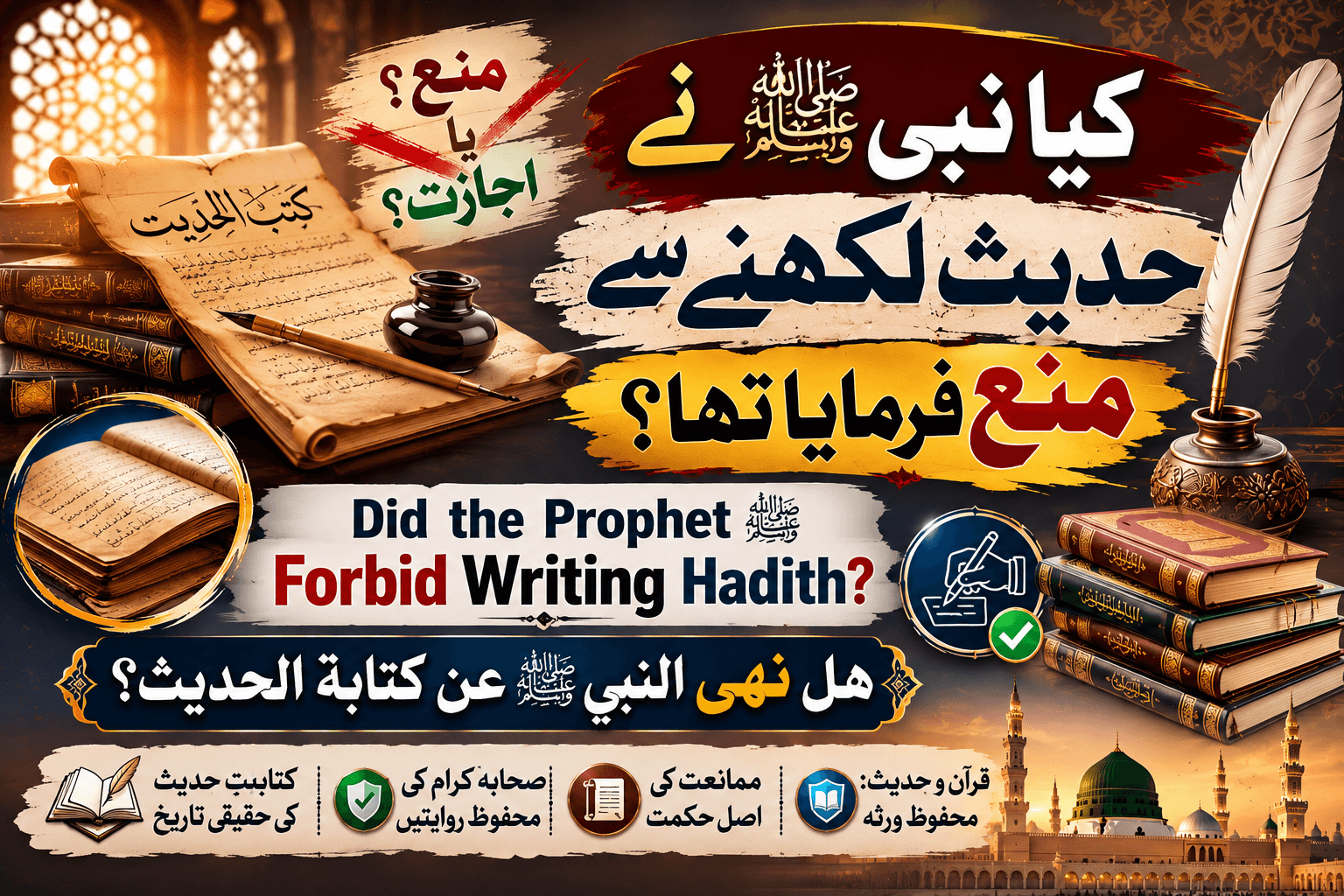
Did the Prophet ﷺ Forbid Writing Hadith?
Objection:
It is objected that the Holy Prophet (PBUH) himself forbade the writing of Hadiths. Therefore, the Companions (Sahabah) were negligent in preserving the science of Hadith, resulting in the Hadiths either being lost or severely mixed up and convoluted.
Response:
The objection that the Messenger of Allah (PBUH) forbade the writing of Hadiths, causing the Companions (RA) to neglect its preservation, is entirely contrary to historical and academic facts. This objection is raised without understanding the reality of the seemingly contradictory narrations regarding the prohibition and permission to write Hadiths.
The True Background and Wisdom Behind the Prohibition
It is true that in the early period, the Messenger of Allah (PBUH) forbade the writing of Hadiths. According to a narration by Abu Sa'id al-Khudri (RA), the Prophet (PBUH) said: "Do not write anything from me except the Quran. Whoever has written anything from me other than the Quran, let him erase it." However, scholars of Hadith (Muhaddithin) and researchers have explained the clear reasons for this prohibition:
Fear of Confusion between the Quran and Hadith: During the early period, the revelation of the Quran was ongoing, and the Arabs were not heavily accustomed to reading and writing. Therefore, the primary reason for the prohibition was the risk of the Quran and Hadiths getting mixed up if written on the same page.
Reliance on Memorization and Subsequent Abrogation of the Prohibition: Once the Quranic style and the essence of the recited revelation became firmly rooted in the minds of the Companions (RA), the words of the Quran became distinct, and the fear of confusion vanished. At that point, the Holy Prophet (PBUH) himself gave general permission to write Hadiths, and the initial prohibition was abrogated.
Explicit Permission and Encouragement to Write Hadiths
There is countless solid historical evidence regarding the orders and permission to write Hadiths, proving that the Companions (RA) showed no negligence in its documentation:
Special Permission to Abdullah bin Amr bin al-Aas (RA): He used to write down everything the Messenger of Allah (PBUH) said. The Quraysh stopped him, arguing that the Prophet (PBUH) is a human being who speaks in states of both anger and happiness, so he should not write every single thing. When he mentioned this to the Prophet (PBUH), the Prophet pointed to his mouth with his finger and said: "Write! By Him in whose hand is my soul, nothing but the truth comes out of this (mouth)."
Guidance for Those with Weak Memory: An Ansari Companion complained to the Prophet (PBUH) that he loved listening to his words but could not remember them. The Prophet (PBUH) replied: "Seek help with your right hand," gesturing toward writing.
Having the Sermon Written for Abu Shah: On the occasion of the Conquest of Makkah, the Prophet (PBUH) delivered a detailed sermon. A man from Yemen, Abu Shah, requested that it be written down for him. The Prophet (PBUH) ordered the Companions: "Write it down for Abu Shah."
The Command to Restrain Knowledge: Anas bin Malik (RA) reports that the Prophet (PBUH) said: "Tie down knowledge by writing."
The Writing of Official Documents During the Prophetic Era
The governance period of the Messenger of Allah (PBUH) was a great era for written documents. He regularly had treaties, decrees, and letters written out:
The Charter of Madinah and the Treaty of Hudaybiyyah: The Prophet (PBUH) personally oversaw the drafting of the detailed written declaration of Madinah (Charter of Madinah), consisting of 48 articles, as well as the written treaty of Hudaybiyyah.
International Letters: Letters of invitation and diplomatic documents were written and sent to the Byzantine Emperor (Caesar), the Muqawqis, Khosrow, and other kings. The number of these documents is stated to be around 281.
The Document of Amr bin Hazm (RA): When Amr bin Hazm (RA) was sent as the governor of Yemen, the Prophet (PBUH) had a detailed document written for him, containing comprehensive instructions on the laws of blood money (Diyyah), obligations (Fara'id), charities (Sadaqat), and Zakat.
Written Compilations (Saha'if) Documented by the Companions
The Companions (RA) compiled Hadiths in written form during the lifetime of the Holy Prophet (PBUH) and immediately after his passing. A few prominent examples include:
Al-Sahifah al-Sadiqah: Abdullah bin Amr bin al-Aas (RA) compiled a collection of one thousand Hadiths heard directly from the Messenger of Allah (PBUH), which he called 'Al-Sahifah al-Sadiqah'. This entire compilation is still preserved verbatim today in the 'Musnad of Ahmad bin Hanbal'.
The Sahifah of Hammam bin Munabbih: Hammam bin Munabbih, a student of Abu Hurairah (RA), compiled a manuscript containing 138 Hadiths that he wrote after hearing them from Abu Hurairah (RA). These Hadiths are preserved without any alteration in meaning or wording in later books (such as Sahih Bukhari, Sahih Muslim, and Musnad Ahmad), which is a testament to the strength of the Hadith writing tradition.
The Sahifah of Ali (RA): Ali (RA) kept a scroll hanging from the scabbard of his sword, which contained rulings on blood money, retaliation for wounds, the release of prisoners, and the sanctity of Madinah.
The Manuscripts of Jabir (RA) and Anas (RA): Jabir (RA) wrote two manuscripts containing details of the Farewell Pilgrimage (Hajjat al-Wida) and miscellaneous topics. Anas (RA) used to write down Hadiths and regularly present them to the Messenger of Allah (PBUH) for verification and correction. Abdullah bin Abbas (RA) had collected so many manuscripts of Hadiths that their combined weight equaled a camel's load.
Conclusion
The claim that Hadiths were not written down and were consequently lost is entirely false and baseless from a historical perspective. The prohibition was merely a temporary measure to ensure the Quran did not mix with any other speech. Once this apprehension was removed, the Companions (RA), with the explicit permission and encouragement of the Holy Prophet (PBUH), preserved the Hadiths with the utmost care, integrity, and dedication—not only memorizing them in their hearts but also formally documenting them in books and scrolls (Saha'if).
Have a question about this post?
Ask a Question
About the Author
Muhammad Awais
By the boundless grace and guidance of Allah Almighty, Muhammad Awais is associated with the noble journey of teaching, research, and writing. In his quest to quench his thirst for knowledge, he has completed the Dars-e-Nizami (Traditional Islamic Education), an MA in English, an M.Phil in Islamic Studies, and a B.Ed. Currently, he is pursuing his Ph.D. in Islamic Studies at Hazara University. The core of his academic interests primarily revolves around Islamic Sciences, Western Philosophy, contemporary intellectual discourses, Ilm al-Kalam (Islamic Scholastic Theology), and both classical and modern logic—subjects he continuously strives to comprehend more deeply and reflect upon. His association as a 'Master Trainer' with the British Council and other local institutions, coupled with his experience in competitive examinations, has acquainted him with a diverse array of academic disciplines, for which he is profoundly grateful to the Lord of Majesty. With his very limited abilities, he is making a humble effort to contribute a small share towards serving knowledge, offering intellectual guidance, and fostering an environment of positive academic dialogue. It is his heartfelt prayer that the Lord of the Worlds graciously accepts these modest and fragmented efforts in His Divine Presence, and makes this knowledge beneficial for His creation. Ameen.