
Were Some Qur'anic Verses Found with Only One Companion?
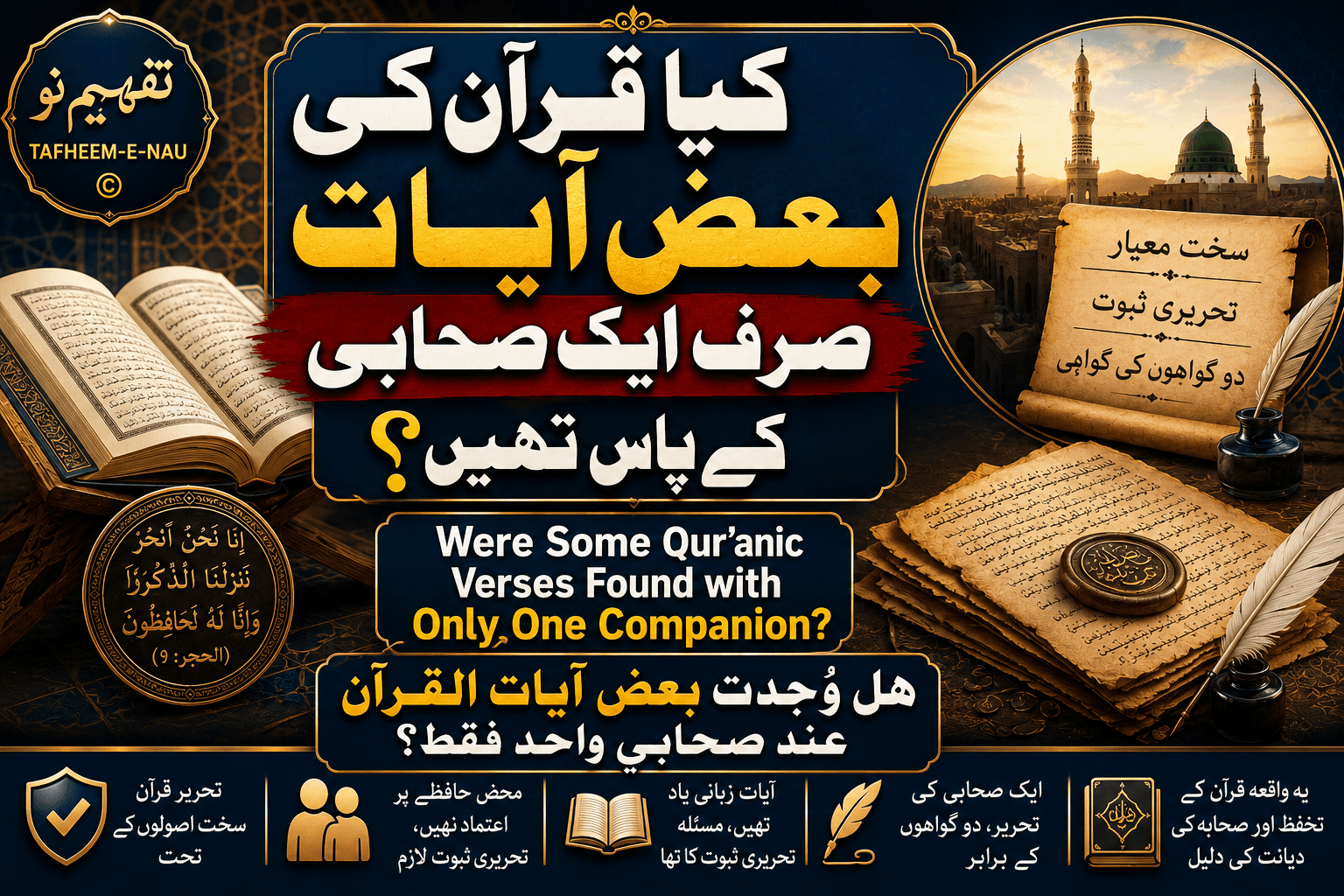
The Objection:
Critics raise the question: When the Quran was memorized by such a vast number of people, why were the final two verses of Surah At-Tawbah (or a verse from Surah Al-Ahzab) found in written form with only a single Companion, Hazrat Khuzaimah bin Thabit Al-Ansari (or Abu Khuzaimah), during the compilation of the Quran?
The Response:
Critics make a fundamental and glaring error in understanding this incident. They completely overlook the distinction between "Hifz" (oral memorization) and "Kitabat" (written evidence).
In reality, this incident is not proof that the Quran was unpreserved; rather, it is the greatest and most magnificent evidence of the exceptionally strict conditions and Academic Rigor applied by the honorable Companions during the compilation of the Quran. The details are as follows:
1. The Difference Between Memorization and Written Evidence
The critics' claim—"If the Quran was memorized by so many, why was the verse found with only one Companion?"—is based on ignorance. The truth is that these verses (the last verses of Surah At-Tawbah or verse 23 of Surah Al-Ahzab) were memorized by hundreds of Companions.
Sayyiduna Zayd bin Thabit (who headed the compilation committee) himself stated: "While copying the Mushaf, I missed a verse from Surah Al-Ahzab which I used to hear the Messenger of Allah ﷺ recite." Similarly, regarding the verses of Surah At-Tawbah, he stated that the verse was preserved in his own memory. This proves that the verses were memorized by the Companions and they recited them in their prayers. The issue was never about "remembering" them, but rather finding their "written proof."
2. The Incredibly Strict Criteria for Quranic Compilation
When the compilation of the Quran began during the era of Sayyiduna Abu Bakr As-Siddiq, he and Sayyiduna Umar established a strict principle: no verse would be included in the official Mushaf based solely on "memory," regardless of how many eminent Huffaz (memorizers) knew it by heart. For every verse, it was mandatory that:
It be memorized by the Huffaz through Tawatur (continuous, overwhelming consensus).
A written manuscript (on parchment, bone, stone, etc.) be presented that was inscribed directly in the presence of the Messenger of Allah ﷺ.
Two witnesses must testify under oath that this physical document was written in the presence of the Prophet ﷺ.
3. The True Meaning of Finding the Manuscript with Only One Companion
When Sayyiduna Zayd bin Thabit began cross-checking the memorized Quran against the written manuscripts, the final verses of Surah At-Tawbah (during Abu Bakr's compilation) were found in writing with Hazrat Abu Khuzaimah Al-Ansari, and the verse from Surah Al-Ahzab (during Uthman's compilation) was found with Hazrat Khuzaimah bin Thabit.
This certainly did not mean that no one else knew these verses. Instead, it meant that despite extensive searching through the written collections possessed by all other Companions, they could not find that exact physical, written fragment of those specific verses that had been transcribed literally in the presence of the Messenger of Allah ﷺ, except with them.
4. The Principle of Testimony and Divine Pre-arrangement
The committee's rule required two witnesses for any written manuscript. But when this manuscript was found only with Hazrat Khuzaimah, on what basis was it accepted?
Historical facts reveal that during his blessed life, the Messenger of Allah ﷺ, pleased with a certain incident (in which Hazrat Khuzaimah testified in favor of the Prophet ﷺ), declared that from that day forward, the testimony of Khuzaimah alone would be considered equal to the testimony of two men. Thus, Divine Providence had already made a scholarly and legal arrangement for this rigorous phase of compilation, ensuring that the strict principles set for it remained uncompromised.
5. The Logical Refutation of the Critics' Objection
If the Quran was—God forbid—to be fabricated or written according to human whims, or if the Companions were relying solely on memory, why would Sayyiduna Zayd bin Thabit (who was a renowned Hafiz himself) need to wander around for months searching for the written fragments of these verses? He could have simply written them down immediately, relying on his own memory or that of dozens of other Hafiz Companions.
The fact that only a single written proof was found for these verses is not an indication of the Quran being incomplete or doubtful. Rather, it is the most magnificent and irrefutable proof of the Companions' utmost caution, investigative methodology, and academic integrity. Instead of settling for oral memorization, they did not make these verses a part of the Mushaf until they found that sacred manuscript written directly after hearing it from the blessed tongue of the Messenger of Allah ﷺ.
Have a question about this post?
Ask a Question
About the Author
Muhammad Awais
By the boundless grace and guidance of Allah Almighty, Muhammad Awais is associated with the noble journey of teaching, research, and writing. In his quest to quench his thirst for knowledge, he has completed the Dars-e-Nizami (Traditional Islamic Education), an MA in English, an M.Phil in Islamic Studies, and a B.Ed. Currently, he is pursuing his Ph.D. in Islamic Studies at Hazara University. The core of his academic interests primarily revolves around Islamic Sciences, Western Philosophy, contemporary intellectual discourses, Ilm al-Kalam (Islamic Scholastic Theology), and both classical and modern logic—subjects he continuously strives to comprehend more deeply and reflect upon. His association as a 'Master Trainer' with the British Council and other local institutions, coupled with his experience in competitive examinations, has acquainted him with a diverse array of academic disciplines, for which he is profoundly grateful to the Lord of Majesty. With his very limited abilities, he is making a humble effort to contribute a small share towards serving knowledge, offering intellectual guidance, and fostering an environment of positive academic dialogue. It is his heartfelt prayer that the Lord of the Worlds graciously accepts these modest and fragmented efforts in His Divine Presence, and makes this knowledge beneficial for His creation. Ameen.