Can Consciousness Survive Brain Death?
Objection
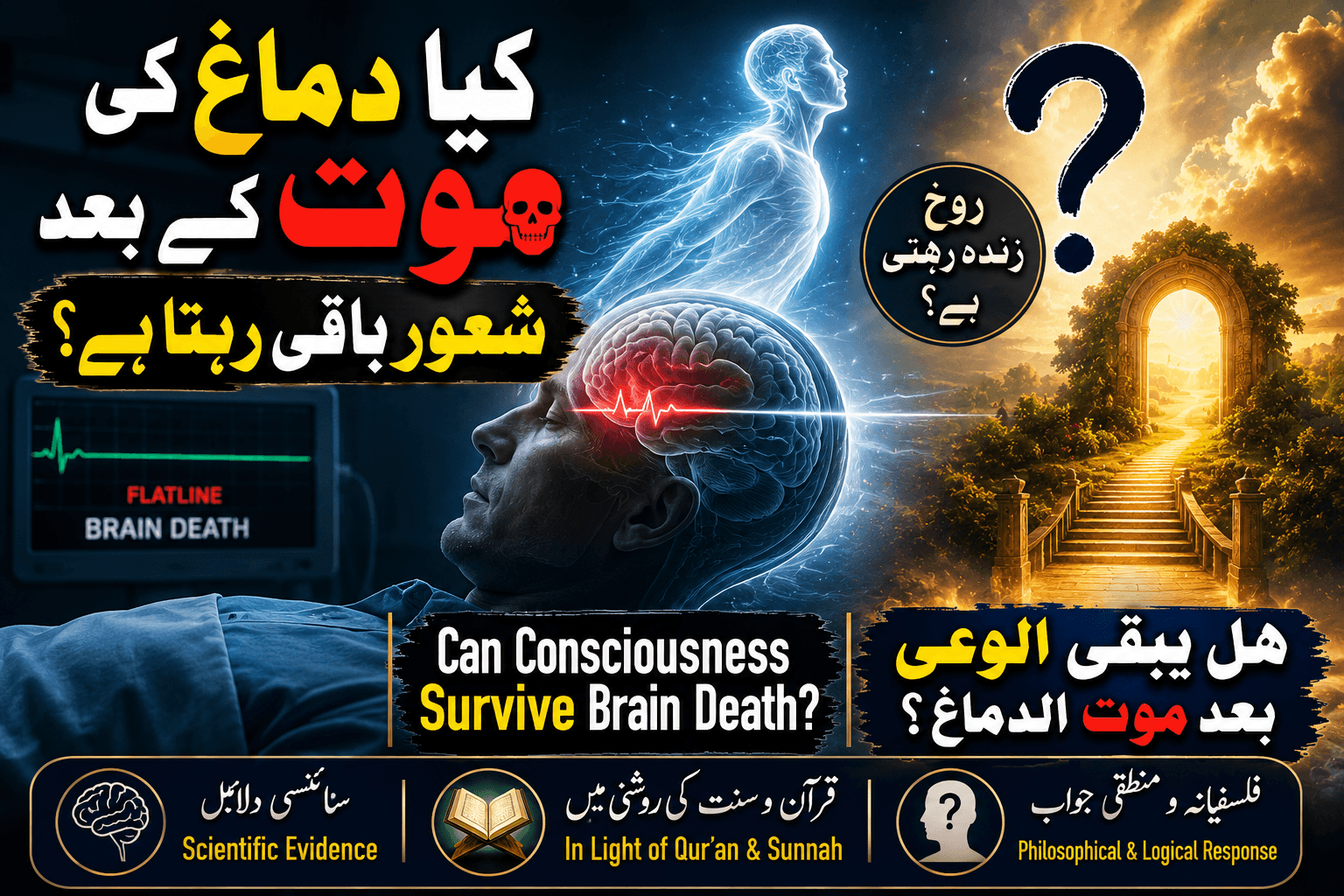
It is argued that consciousness is entirely dependent upon the functions of the human brain. When brain death occurs, all brain activity permanently ceases, and with it consciousness also comes to an end. If damage to the brain impairs the mind and consciousness, then how can a "soul" or consciousness continue to exist after the complete destruction of the brain? From a scientific and logical standpoint, the independent existence of the mind and consciousness without the physical brain appears impossible.
Response:
1. The Difference Between Correlation and Causation
It is an established scientific fact that damage to certain regions of the brain—such as the Reticular Activating System or the Thalamus—can impair human consciousness. Based on this observation, some conclude that if the brain is completely destroyed, the mind and consciousness must also cease to exist permanently.
However, this argument rests on a fundamental confusion between correlation and causation. While the brain is closely associated with consciousness, this does not necessarily mean that the brain creates consciousness. A useful analogy is that of a television or radio. If the hardware of a television is damaged, the picture and sound disappear. This does not mean that the broadcast signals themselves have ceased to exist; rather, the device that receives and displays those signals has become defective. Likewise, the human brain is a physical instrument through which consciousness—or the soul—is manifested in the material world. When the brain is destroyed, the manifestation of consciousness in this worldly life ceases, but this does not necessarily imply that consciousness itself has been annihilated.
2. The Islamic and Metaphysical Understanding of Death and the Soul
From the Islamic perspective, death is not the ultimate extinction (Eternal Oblivion) of life or consciousness. Rather, it is a transition from one mode of existence to another. Death signifies the separation of the soul from the physical body, after which the soul enters the next stage of existence in the Hereafter.
Both Islamic theology and classical philosophy clearly distinguish between the material body and the immortal soul. According to this view, the soul survives physical death and continues to exist independently. Consequently, the ultimate source of consciousness is not matter itself but the immaterial soul, which utilizes the brain as an instrument for expressing itself in the physical world.
3. The Limits of Empirical Science
The discipline of neuroscience is concerned with studying the material and physical aspects of the human brain. When brain death occurs, all measurable biological and chemical activities within the brain come to an end. Therefore, science can legitimately conclude only that the brain's physical functions have ceased.
To claim, however, that consciousness itself has been completely annihilated is not a scientific conclusion but a philosophical assumption grounded in Naturalism and Materialism. Science possesses neither the instruments nor the methodology to investigate consciousness beyond the material realm, nor can it empirically examine realities such as the unseen world or the intermediate state (Barzakh).
4. A Contradiction in Contemporary Atheistic and Secular Thought
Contemporary atheistic and secular thought often exhibits an interesting inconsistency. On the one hand, it dismisses concepts such as religion, the soul, and angels as unscientific or mythical. On the other hand, it readily accepts—based on the laws of thermodynamics—that energy is neither created nor destroyed.
More strikingly, many modern thinkers reject the concept of the soul while remaining open to discussions about whether mind and consciousness might exist independently of the brain. They are willing to entertain concepts such as Supreme Intelligence or Collective Consciousness, yet reject analogous metaphysical concepts when they originate from divine revelation.
Ultimately, the denial of life after death rests upon a prior philosophical assumption: that matter alone constitutes reality. Since science can observe only the material brain, some conclude that the death of the brain signifies the end of the person.
According to Islam, however, the human being is not merely a biological machine. The essence of human identity is the soul, which does not depend upon the brain for its existence. Rather, the brain depends upon the soul as the instrument through which it functions in the physical world. When that instrument ceases to function, the soul enters the state of Barzakh, awaiting resurrection and the Final Judgment.
Have a question about this post?
Ask a Question
About the Author
Muhammad Awais
By the boundless grace and guidance of Allah Almighty, Muhammad Awais is associated with the noble journey of teaching, research, and writing. In his quest to quench his thirst for knowledge, he has completed the Dars-e-Nizami (Traditional Islamic Education), an MA in English, an M.Phil in Islamic Studies, and a B.Ed. Currently, he is pursuing his Ph.D. in Islamic Studies at Hazara University. The core of his academic interests primarily revolves around Islamic Sciences, Western Philosophy, contemporary intellectual discourses, Ilm al-Kalam (Islamic Scholastic Theology), and both classical and modern logic—subjects he continuously strives to comprehend more deeply and reflect upon. His association as a 'Master Trainer' with the British Council and other local institutions, coupled with his experience in competitive examinations, has acquainted him with a diverse array of academic disciplines, for which he is profoundly grateful to the Lord of Majesty. With his very limited abilities, he is making a humble effort to contribute a small share towards serving knowledge, offering intellectual guidance, and fostering an environment of positive academic dialogue. It is his heartfelt prayer that the Lord of the Worlds graciously accepts these modest and fragmented efforts in His Divine Presence, and makes this knowledge beneficial for His creation. Ameen.