
The Prophetic Biography (Sīrah) ﷺ: Definition, Introduction, and Scholarly Significance
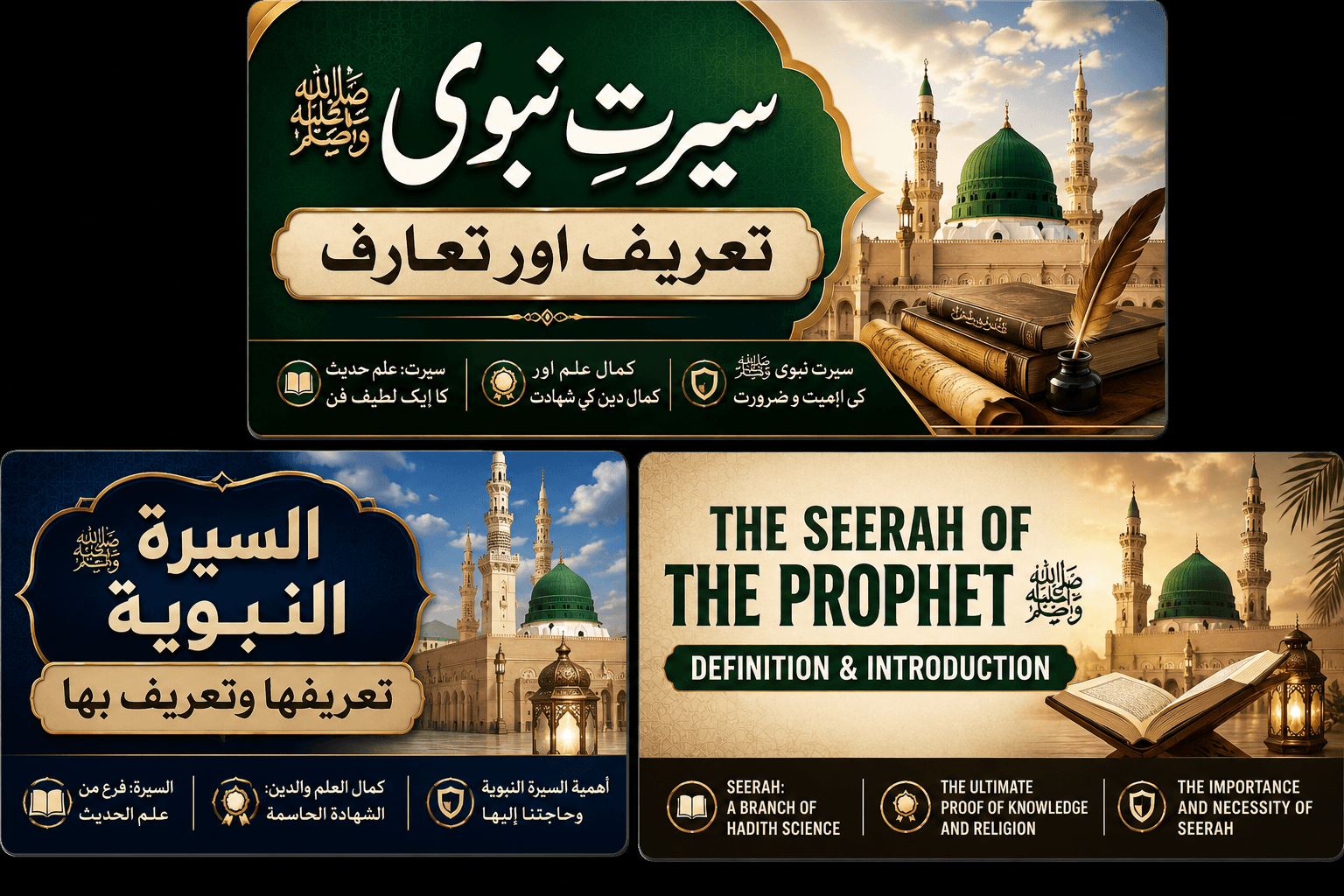
Sīrah of the Prophet ﷺ: Definition and Introduction
The Sīrah of the Prophet ﷺ refers to the branch of Islamic scholarship that systematically studies every aspect of the life of the Messenger of Allah ﷺ in the light of authentic historical records and the principles of ḥadīth criticism. It encompasses his noble lineage, birth, prophethood, the beginning of revelation, his mission of da‘wah, migration (Hijrah), military expeditions (Maghāzī), noble character and personal qualities (Shamāʾil), unique characteristics (Khaṣāʾiṣ), his wives (the Mothers of the Believers), his relationship with the Companions, and the events leading to his blessed passing. The purpose of preserving these aspects is to provide the Muslim community with a permanent source of religious, intellectual, and practical guidance.
According to the scholars of ḥadīth, Sīrah is not merely a collection of historical events; rather, it is a well-established scholarly discipline through which every aspect of the Prophet’s ﷺ life is preserved according to rigorous academic standards. Through this discipline, Muslims gain a correct understanding of Islam, an accurate knowledge of the Prophetic Sunnah, and a proper appreciation of the practical application of Islamic law. For this reason, Sīrah occupies a central position among the Islamic sciences, since the practical meanings of the Qur’an, the explanation of the Sunnah, juristic reasoning (fiqh), and the true nature of Islamic civilization are all manifested through the blessed life of the Prophet ﷺ. Consequently, the scholars of ḥadīth, Qur’anic exegesis, and Islamic history regarded Sīrah not simply as a historical narrative but as a fundamental source for understanding the religion, authenticating ḥadīth, and guiding the Muslim Ummah in both knowledge and practice.
(Al-Iʿlān bi al-Tawbīkh li-man Dhamm Ahl al-Tārīkh, al-Sakhāwī, p. 91; Al-Bidāyah wa al-Nihāyah, Ibn Kathīr, Vol. 6, pp. 111–113)
Sīrah: A Refined Branch of the Science of Ḥadīth
According to the leading scholars of ḥadīth, Sīrah is essentially an important branch of the science of ḥadīth. Its function extends far beyond preserving historical narratives; it plays a fundamental role in verifying the authenticity of traditions, evaluating the biographies of narrators, determining the chronology of events, and distinguishing between abrogating and abrogated rulings (Nāsikh and Mansūkh). Through Sīrah, scholars reconcile apparently conflicting narrations, identify false attributions, and expose fabricated claims. Therefore, the scholars of ḥadīth considered Sīrah an indispensable means of preserving Islam, understanding the Sunnah correctly, and verifying historical facts.
(Al-Iʿlān bi al-Tawbīkh li-man Dhamm Ahl al-Tārīkh, al-Sakhāwī, p. 170)
The Ultimate Testimony to Perfect Knowledge and Perfect Faith
The blessed life of the Prophet ﷺ constitutes the clearest and most decisive proof of his prophethood. His entire life exemplifies perfect knowledge, wisdom, justice, piety, mercy, and noble character in a manner unparalleled in human history. In every sphere of life, he demonstrated exceptional wisdom, insight, and divine guidance, providing compelling evidence that he was truly the Messenger of Allah. Consequently, studying the Prophetic Sīrah not only strengthens faith but also deepens certainty, enhances spiritual awareness, and reinforces intellectual conviction.
(Al-Bidāyah wa al-Nihāyah, Ibn Kathīr, Vol. 6, p. 113)
An Impeccable Character Despite Changing Circumstances
One of the most remarkable features of the Prophet’s ﷺ life is the consistency of his flawless character under every circumstance. Whether before or after prophethood, during the hardships of Makkah or the establishment of the Islamic state in Madinah, in times of poverty or prosperity, peace or war, he consistently embodied truthfulness, trustworthiness, justice, fidelity, patience, forgiveness, and mercy. Historians and scholars of ḥadīth unanimously affirm that there is not a single authentic report in his entire life that attributes to him any act of falsehood, betrayal, oppression, or breach of trust. This unparalleled moral integrity remains one of the strongest and most undeniable proofs of his prophethood.
(Al-Bidāyah wa al-Nihāyah, Ibn Kathīr, Vol. 6, p. 111)
The Preservation of the Prophetic Sīrah in Comparison with Earlier Scriptures
Just as Allah Almighty guaranteed the preservation of the Qur’an, He also preserved the life and Sunnah of His Messenger ﷺ through the unparalleled scholarly efforts of the scholars of ḥadīth, Qur’anic exegesis, and Islamic history. While the historical records of earlier communities became affected by distortions, unreliable reports, and fabricated narratives, the Prophetic Sīrah was preserved through rigorous principles of transmission, chains of narration (isnād), narrator criticism (jarḥ wa taʿdīl), and meticulous academic investigation. Consequently, the Sīrah of the Prophet ﷺ remains the most authentic, reliable, and thoroughly preserved biography in human history, forming the foundation upon which the Sunnah, Islamic law, and religious guidance firmly rest.
(Al-Bidāyah wa al-Nihāyah, Ibn Kathīr, Vol. 1, p. 9)
Dispelling Falsehood and Developing Sound Insight
A profound study of the Prophetic Sīrah enables a person to distinguish truth from falsehood with clarity. By carefully examining the Prophet’s ﷺ mission, wisdom, character, intellectual insight, and practical example, one becomes capable of identifying false ideologies, misleading philosophies, historical distortions, and fabricated claims. For this reason, Muslim scholars regarded Sīrah not merely as a source of historical information but as a foundation for faith, sound judgment, intellectual stability, and critical scholarship, enabling believers to remain steadfast against trials and recognize the truth with confidence.
(Al-Iʿlān bi al-Tawbīkh li-man Dhamm Ahl al-Tārīkh, al-Sakhāwī, p. 85)
The Essential Components of the Prophetic Sīrah
According to the methodology of Ibn Kathīr, the Prophetic Sīrah is a comprehensive discipline encompassing every major aspect of the Messenger’s ﷺ blessed life. It includes the study of his noble lineage, birth, childhood, prophethood, the revelation of the Qur’an, his mission of da‘wah, migration, military expeditions (Ghazawāt and Sarāyā), noble character and personal qualities, unique characteristics of prophethood, proofs of prophethood (Dalāʾil al-Nubuwwah), and all other significant historical and religious dimensions of his life. Owing to this comprehensiveness, the Prophetic Sīrah has become an independent and indispensable Islamic discipline without which neither a complete understanding of the Sunnah nor a proper comprehension of Islamic history and Sharīʿah is possible.
(Al-Bidāyah wa al-Nihāyah, Introduction, Ibn Kathīr, p. 70)
Have a question about this post?
Ask a Question
About the Author
Sheikh Hassan Dawood
Hassan Dawood is a dedicated, accomplished, and distinguished Islamic scholar whos academic and professional journey exemplifies a harmonious integration of traditional Islamic scholarship and modern education. After completing the memorization of the Holy Qur'an, he earned the Shahadat al-'Alamiyyah (Dars-e-Nizami) degree from Wifaq ul Madaris Al-Arabia Pakistan with distinction. He also obtained formal certifications in the Science of Tajweed, achieving outstanding academic results. In the field of modern education, he completed both his M.A. and M.Phil. in Islamic Studies from Hazara University with exceptional success. Continuing his pursuit of academic excellence, he is currently a Ph.D. scholar in Islamic Studies at the same university. He possesses extensive and distinguished experience in the fields of scholarship, preaching, and education. For the past twelve years, he has been serving as a Khateeb (Friday preacher), delivering sermons and providing religious guidance. In addition, he has over ten years of teaching experience. Alongside his teaching and preaching responsibilities, he has also served as the Principal of a Maktab (Islamic elementary school), where he gained valuable administrative and leadership experience. He has particular expertise in Tajweed, public speaking, and Islamic instruction. His primary academic interests include Islamic History, the Principles of Hadith (Usul al-Hadith), and the interpretation and application of Islamic principles in the contemporary context. Through his extensive study, sound pedagogical insight, and eloquent preaching, he is passionately committed to promoting moral values, intellectual awareness, and a purposeful way of life within society.